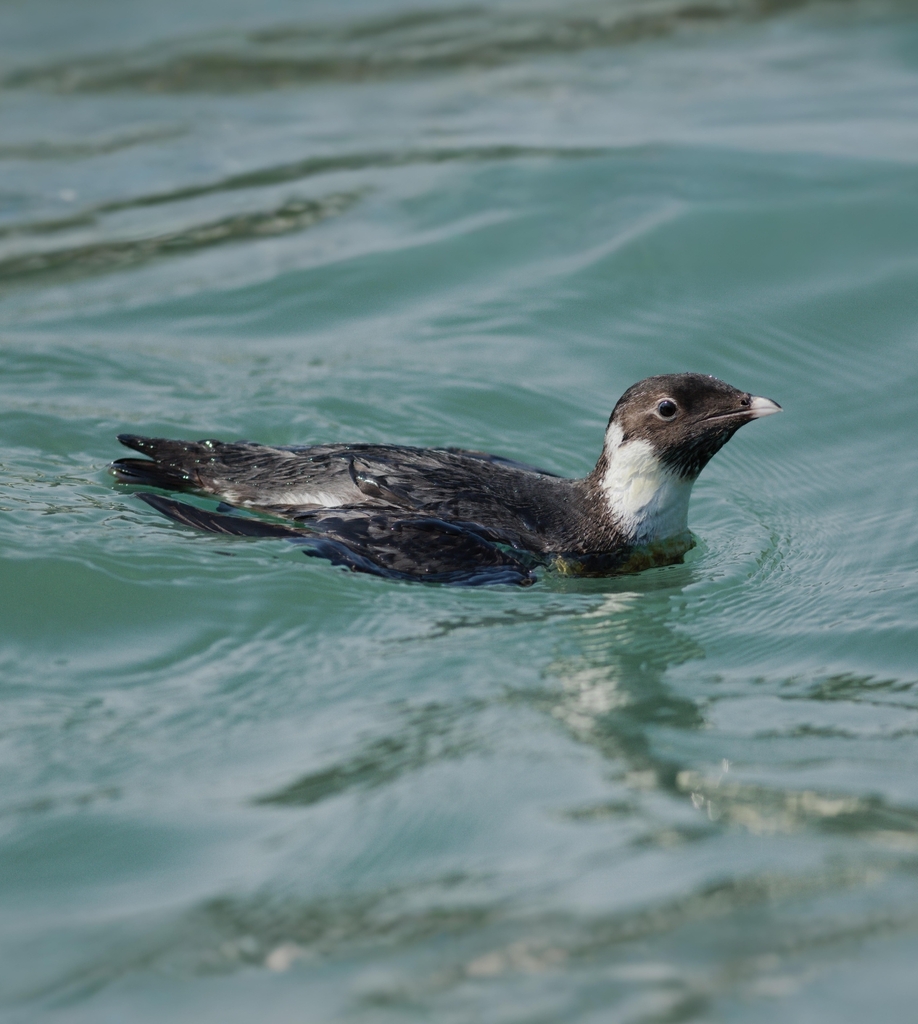
Ancient Murrelet
Photo © Jacob She
Photo © Jacob She — CC BY 4.0 — Source: iNaturalist #332998241Identification
The ancient murrelet is a small auk, measuring 20–24 cm in length with a wingspan of 45–46 cm and weighing 150–250 g. In summer plumage, it is distinctive: black on the head, throat, and rear neck, with a grey back and white underparts. Fine white streaks on the crown give breeding adults an aged appearance—the origin of their evocative common name. The bill is short, stubby, and yellow. In flight, ancient murrelets are notably agile, banking steeply from side to side more than other small auks, powered by rapid wing beats characteristic of short-winged alcids.
Range & Habitat
Ancient murrelets breed across the northern Pacific rim from the Yellow Sea through the Russian Pacific coast and Aleutian Islands to Haida Gwaii in British Columbia, which hosts about half the world population. Most colonies nest on remote islands in the North Pacific. Remarkably, some birds undertake epic migrations of 8,000 kilometres from Canada to winter waters off Japan and China—the only bird known to cross the entire North Pacific. Others winter closer, migrating only as far as California. Genetic evidence suggests the species originated in Asia and only recently colonized North America, making their trans-Pacific journeys a return to ancestral grounds.
Behaviour & Diet
Ancient murrelets are diving alcids that forage underwater using their wings for propulsion. They feed mainly on crustaceans in winter, supplemented by small fish in summer; off Haida Gwaii, small mesopelagic fish form the bulk of their diet. Their breeding biology is remarkable: they nest in colonies in burrows among tree roots, under logs, or in grass tussocks on forested islands, laying one or two eggs. Parents arrive and depart only at night to avoid predators. Most extraordinarily, chicks leave the nest just 1–3 days after hatching and are escorted to sea by their parents, recognizing each other by call. The family then travels up to 48 kilometres offshore, usually nocturnally, where chicks are fed exclusively at sea for over a month. Ancient murrelets spend less time on land than any other bird species.
Best Time & Places to See It
Visiting breeding colonies requires permits and specialist knowledge; Frederick Island in British Columbia hosts one of the largest. Spring and early summer offer the best chance to observe this elusive species at colonies. However, ancient murrelets are more accessible during their wintering grounds off Japan and China. The return migration begins in February, with birds making daily flights of four to five hours. Due to their nocturnal habits on land and swift oceanic lifestyle, even dedicated birders find them challenging. Occasional vagrants appear far from their normal range—notably, one individual returned to Lundy Island in Devon, England, for three consecutive springs beginning in 1990.
Photography Tips
Photographing ancient murrelets demands patience and specialized equipment. Pelagic boat trips near major colonies or wintering grounds offer the best opportunities for distant sightings. Use fast shutter speeds to freeze their rapid, darting flight and erratic banking behaviour. Early morning light during breeding season may reveal birds returning to or departing colonies, though nocturnal timing limits options. Offshore, capture their characteristic low-profile swimming posture and diving behaviour. A sturdy tripod and image stabilization are essential on deck; expect challenging light and rough water. Respect restricted access to breeding islands and always follow local guidelines for seabird observation.
Gulf Islands National Park Reserve
Southern Gulf Islands Electoral Area, Canada
+268 birds+26 mammals
Scattered across the Salish Sea in British Columbia's southwestern corner, this national park reserve stitches together a fragmented archipelago of forested islands and rocky outcrops where…
VIEW NATIONAL PARKBanff National Park
Improvement District No. 9, Canada
+264 birds+33 mammals
Where the Canadian Rockies thrust skyward in a cathedral of limestone and ice, Banff National Park preserves a wilderness of astounding vertical drama. Glacier-carved valleys cradle…
VIEW NATIONAL PARKKenai Fjords National Park
Kenai Peninsula Borough, United States
+164 birds+19 mammals
Granite peaks and tidewater glaciers dominate Alaska's Kenai Peninsula, where nearly 7,900 square kilometers of pristine coastal wilderness descend from the Harding Icefield toward the Gulf…
VIEW NATIONAL PARKKatmai National Park
Lake and Peninsula Borough, United States
+160 birds+19 mammals
Across southwestern Alaska's Lake and Peninsula Borough, nearly 27,000 square kilometers of subarctic wilderness sprawl between volcanic peaks and coastal wetlands, anchored by the confluence of…
VIEW NATIONAL PARKGlacier Bay National Park
Unorganized Borough, United States
+221 birds+15 mammals
Tidewater glaciers calving into fjords of impossible blue, where temperate rainforest rises steeply from the water's edge and alpine peaks pierce the clouds—this is the ecological…
VIEW NATIONAL PARKRedwood National Park
Humboldt County, United States
+343 birds+43 mammals
Where the Pacific fog rolls deep into northern California's coastal valleys, some of the tallest trees on Earth rise from a landscape shaped by tectonic forces…
VIEW NATIONAL PARKOlympic National Park
Jefferson County, United States
+263 birds+35 mammals
Where temperate rainforest meets alpine wilderness, Olympic National Park sprawls across nearly 11,000 square kilometers of the Pacific Northwest's most pristine landscape. The park's three distinct…
VIEW NATIONAL PARKWrangell-Saint Elias National Park
Unorganized Borough, United States
+155 birds+13 mammals
Where granite peaks thrust above 5,400 metres and vast fields of glacial ice dominate the landscape, Wrangell-Saint Elias encompasses one of North America's most extreme wilderness…
VIEW NATIONAL PARKGwaii Haanas National Park Reserve and Haida Heritage Site
Area E (Moresby Island), Canada
+98 birds+8 mammals
Where temperate rainforest meets the Pacific's edge, the islands of southern Haida Gwaii rise as one of North America's most pristine coastal wilderness areas. Spanning approximately…
VIEW NATIONAL PARKSt. Paul Island
Saint Paul, United States
+255 birds+8 mammals
Windswept tundra rolls across this remote Pribilof island, where volcanic basalt cliffs plunge into the Bering Sea and fog rolls in thick enough to erase the…
VIEW PROTECTED LANDSCAPEChannel Islands National Park
Santa Barbara County, United States
+330 birds+15 mammals
A chain of eight volcanic islands rises from the cold Pacific waters off the California coast, their rugged sea cliffs and windswept terrain shaped by millions…
VIEW NATIONAL PARKKodiak National Wildlife Refuge
United States
+221 birds+22 mammals
Where temperate rainforest meets subarctic coast, Kodiak National Wildlife Refuge sprawls across Alaska's largest island, a sanctuary defined by steep valleys carved by tidewater glaciers and…
VIEW WILDLIFE SANCTUARYAlaska Maritime National Wildlife Refuge
Alaska, United States
+391 birds+58 mammals
Where the North Pacific collides with Alaska's rugged coastline, a sprawling archipelago of islands, rocky outcrops, and coastal headlands forms one of North America's most remote…
VIEW WILDLIFE SANCTUARYIzembek National Wildlife Refuge
Cold Bay, United States
+138 birds+9 mammals
Where the Aleutian archipelago reaches westward into the Bering Sea, subarctic tundra and shallow coastal waters converge to create one of Alaska's most ecologically vital wildlife…
VIEW WILDLIFE SANCTUARYBecharof National Wildlife Refuge
United States
+146 birds+2 mammals
Across southwestern Alaska's windswept lowlands, where the Bristol Bay watershed spills into vast tidal flats and sedge marshes, lies one of North America's most pristine subarctic…
VIEW WILDLIFE SANCTUARYFarallon National Wildlife Refuge
San Francisco, United States
+384 birds+16 mammals
Windswept granite peaks rising abruptly from the Pacific, the Farallon Islands form a wildlife sanctuary of extraordinary seabird abundance and ecological significance just twenty-seven miles west…
VIEW WILDLIFE SANCTUARYNo community photos yet. Log in to add the first one.
No community observations of this species yet.