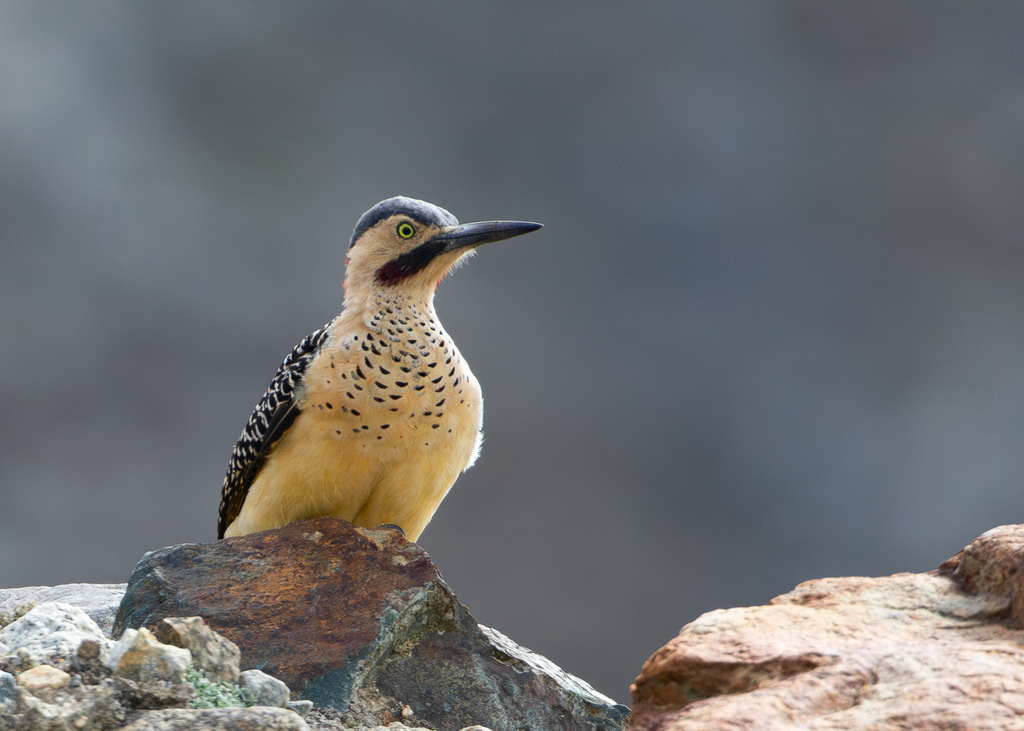
Andean Flicker
Photo © RJ Baltierra
Photo © RJ Baltierra — CC BY 4.0 — Source: iNaturalist photo #460622705Identification
The Andean Flicker is a medium-sized woodpecker approximately 32 cm (13 inches) long, with distinctive plumage that varies slightly between the sexes and three recognized subspecies. Males feature dark slate-gray heads from forehead to hindneck, often with a hint of red on the hindneck, while females lack this red coloring entirely. Both sexes display pale buffy-white faces with a thin black malar (cheek) stripe; in males, this stripe has red-tipped feathers, whereas females' stripes are entirely black. The upperparts are barred with brown and buffy white, with white uppertail coverts narrowly barred in dark. The underparts are whitish with a variable orange-buff wash on the breast and small blackish marks. The bird has a long black bill, lemon-yellow iris, and yellowish-gray to greenish legs. The three subspecies show regional variations: C. r. puna is darker overall with larger breast markings and a dark red hindneck patch in both sexes; C. r. cinereicapillus is significantly different with rich tan-buff face and throat, yellow-buff belly, and barred (rather than spotted) breast markings.
Range & Habitat
The Andean Flicker is found across the high Andes of South America, distributed across five countries: Ecuador, Peru, Bolivia, Chile, and Argentina. The northernmost subspecies, C. r. cinereicapillus, ranges from Loja Province in extreme southern Ecuador south through central Peru. C. r. puna inhabits central and southern Peru, while the nominate subspecies C. r. rupicola extends from northern Chile through Bolivia into northwestern Argentina as far as Catamarca Province. This is a bird of open, high-altitude terrain, inhabiting páramo grasslands, puna plateaus, Polylepis woodland, montane scrublands, and mixed rocky and grassy landscapes. The species ranges in elevation between 2,000 and 5,000 meters (6,600 to 16,400 feet), though it typically remains above 3,000 meters. The bird uses rocks, cliffs, and trees as vantage points for hunting and observation.
Behaviour & Diet
Unlike most woodpeckers, the Andean Flicker is almost entirely terrestrial in its foraging habits. Single birds, pairs, or gregarious groups of up to ten (occasionally more) move across the landscape, dropping from elevated perches to probe, dig, and sweep away pebbles and debris in search of prey before returning to their vantage point. The diet consists primarily of insects, including adult and larval beetles and other large larvae such as butterfly caterpillars. The species is mostly a year-round resident throughout its range, though it may relocate from the highest elevations during severe snow or cold weather.
Best Time & Places to See It
The Andean Flicker is uncommon to locally fairly common across most of its range, though it remains uncommon and local in Ecuador, where it was only first documented in the 1990s. The species occurs in several national parks and sanctuaries throughout the Andes. Its breeding season varies by location: September to November in central Peru and January to March in other areas, with timing influenced by snow and cold weather. For the best viewing opportunities, target high-altitude páramo and puna habitats above 3,000 meters during the breeding season, when birds are more active and vocal.
Photography Tips
Photograph this species in open, rocky high-altitude terrain where its contrasting plumage stands out against the landscape. The bird's distinctive pale face with black malar stripe and slate-gray or brown barred upperparts provide good contrast for photography. Watch for birds dropping from elevated perches such as rocks, cliffs, and scattered trees—these movements offer dynamic shooting opportunities. Early morning is often productive for capturing the bird's vocal displays and social interactions. The species' gregarious nature means that colonial nesting sites, when located, may provide opportunities to photograph multiple individuals. Use longer focal lengths to photograph birds on ground level as they forage, and be prepared for the bright, high-altitude light conditions typical of Andean environments.
Yacuri National Park
Las Juntas, Ecuador
+166 birds+1 mammals
Where the eastern slopes of the Andes descend into Ecuador's southern frontier, Yacuri National Park unfolds across nearly 1,300 square kilometers of montane cloud forest and…
VIEW NATIONAL PARKYanachaga–chemillén National Park
Palcazu, Peru
+639 birds+6 mammals
Where the eastern slopes of Peru's central cordillera plunge into cloud forest, Yanachaga–Chemillén National Park protects nearly three thousand square kilometres of montane wilderness that few…
VIEW NATIONAL PARKManu National Park
Manu, Peru
+892 birds+26 mammals
Across the eastern slopes of the Peruvian Andes, tropical rainforest descends into the Amazon basin with a complexity that few terrestrial ecosystems match. Manu National Park…
VIEW NATIONAL PARKHuascarán National Park
Independencia, Peru
+201 birds+5 mammals
Where granite peaks pierce the Andean sky above 6,000 metres, Huascarán National Park sprawls across more than 11,500 square kilometres of Peru's Cordillera Blanca, a landscape…
VIEW NATIONAL PARKSalar del Huasco National Park
Pica, Chile
+75 birds+2 mammals
High above the Atacama's shimmering flats, where the Andes grip the sky, lies a landscape of stark geological drama and surprising biological richness. Salar del Huasco…
VIEW NATIONAL PARKLauca National Park
Putre, Chile
+139 birds+17 mammals
Where the Andes rise toward the altiplano in Chile's far north, Lauca National Park sprawls across more than 3,000 square kilometres of some of South America's…
VIEW NATIONAL PARKReserva Nacional las Vicuñas
Putre, Chile
+87 birds+6 mammals
High desert plateaus interlace with volcanic ridges across this 4,204-square-kilometre expanse at the border between Chile and Bolivia, where altitudes exceed 3,500 metres and the climate…
VIEW NATIONAL PARKSalar de Surire Natural Monument
Putre, Chile
+61 birds
High across the Altiplano of northern Chile, where the Andes push toward 4,300 metres and the air thins to a crystalline clarity, lies a vast shallow…
VIEW NATURAL MONUMENTLos Cardones National Park
Argentina
+193 birds+6 mammals
Where the Andes descend into northwestern Argentina, Los Cardones National Park sprawls across nearly 1,200 square kilometres of one of South America's most distinctive high-altitude desert…
VIEW NATIONAL PARKNo community photos yet. Log in to add the first one.
No community observations of this species yet.