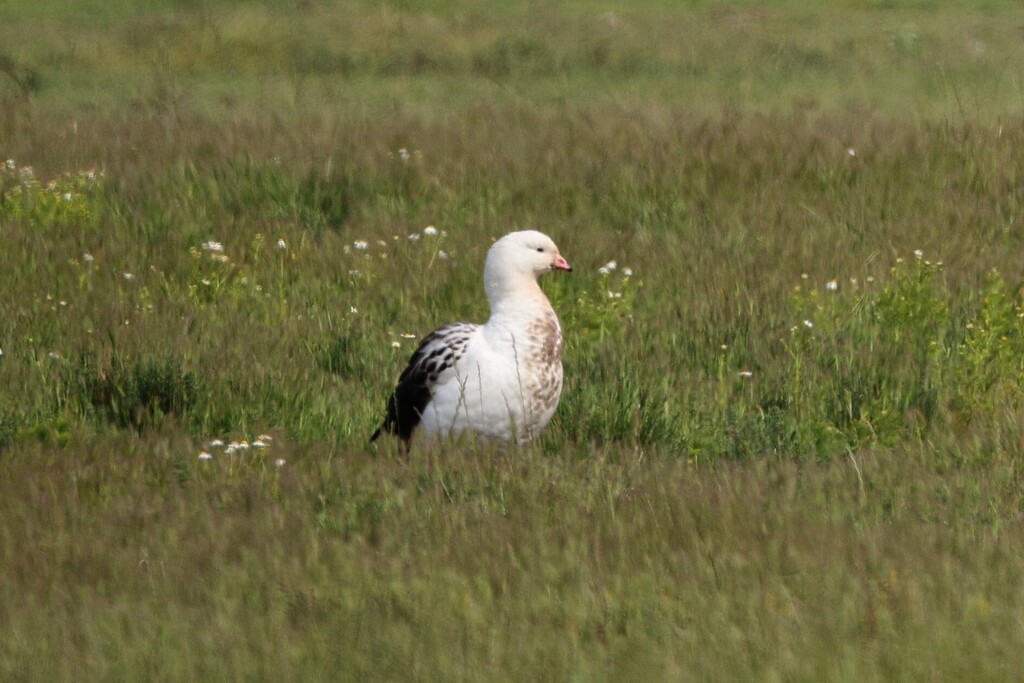
Andean Goose
Photo © ivesklein
Photo © ivesklein — CC BY 4.0 — Source: iNaturalist photo #755020175Identification
The Andean goose is a striking medium-sized waterfowl measuring 70 to 76 cm in length and weighing between 2.73 and 3.64 kg. Both males and females share identical plumage, making this species straightforward to identify in the field. Adults are predominantly white on the head and body, with distinctive dark markings on the shoulders created by sooty-centered and dark brown scapulars that give a striped appearance. The wings' primary feathers and tail are black with a greenish gloss, providing sharp contrast to the otherwise pale plumage. The bill is coral red with a black tip, while the legs and feet are light red. Immature birds are duller than adults, with off-white bodies, gray on the sides of the head, and brownish-gray scapulars, while downy young are mostly white with blackish spots and streaks.
Range & Habitat
The Andean goose is endemic to South America, found in Peru, Bolivia, Chile, and Argentina. Its range extends from Peru's departments of Ancash and Junín southward through western Bolivia to the Ñuble Region of Chile and into Argentina's Catamarca Province. This species is a high-altitude specialist, found almost entirely above 3,000 meters elevation, though it temporarily descends to lower elevations in Chile during heavy winter snows. The Andean goose inhabits open grasslands, bogs, and the shores of lakes and lagoons—environments characteristic of the Andean plateau.
Behaviour & Diet
The Andean goose is a year-round resident throughout its range, remaining in the same areas except for temporary elevational shifts in response to weather. Although classified as a waterfowl, it is almost entirely terrestrial in habit, though it will take to the water to escape danger and to lead chicks away from predators. Very little is known about the species' diet, but it appears to feed almost exclusively on grasses. These geese are highly vocal, with males and females producing distinctly different calls: males utter soft "huit-wit-wit" sounds, grunting calls, threat whistles, and sexual calls, while females make louder, somewhat grating "kwa-kwak" and hoarse "gack-gack" vocalizations. Outside the breeding season, they often form loose flocks.
Best Time & Places to See It
The Andean goose's remote high-altitude habitat makes it a rewarding species for dedicated travellers. The breeding season begins in November (austral spring), when birds are territorial and vocal, offering good opportunities for observation. The species is found year-round throughout its range, so timing depends more on your itinerary than on seasonal absence. However, the remote, high-altitude grasslands and lake regions of Peru, Bolivia, Chile, and Argentina that this species inhabits remain relatively undeveloped, making encounters unpredictable but potentially more rewarding than in more heavily visited areas.
Photography Tips
The Andean goose's striking white plumage with black wings and tail provides excellent contrast for photography against the alpine landscape. The high altitude and often open terrain offer good visibility and natural lighting on clear days. The species' terrestrial habits mean you may encounter birds on grasslands away from water, so approach slowly and quietly to avoid flushing them into flight. Males and females are identical in plumage, but their distinctive and different vocalizations can help confirm identification and may indicate breeding activity. The coral-red bill and light red legs provide useful identification details worth capturing in close-up shots.
Huascarán National Park
Lauca National Park
Reserva Nacional las Vicuñas
Salar de Surire Natural Monument
Nothing matches these filters.
No community photos yet. Log in to add the first one.