Andean Guan
Penelope montagnii
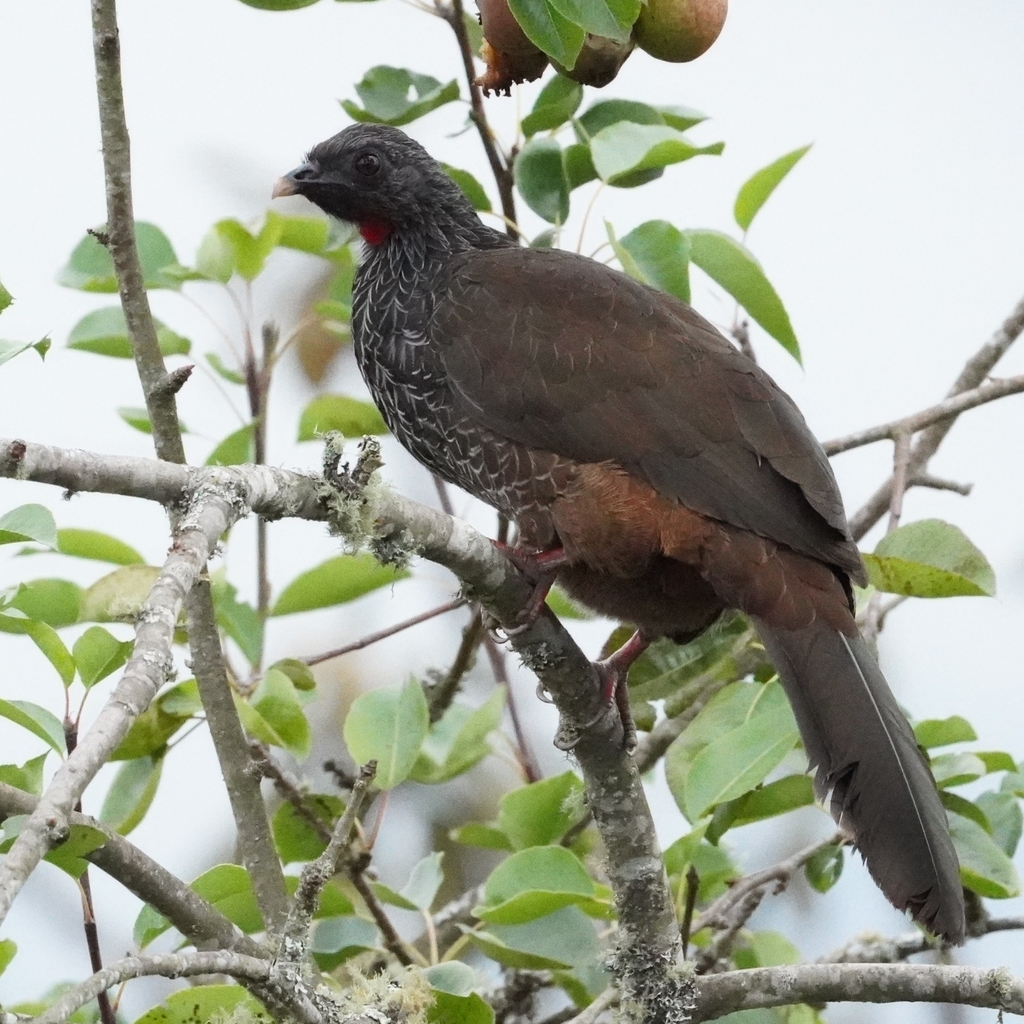
Photo © Esteban Poveda
Photo © Esteban Poveda — CC BY 4.0 — Source: iNaturalist #258750398ABOUT
Subspecies of Andean Guan
Penelope montagnii montagniiPenelope montagnii plumosaPenelope montagnii brookiPenelope montagnii sclateriPenelope montagnii atrogularis
Identification
The Andean guan is a medium-sized galliform measuring 40–58 centimetres in length and weighing 500–840 grams. It displays the characteristic body plan of its family: long-bodied with a thin neck and small head, resembling a slender, more elegant turkey. The overall plumage is brown with whitish edging to the feathers of the head, neck, and chest, while distinctive red dewlaps and reddish legs add diagnostic colour. The combination of these features makes it identifiable within its highland range, though it may be confused with related guan species where ranges overlap.
Range & Habitat
The Andean guan is found throughout the highlands of the Andes, occurring at elevations of 1,500 metres and above, from Venezuela and Colombia south through Ecuador and Peru to Bolivia, with records possibly extending into northwesternmost Argentina. This bird is strictly a cloud forest inhabitant, favouring the wet, misty montane forests characteristic of high Andean slopes. Its distribution is closely tied to this specialized habitat, and sightings are often associated with the migrations of army ants, which the bird regularly follows, presumably to feed on insects disturbed by the ant columns.
Behaviour & Diet
The Andean guan is a tree-nesting species that raises a single egg per breeding season. Observations from Ecuador in late June documented two adults with a young bird, suggesting breeding extends into early summer. The species undergoes regular tail moult, shedding old tail feathers in alternating pairs in a pattern that progresses from the outer feathers inward. Its habit of following army ants hints at an insectivorous component to its diet, though the full range of foods consumed remains undocumented in available sources.
Best Time & Places to See It
Late June appears to be a reliable time for observing Andean guans, particularly when family groups are visible. Several protected areas across its range offer the best opportunities for sightings: the Cocora valley and Quimbaya protected forest in Colombia's coffee region are notable locations, as is the Yanacocha Reserve in Ecuador. The bird's dependence on intact cloud forest means that these reserves and other protected highland areas provide the most consistent viewing opportunities, though patience and hiking at elevation are required.
Photography Tips
The Andean guan's preference for dense cloud forest and shy behaviour present challenges for photographers. Early morning visits to known sites, particularly around areas where army ants are active, may increase encounter rates. The bird's reddish legs and dewlap provide striking colour accents against its brown plumage—focus on these features when possible. The species' relatively small size and tree-dwelling habits demand a telephoto lens, and overcast cloud forest conditions typical of its habitat will require appropriate exposure compensation and potentially higher ISO settings to capture sharp images.
STAYS
HOTSPOTS
National Park
Sangay National Park
Cebadas, Ecuador
+320 birds+10 mammals
High in Ecuador's Andean spine, where the Western Cordillera rises to touch perpetual snow, a landscape of volcanic drama and ecological intensity unfolds across Sangay National…
VIEW NATIONAL PARKNational Park
Podocarpus National Park
Zamora, Ecuador
+496 birds+6 mammals
Where the Andes descend toward the Amazon basin, Podocarpus National Park sprawls across nearly 2,800 square kilometres of the most biodiverse terrain in Ecuador's southern highlands.…
VIEW NATIONAL PARKNational Park
Sumaco Napo-Galeras National Park
Loreto, Ecuador
+563 birds+4 mammals
Where Ecuador's Amazon transitions into cloud forest, a massive shield volcano rises from the emerald lowlands of Orellana Province, anchoring one of the continent's most biodiverse…
VIEW NATIONAL PARKNational Park
Antisana National Park
Quijos, Ecuador
+432 birds+21 mammals
Where the eastern Andean slopes descend into the Amazon basin, Antisana National Park sprawls across roughly 2,500 square kilometers of some of South America's most dramatic…
VIEW NATIONAL PARKNational Park
Cotopaxi National Park
Mulaló, Ecuador
+211 birds+6 mammals
High in Ecuador's volcanic corridor, where the páramo transitions into cloud forest along the slopes of Cotopaxi volcano, the national park unfolds across nearly 500 square…
VIEW NATIONAL PARKNational Park
Llanganates National Park
Tena, Ecuador
+239 birds+8 mammals
Where the eastern slopes of the Andes plunge toward the Amazon basin, Llanganates National Park sprawls across nearly 3,500 square kilometers of montane wilderness, its terrain…
VIEW NATIONAL PARKNational Park
Cajas National Park
Cuenca, Ecuador
+190 birds+7 mammals
High in the Andes above Cuenca, where elevation ranges from 3,100 to 4,200 metres, the páramo landscape dominates—a windswept realm of cushion plants, alpine grasses, and…
VIEW NATIONAL PARKNational Park
Natural Serranía de los Yariguíes National Park
El Carmen de Chucurí, Colombia
+320 birds+3 mammals
Where the northern cordilleras of Colombia rise toward cloud forest, the Serranía de los Yariguíes unfolds across nearly 1,820 square kilometers of some of the most…
VIEW NATIONAL PARKNational Park
Natural Chingaza National Park
Junín, Colombia
+285 birds+6 mammals
Where the Andes rise above three thousand metres in the Cundinamarca region, high-altitude grasslands and cloud forests converge in a landscape shaped by both geology and…
VIEW NATIONAL PARKNational Park
Puracé National Natural Park
Puracé, Colombia
+327 birds+2 mammals
Where the Andes thrust upward across southwestern Colombia, Puracé National Natural Park spans nearly 2,631 square kilometers of some of South America's most dramatic montane terrain.…
VIEW NATIONAL PARKNational Park
El Tamá National Park
Toledo, Colombia
+435 birds
Where the Andes descend toward the Caribbean coastal lowlands of northern Colombia, El Tamá National Park sprawls across nearly 3,800 square kilometres of montane forest, cloud…
VIEW NATIONAL PARKNational Park
Natural Nevado del Huila National Park
Planadas, Colombia
+117 birds
Where the Colombian Andes rise above 5,000 metres, tropical cloud forest yields to páramo and glaciated peaks, and the Planadas region of Tolima contains one of…
VIEW NATIONAL PARKNational Park
Yanachaga–chemillén National Park
Palcazu, Peru
+639 birds+6 mammals
Where the eastern slopes of Peru's central cordillera plunge into cloud forest, Yanachaga–Chemillén National Park protects nearly three thousand square kilometres of montane wilderness that few…
VIEW NATIONAL PARKNational Park
Manu National Park
Manu, Peru
+892 birds+26 mammals
Across the eastern slopes of the Peruvian Andes, tropical rainforest descends into the Amazon basin with a complexity that few terrestrial ecosystems match. Manu National Park…
VIEW NATIONAL PARKNational Park
Tingo Maria National Park
Mariano Dámaso Beraún, Peru
+423 birds
Where the eastern slopes of the Peruvian Andes descend toward the Amazon basin, the landscape fractures into a maze of limestone ridges, humid gorges, and cloud-wrapped…
VIEW NATIONAL PARKCOMMUNITY
Share your photo of this species
No community photos yet. Log in to add the first one.
0
Observed by
0
Hotspots reported
0
Countries
No community observations of this species yet.