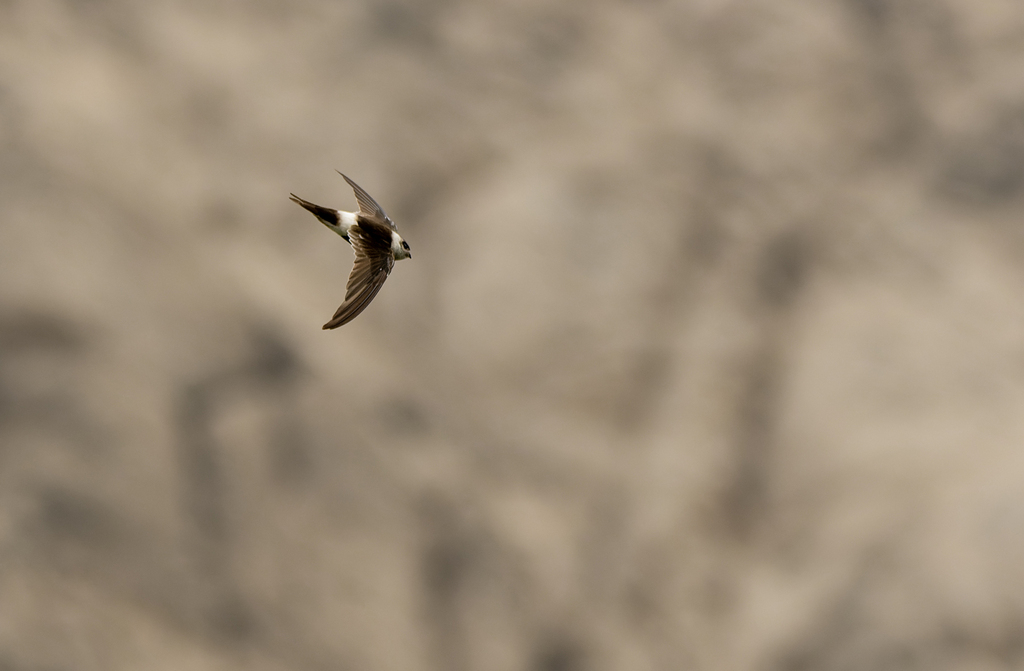
Andean Swift
Photo © David F. Belmonte
Photo © David F. Belmonte — CC BY 4.0 — Source: iNaturalist photo #453100655Identification
The Andean Swift is a small swift, approximately 14 cm (5.5 in) long, characterized by sharply pointed wings and a long, deeply forked tail. Adults of the nominate subspecies display mostly black upperparts contrasted with a distinctive white collar and rump band. The face and underparts are predominantly white to off-white, with mottled buff tones on the flanks and vent. The sexes are alike in plumage.
Two smaller subspecies show subtle but important differences. Subspecies parvulus features very sharply defined borders between black and white areas, while peruvianus displays purer white plumage, darker undertail coverts, and a shorter, less deeply forked tail. These distinctions are useful for observers across the bird's wide range.
Range & Habitat
The Andean Swift is found exclusively in the Andes of western South America, with three subspecies occupying distinct regions. Subspecies parvulus inhabits the western Andean slope from Peru's Cajamarca Department south into far northern Chile's Tarapacá Region. The nominate subspecies ranges from central Bolivia south to Río Negro Province in west central Argentina, while peruvianus is restricted to the eastern Andean slope in southeastern Peru.
This species favors semi-arid montane scrub landscapes, though it is also encountered in drier and more humid areas, and occasionally over forested slopes. Elevation ranges typically between 2,500 and 3,550 m (8,200 and 11,600 ft) in Peru and Bolivia, and between 2,000 and 2,500 m (6,600 and 8,200 ft) in Argentina, with records above 4,100 m (13,500 ft) in Peru.
Behaviour & Diet
The Andean Swift is a year-round resident throughout its range, though it may descend to lower elevations temporarily during snowstorms. Like all swifts, it is an aerial insectivore, capturing small insects in flight, though detailed dietary information remains undocumented. It frequently forages in mixed-species flocks alongside wintering Chimney Swifts.
Breeding biology is poorly known, but the species has been documented nesting in holes within steep rock faces, including behind waterfalls. The bird's most characteristic vocalization is a buzzy, grating call described as 'tzee-tz-tz-trrr...tzee-tz-tz-tzee...', with an alternative series of single notes 'tzree..tzree..tzree...'
Best Time & Places to See It
The Andean Swift is generally considered common throughout its range, though it is uncommon in northern Chile and local and irregular in parts of Argentina. As a year-round resident, it can be observed in all seasons, though visibility may be reduced during heavy snowfall when birds move to lower elevations. Look for it in semi-arid montane scrub habitats between 2,000 and 3,500 m elevation, particularly in Peru, Bolivia, and Argentina.
Listen for its distinctive buzzy, grating calls to locate flocks, which often congregate in open airspace above steep terrain. Early morning hours typically offer the best viewing opportunities, when aerial insectivores are most active.
Photography Tips
Photographing the Andean Swift presents significant challenges due to its rapid, acrobatic flight and the remote, mountainous terrain it inhabits. A fast shutter speed (1/2000 sec or faster) and continuous autofocus are essential for capturing sharp images of birds in flight. Position yourself in open areas with commanding views of the sky, particularly near steep rock faces and waterfalls where the species nests.
The bird's high-contrast plumage—black upperparts against white underparts—can confuse metering systems; exposure compensation may be necessary. Wide-angle lenses can effectively capture the bird within its dramatic Andean landscape, while telephoto lenses (500+ mm) are needed for detailed portraits. Early morning light often provides optimal conditions for photographing against mountain backdrops.
Huascarán National Park
Lauca National Park
Los Cardones National Park
Manu National Park
Reserva Nacional las Vicuñas
Salar de Surire Natural Monument
Salar del Huasco National Park
Sierra de las Quijadas National Park
Tingo Maria National Park
Nothing matches these filters.
No community photos yet. Log in to add the first one.
No community observations of this species yet.