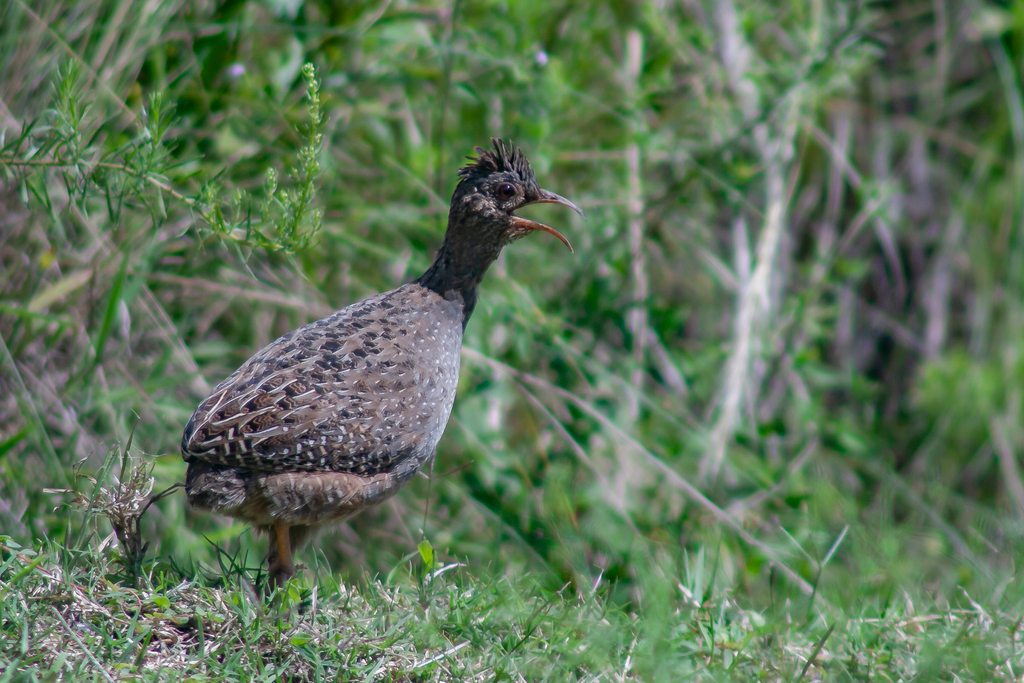
Andean Tinamou
Photo © Gabriel Reinoso Franchino
Photo © Gabriel Reinoso Franchino — CC BY 4.0 — Source: iNaturalist photo #443914231Identification
The Andean tinamou is a compact bird, approximately 27 cm (11 inches) in length, making it relatively small and easy to overlook in its mountain habitat. Its plumage is subtly patterned rather than bold: the upper parts are greyish-brown to olive brown, finely barred with black and white markings that provide effective camouflage in rocky, scrubby terrain. The breast is grey with white or buff spotting, while the belly is buff or whitish. A distinctive black crown contrasts with mottled grey sides to the head and throat. The bird's yellow legs provide a useful identifying feature when glimpsed in the field.
Range & habitat
The Andean tinamou is found throughout the Andes mountain chain from southern Ecuador south to central Chile, with an additional population in the Sierras de Córdoba in Argentina. Seven subspecies are recognized across this range, each adapted to specific regions from the high Andes of Peru and Bolivia to the southern mountains of Argentina. The species shows a marked preference for subtropical and tropical shrubland at elevations between 800 and 4,100 metres (2,600–13,500 feet), where it navigates rocky slopes dotted with low vegetation.
Behaviour & diet
Like other tinamous, the Andean tinamou is a member of an ancient bird lineage—tinamous are ratites and represent the closest living relatives to the prehistoric flying birds from which all ratites evolved. Unlike their flightless ratite cousins, tinamous retain the ability to fly, though they are not strong or sustained fliers and typically prefer to move through their habitat on foot. The species' cryptic plumage and preference for dense shrubland make it a challenging bird to observe, and detailed information about its specific dietary and social behaviour remains limited in available literature.
Best time & places to see it
The Andean tinamou is classified by the IUCN as Least Concern with a substantial occurrence range of 550,000 square kilometres, indicating it remains common throughout suitable habitat across the Andes. Travellers seeking this species should focus on high-altitude shrubland environments within its range, particularly in Ecuador, Peru, Bolivia, Chile, and Argentina. The bird's preference for remote mountain terrain means that dedicated birdwatching expeditions to Andean shrubland habitats offer the best chance of encounter, though patience and early-morning searches when birds are most vocal will improve success rates.
Photography tips
Photographing the Andean tinamou presents a rewarding challenge due to its cryptic nature and preference for dense vegetation. The bird's subtle earth-toned plumage blends seamlessly with rocky mountain scrub, so scanning open patches and taking advantage of early-morning light will help reveal its presence. A telephoto lens is essential, as the species will allow only limited approach before flushing. The yellow legs and fine black-and-white barring on the upperparts are key diagnostic features worth capturing; shooting from lower angles against the sky can help separate the bird from its background.
Manu National Park
Manu, Peru
+892 birds+26 mammals
Across the eastern slopes of the Peruvian Andes, tropical rainforest descends into the Amazon basin with a complexity that few terrestrial ecosystems match. Manu National Park…
VIEW NATIONAL PARKHuascarán National Park
Independencia, Peru
+201 birds+5 mammals
Where granite peaks pierce the Andean sky above 6,000 metres, Huascarán National Park sprawls across more than 11,500 square kilometres of Peru's Cordillera Blanca, a landscape…
VIEW NATIONAL PARKLos Cardones National Park
Argentina
+193 birds+6 mammals
Where the Andes descend into northwestern Argentina, Los Cardones National Park sprawls across nearly 1,200 square kilometres of one of South America's most distinctive high-altitude desert…
VIEW NATIONAL PARKSierra de las Quijadas National Park
Argentina
+168 birds+5 mammals
Sandstone cliffs and deeply incised canyons define this 1,137-square-kilometre expanse in San Luis Province, where the dry Chacoan landscape of central Argentina reveals an unexpected ecological…
VIEW NATIONAL PARKNo community photos yet. Log in to add the first one.
No community observations of this species yet.