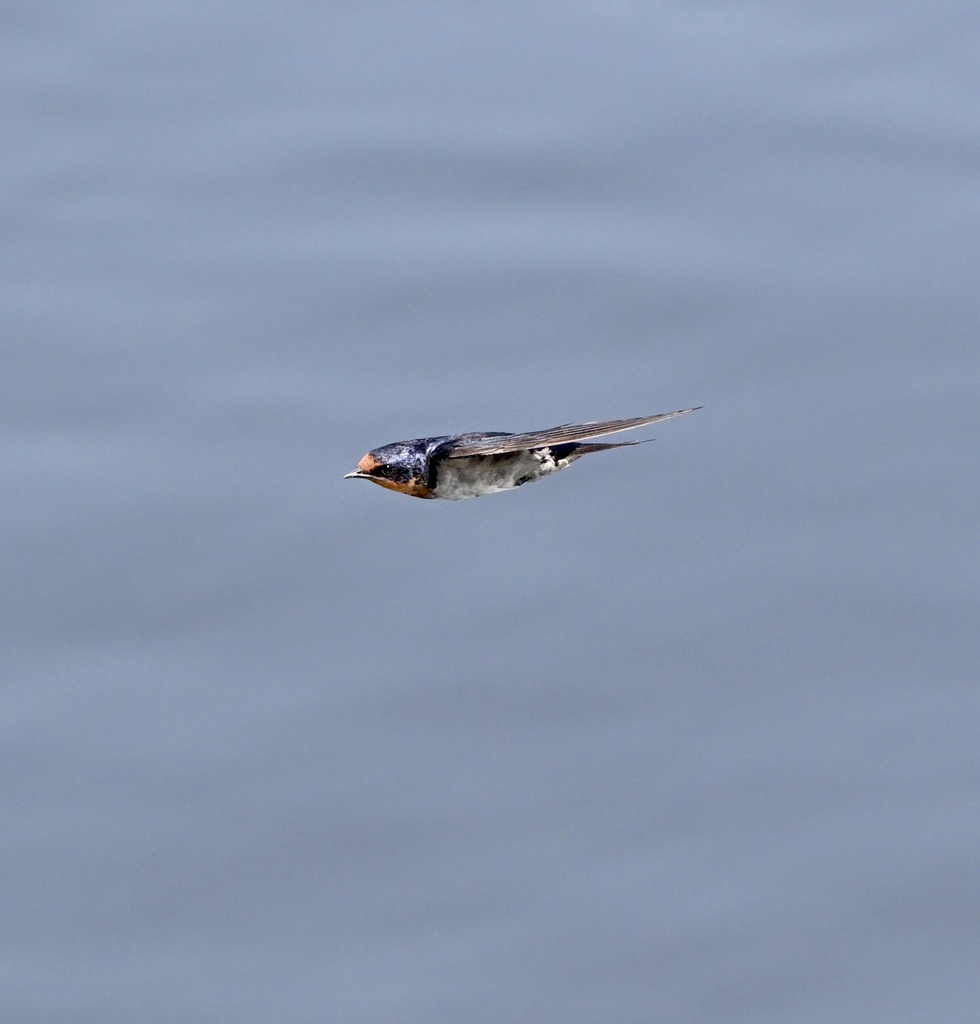
Angola Swallow
Photo © Lukas Zangl
Photo © Lukas Zangl — CC BY 4.0 — Source: iNaturalist #304438536Identification
The Angola swallow is a small and striking passerine measuring 15 cm in length, with a lean weight of 16 to 19 grams. The species displays distinctive plumage that makes it recognizable in the field. Its most eye-catching feature is the deep rufous-chestnut colouring of the forehead, throat and upper breast, which contrasts beautifully with the shiny steel-blue crown and upperparts. The flight feathers and tail are black, with notably large white windows on the tail that are particularly visible in flight, providing an excellent field mark for identification.
Range & Habitat
This species is endemic to the Afrotropics and has a wide distribution across sub-Saharan Africa. The Angola swallow is found in Angola, Burundi, Democratic Republic of the Congo, Gabon, Kenya, Malawi, Namibia, Rwanda, Tanzania, Uganda, and Zambia. The species shows a preference for a variety of open habitats, ranging from natural grasslands and savannas to areas modified by human activity. They also frequent the fringes of forest margins, demonstrating considerable adaptability to different environmental conditions across their range.
Behaviour & Diet
Angola swallows are aerial insectivores with a diet consisting of a variety of flying insects captured in flight. They are flexible foragers that may hunt alone or congregate in flocks, depending on local conditions and food availability. These birds are vocally subtle, emitting weak twittering calls rather than loud vocalizations. Their breeding season and local abundance vary considerably across different regions of their range, reflecting the diversity of habitats and climatic conditions they inhabit. Notably, some populations undertake migrations, though the extent and timing of these movements depend on their specific location of residence.
Best Time & Places to See It
The best time and location to observe Angola swallows will depend on which part of their wide African range you are visiting, as breeding season and abundance vary regionally. The species occurs across multiple countries, with populations in East Africa represented by the subspecies H. a. arcticincta, while the nominate subspecies H. a. angolensis is found in western and central regions. Visitors to open habitats and savanna margins throughout their distribution in countries such as Tanzania, Kenya, Uganda, and Zambia stand a good chance of encountering this species. Since some populations are migratory, local timing and seasonal abundance should be confirmed with regional guides or birding resources before planning a visit.
Photography Tips
Photographing Angola swallows presents the typical challenges of capturing small, fast-moving aerial birds. Their frequent foraging flights make action photography the most rewarding approach; fast shutter speeds of at least 1/2000th of a second are essential to freeze their rapid movements. The distinctive white tail windows are a key identifying feature worth capturing, so aim for clear shots of the tail in flight when possible. The contrast between the deep rufous-chestnut breast and steel-blue upperparts renders beautifully in good light, so photography in morning or late afternoon sunshine will show the plumage colours at their best. When birds perch briefly on wires or dead branches—a behaviour they occasionally adopt—use these opportunities to capture detailed portraits showing the striking head and breast markings.
Serengeti National Park
Tanzania
+558 birds+57 mammals
Across Tanzania's northern plateau, where volcanic soils meet acacia woodland and open grassland, unfolds one of Earth's most dynamic ecosystems. The Serengeti National Park sprawls across…
VIEW NATIONAL PARKRubondo Island National Park
Tanzania
+99 birds+8 mammals
Across the waters of Lake Victoria's northeastern arm, Rubondo Island rises as a freshwater wilderness where papyrus swamps grade into acacia woodlands and dense thickets of…
VIEW NATIONAL PARKVirunga National Park
Uganda
+418 birds+13 mammals
Where the Western Rift Valley fractures the landscape of North Kivu, Virunga National Park sprawls across terrain as geologically dramatic as it is ecologically vital. Volcanic…
VIEW NATIONAL PARKBwindi Impenetrable National Park
Kanyashogi, Uganda
+603 birds+26 mammals
Steep ridges cloaked in montane forest rise from Uganda's southwestern borderlands, where the landscape grows so dense and tangled that early explorers named it impenetrable. At…
VIEW NATIONAL PARKVolcanoes National Park
Musanze District, Uganda
+152 birds+6 mammals
Where volcanic cones rise sharply above the montane forests of northern Uganda, Volcanoes National Park protects one of East Africa's most dramatic high-altitude ecosystems. The park's…
VIEW NATIONAL PARKKidepo Valley National Park
Uganda
+478 birds+24 mammals
Where the Narus and Kidepo rivers carve through northeastern Uganda's semi-arid lowlands, a landscape of sparse acacia woodland, grassland, and riverine thickets creates one of East…
VIEW NATIONAL PARKMurchison Falls National Park
Uganda
+608 birds+33 mammals
Where the Victoria Nile compresses through a narrow gorge and explodes across a 45-meter precipice, the landscape speaks in thunder. Murchison Falls National Park sprawls across…
VIEW NATIONAL PARKMgahinga Gorilla National Park
Cyanika, Uganda
+429 birds+6 mammals
Where the Virunga Mountains rise steeply from the Uganda–Rwanda–Democratic Republic of Congo frontier, montane forest cloaks the volcanic slopes in a dense, moisture-laden embrace. Mgahinga Gorilla…
VIEW NATIONAL PARKLake Mburo National Park
Uganda
+505 birds+24 mammals
Rolling acacia woodland and scattered lakes define this intimate savanna preserve in southwestern Uganda, where the rift valley's geological drama shapes every water source and grassland.…
VIEW NATIONAL PARKMount Elgon National Park
Matumbei ward, Kenya
+164 birds+7 mammals
Where the volcanic slopes of Mount Elgon rise above the Trans-Nzoia landscape, a montane wilderness unfolds across multiple ecological zones, each harbouring distinct communities adapted to…
VIEW NATIONAL PARKMount-Kenya National Park
Abothuguchi west ward, Kenya
+334 birds+11 mammals
Where the slopes of Kenya's second-highest mountain rise steeply from the Meru County foothills, a landscape of profound ecological richness unfolds across Mount Kenya National Park.…
VIEW NATIONAL PARKTarangire National Park
Tanzania
+527 birds+50 mammals
Acacia woodland and grassland sweep across the Manyara Region where the Tarangire River carves through low hills and volcanic soils, creating one of East Africa's most…
VIEW NATIONAL PARKKitulo National Park
Tanzania
+59 birds+1 mammals
Where the southern highlands of Tanzania rise above two thousand metres, rolling grasslands and montane meadows create a landscape rarely encountered in East Africa—a sweeping plateau…
VIEW NATIONAL PARKToro-Semliki Proposed National Park
Uganda
+474 birds+5 mammals
Where the Albertine Rift's western escarpment rises above the Semliki River valley, a vast mosaic of forest, savanna and wetland converges to create one of East…
VIEW NATIONAL PARKQueen Elizabeth National Park
Uganda
+672 birds+30 mammals
Across the southwestern escarpment of Uganda, where the Western Rift Valley descends through ancient volcanic terrain, Queen Elizabeth National Park sprawls across more than 8,300 square…
VIEW NATIONAL PARKMabamba Swamp
Memere, Uganda
+464 birds+2 mammals
Across the Central Region of Uganda spreads one of Africa's most biodiverse freshwater wetlands, a sprawling nature reserve of roughly 283 square kilometres where papyrus swamps…
VIEW NATURE RESERVEZiwa Rhino and Wildlife Ranch
Nakasongola, Uganda
+359 birds+11 mammals
Where papyrus wetlands merge into sprawling savanna, Uganda's central landscape opens into one of East Africa's most vital rhino recovery zones. Ziwa Rhino and Wildlife Ranch…
VIEW WILDLIFE SANCTUARYNairobi National Park
Nairobi, Kenya
+515 birds+35 mammals
Just minutes from Kenya's capital, where the Nairobi River winds through acacia woodland and open grassland, lies one of Africa's most paradoxical wildlife sanctuaries. The park's…
VIEW NATIONAL PARKLake Nakuru National Park
Nakuru West, Kenya
+494 birds+32 mammals
Alkaline waters ringed by acacia woodland and grassland create one of East Africa's most distinctive wetland ecosystems, where the interplay of geology and climate sustains a…
VIEW NATIONAL PARKAberdare National Park
Mweiga ward, Kenya
+394 birds+30 mammals
Where the central highlands of Kenya rise to their elemental grandeur, the Aberdare range unfolds across Nyeri County as a montane stronghold of cool, misty forest…
VIEW NATIONAL PARKSamburu National Reserve
Samburu, Kenya
+430 birds+42 mammals
Across the arid plains of northern Kenya, where scattered acacia woodland gives way to rocky outcrops and dry riverbeds, Samburu National Park unfolds as one of…
VIEW NATURE RESERVEHell’s Gate National Park
Olkaria ward, Kenya
+388 birds+18 mammals
Volcanic scarps and geothermal vents dominate the floor of Hell's Gate, where the East African Rift has carved a dramatic gorge through crystalline rock formations. The…
VIEW NATIONAL PARKRuma National Park
Suba, Kenya
+250 birds+8 mammals
Where the Winam Gulf narrows toward the Kenyan mainland, Ruma National Park rises as a sanctuary of evergreen woodland set within the humid tropics of Homa…
VIEW NATIONAL PARKSaiwa Swamp National Park
Sinyerere ward, Kenya
+255 birds+4 mammals
Where papyrus and sedge marshes stretch across a highland plateau in western Kenya, Saiwa Swamp National Park shelters one of East Africa's most productive freshwater wetland…
VIEW NATIONAL PARKNo community photos yet. Log in to add the first one.
No community observations of this species yet.