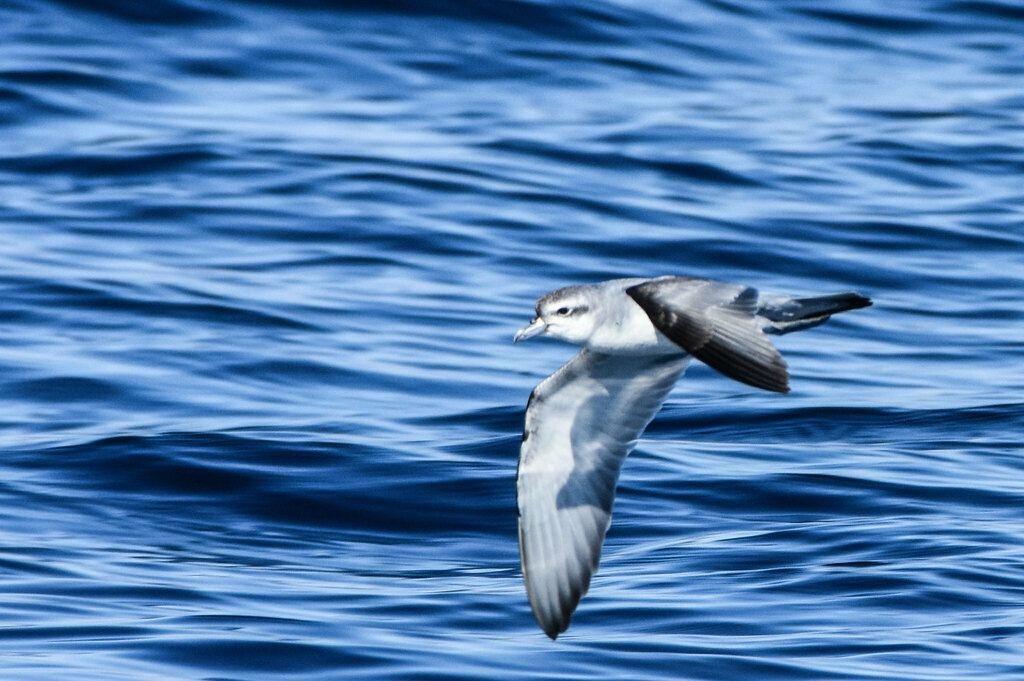
Antarctic Prion
Photo © Jay Pruett
Photo © Jay Pruett — CC BY 4.0 — Source: iNaturalist photo #267863115Identification
The Antarctic prion is the largest member of the prion genus, measuring 27 cm in length with a wingspan of 61–66 cm and weighing 150–160 g. Like all prions, it displays white underparts contrasting with blue-grey upperparts, and a distinctive dark "M" marking across its back and wings. The species has a white eyebrow stripe, blue-grey bill, and bright blue feet. Its tail is grey and wedge-shaped with a black tip, and the greater wing coverts are nearly black. It is so similar in appearance to Salvin's prion that the two cannot be reliably distinguished at sea.
Range & Habitat
The Antarctic prion breeds in colonies across the Southern Ocean, with established populations on the Auckland Islands, Heard Island, Macquarie Island, Scott Island, South Georgia, the South Sandwich Islands, South Orkney Islands, South Shetland Islands, Crozet Islands, and Kerguelen Islands. Outside the breeding season, the species ranges throughout the southern oceans across a vast occurrence range of 76.6 million square kilometers.
Behaviour & Diet
Antarctic prions feed primarily on zooplankton, which they obtain by a specialized filtration feeding technique—drawing water through their uniquely structured upper bill. Like other members of the order Procellariiformes, they possess naricorns (nasal passages attached to the upper bill) and produce stomach oil rich in wax esters and triglycerides. This oil serves multiple functions: it can be sprayed defensively against predators and provides energy-rich nutrition for chicks and adults during long ocean flights. A specialized salt gland above the nasal passage helps desalinate their bodies, excreting excess salt through the nostrils. The species nests in colonies and practices biparental care, with both sexes sharing nest construction, egg incubation, and chick-rearing duties.
Best Time & Places to See It
The Antarctic prion's breeding colonies on sub-Antarctic islands offer the most reliable viewing opportunities during the breeding season. Key locations include South Georgia, the South Shetland Islands, Kerguelen Islands, and Macquarie Island. Outside breeding season, sightings at sea throughout the southern oceans are possible, though the species' preference for remote waters and its similarity to Salvin's prion make identification challenging. The species has a robust global population estimated at 50 million adults.
Photography Tips
Photographing Antarctic prions requires patience and access to their remote breeding islands or pelagic seabird expeditions. The distinctive dark "M" marking across the back and wings is a key identifying feature to capture. The contrast between white underparts and blue-grey upperparts is striking in good light. At sea, photograph the species in profile to document the white eyebrow and black-tipped tail. Given the challenge of distinguishing this species from Salvin's prion at distance, capture detailed shots of the head pattern, bill coloration, and wing markings for reliable identification. Early morning light often provides optimal contrast for documenting plumage patterns.
Murrell Farm
falskland islands, Falkland Islands
+54 birds
Rolling grasslands sweep across windswept plateaux where the South Atlantic exerts its relentless influence on the vegetation, sculpting tussock grassland into a tapestry of browns and…
VIEW NATURE RESERVEDeception Island
Gabriel de Castilla Base, Antarctica
+26 birds+10 mammals
Steaming geothermal vents pierce a landscape of blackened volcanic sand and ice, where the earth's raw power still trembles beneath your feet. This horseshoe-shaped caldera, flooded…
VIEW ISLAND & ARCHIPELAGOBrown Bluff
Brown Bluff, Antarctica
+23 birds+9 mammals
Where rust-colored volcanic peaks pierce the Antarctic Peninsula's icy realm, a geologist's dreamscape unfolds beneath towering cliffs of iron oxide and ancient lava. Brown Bluff rises…
VIEW PROTECTED LANDSCAPEHalf Moon Island
Cámara Base, Antarctica
+25 birds+8 mammals
Jagged volcanic peaks rise from the cobalt waters of the South Shetland Islands, their slopes carpeted in moss and lichen where hardy vegetation clings to windswept…
VIEW ISLAND & ARCHIPELAGOLemaire Channel
Orne Harbour, Antarctica
+25 birds+13 mammals
Where granite peaks plunge into steel-grey waters, the Lemaire Channel carves one of Antarctica's most dramatic passages. This narrow strait, squeezed between the Antarctic Peninsula and…
VIEW PROTECTED LANDSCAPESalisbury Plain
South Georgia, South Georgia and the South Sandwich Islands
+33 birds+4 mammals
Where tussock grasses bow to relentless Antarctic winds and glacial meltwater carves braided channels through obsidian volcanic soil, one of Earth's most remote wildlife sanctuaries reveals…
VIEW PROTECTED LANDSCAPESt. Andrews Bay
South Georgia, South Georgia and the South Sandwich Islands
+34 birds+6 mammals
Where windswept tundra dissolves into obsidian beaches, one of the planet's most extraordinary wildlife theaters unfolds across St. Andrews Bay. This remote corner of South Georgia…
VIEW PROTECTED LANDSCAPEFortuna Bay
Stromness, South Georgia and the South Sandwich Islands
+37 birds+5 mammals
Where tussock grasslands sweep down to black-sand beaches and elephant seals haul out in thunderous colonies, the raw sub-Antarctic landscape reveals itself in its most dramatic…
VIEW PROTECTED LANDSCAPEPrion Island
Prince Olav Harbour, South Georgia and the South Sandwich Islands
+36 birds+2 mammals
Windswept tussock grasslands rise sharply from boulder-strewn beaches where the Southern Ocean hurls its grey swells against black volcanic rock. This remote speck in South Georgia's…
VIEW ISLAND & ARCHIPELAGOCooper Bay
Cooper Bay, South Georgia and the South Sandwich Islands
+28 birds+5 mammals
Where black-sand beaches meet towering cliffs striped with cascading meltwater, one of the Southern Ocean's most dramatic amphitheaters reveals itself. Cooper Bay cuts a deep indent…
VIEW PROTECTED LANDSCAPEElsehul Bay
Bird Island Station, South Georgia and the South Sandwich Islands
+33 birds+4 mammals
Granite peaks rise sheer from the Southern Ocean, their weathered faces streaked with cascading meltwater and cloaked in tussock grass that bends beneath relentless winds. This…
VIEW PROTECTED LANDSCAPENo community photos yet. Log in to add the first one.
No community observations of this species yet.