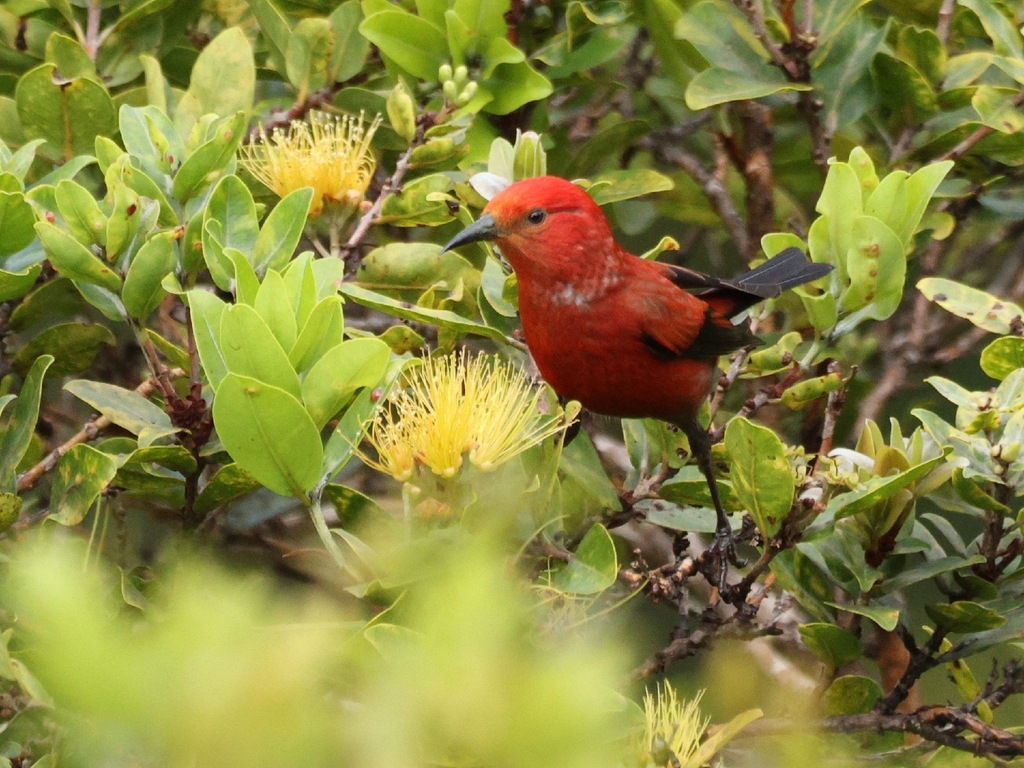
Apapane
Photo © Damien Wallace
Photo © Damien Wallace — CC BY 4.0 — Source: iNaturalist photo #632966618The ʻapapane ( AH-pah-PAH-nay;) (Himatione sanguinea) is a small, crimson species of Hawaiian honeycreeper endemic to the Hawaiian Islands. They are the most abundant and widely distributed honeycreeper and are found on the islands of Hawaiʻi, Maui, Lānaʻi, Kauaʻi, Molokaʻi and Oʻahu. ʻApapane commonly forage in the canopies of ʻōhiʻa (Metrosideros polymorpha) trees, drinking nectar from the flowers and serving as important pollinators. Hawaiians primarily used red feathers from ʻiʻiwi, but also some from ʻapapane, to adorn the ʻahuʻula (capes), mahiole (helmets), and nā lei hulu (feather leis) of aliʻi (Hawaiian nobility). == Description == ʻApapane are small at 13 cm (5.1 in) when fully grown. They are sexually dimorphic in size: male ʻapapane have a mass of 16 g (0.56 oz), while females average 14.4 g (0.51 oz). Adult ʻapapane are overall bright crimson, with distinct white undertail-coverts and lower abdomen feathers. They have black primaries and retricies. Juvenile ʻapapane are yellow-brown and gray, with the same white plumage as adults, and molt into crimson plumage over the course of two years. 'Apapane are often seen in a tail-up posture, showing off their white feathers. === Song === ʻApapane are active singers, including in flight. There is considerable variation…
Hawaiʻi Volcanoes National Park
Hawaiʻi County, United States
+84 birds+2 mammals
Where volcanic slopes descend toward the Pacific across more than five thousand square kilometers, Hawaiʻi Volcanoes National Park presents one of Earth's most dynamic laboratories of…
VIEW NATIONAL PARKHaleakalā National Park
Maui County, United States
+66 birds+4 mammals
Ascending from sea level to over 10,000 feet across a mere thirty miles, Haleakalā National Park commands one of the Pacific's most dramatic elevation gradients, where…
VIEW NATIONAL PARKKīlauea Point National Wildlife Refuge
Kilauea, United States
+79 birds+1 mammals
At the northernmost tip of Kauai, where the Pacific trades collide with volcanic rock, Kīlauea Point National Wildlife Sanctuary crowns a dramatic headland overlooking one of…
VIEW WILDLIFE SANCTUARYNo community photos yet. Log in to add the first one.
No community observations of this species yet.