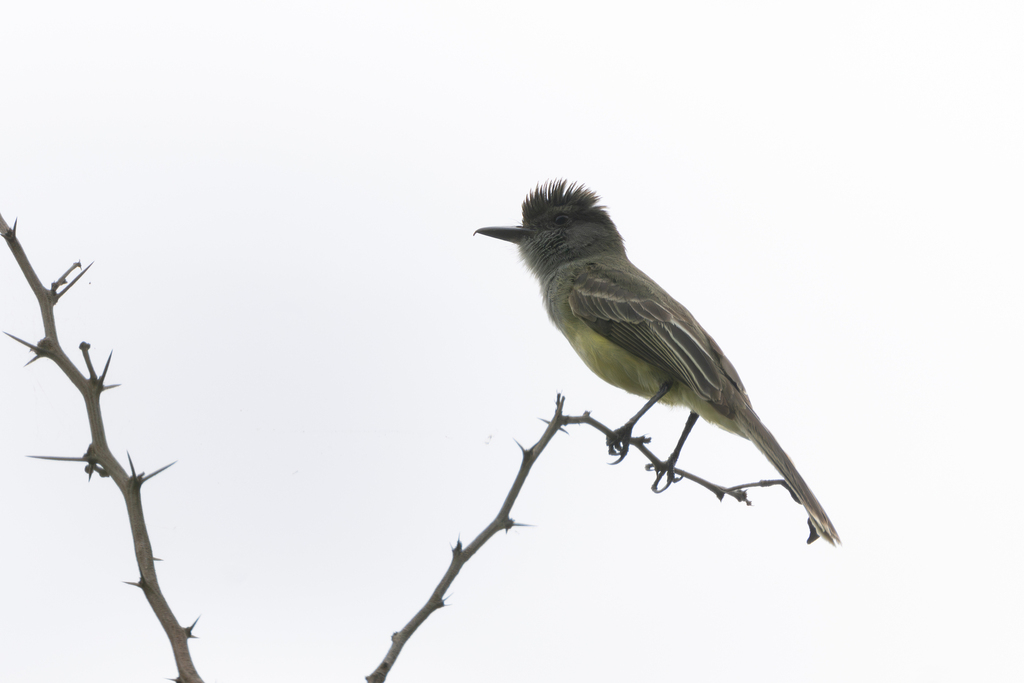
Apical Flycatcher
Photo © Ryan F. Mandelbaum
Photo © Ryan F. Mandelbaum — CC BY 4.0 — Source: iNaturalist #204306086Identification
The apical flycatcher is a slim, medium-sized tyrant flycatcher measuring 17 to 18 cm in length and weighing 26 to 33.5 grams. Like many Myiarchus flycatchers, it lacks bold field marks, but several subtle features help identify it. The bird sports a brownish olive crown with a slight crest and darker center feathers that create a streaked appearance. Its face is predominantly gray, while the upperparts are darkish olive. The wings are mostly brownish, with pale whitish to yellowish outer edges on the secondaries and tertials, and faint yellowish edges on the innermost primaries. Most distinctive is the tail: brownish with pale creamy white tips on all but the central pair of feathers—a feature reflected in the bird's name. The throat and breast are gray (whiter on the throat), with an olive wash on the breast sides, while the belly and undertail coverts are yellowish. Adults have a dark iris, dark bill, and dark legs. The sexes are identical in plumage, though juveniles show rufous edges on wing coverts and tail feathers.
Range & Habitat
The apical flycatcher is endemic to Colombia, occurring in a distinctive disjunct distribution across four west-central river valleys: the Cauca, Dagua, Patía, and Magdalena rivers, spanning from Antioquia Department in the north to Nariño Department in the south. The species favors dry to arid valleys with scrubby vegetation, also occurring along forest and woodland edges, in riparian areas with trees and brush, and in agricultural zones. Elevations range from at least 400 to 2,300 meters, with most birds found below 1,700 meters. Interestingly, the species appears to be benefiting from habitat change, with its population possibly expanding as secondary woodland, scrub, and pasture replace cleared humid forest at higher elevations.
Behaviour & Diet
The apical flycatcher is a year-round resident that feeds primarily on insects and fruit. It typically forages singly or in pairs, using a sit-and-wait hunting strategy, taking prey and fruit with aerial sallies from perches at low to mid-levels of the habitat. When confronted by other apical flycatchers, the bird produces repeated rolls, hiccups, and whistles, with one distinctive call being a sharp, repeated "weet." Breeding occurs year-round with recorded egg-laying in July, September, and between November and February, suggesting multiple breeding seasons may be possible. Available breeding information comes primarily from suburban nest boxes, where birds constructed nests from dry grass and fur on stick platforms, lined with fur, feathers, plastic, and snake skin. Average clutches contained 2.6 eggs, with fledging occurring 16 to 17 days after hatching.
Best Time & Places to See It
As a year-round resident, the apical flycatcher can be encountered in Colombia throughout the year. The species is considered locally common within its range, making it a reasonably reliable find for visitors exploring the dry valleys of west-central Colombia, particularly in the Cauca, Magdalena, and other river valleys where it occurs. The bird is most numerous below 1,700 meters elevation. However, it is not currently known to occur in any protected areas, so travelers may need to explore private lands or secondary habitats carefully. Early mornings often provide the best viewing opportunities when bird activity peaks.
Photography Tips
Photographing the apical flycatcher requires patience and attention to subtle plumage details. Position yourself near productive foraging areas in scrubby habitat or at forest edges where the bird typically perches at low to mid-canopy levels. Watch for the characteristic tail-tip pattern—the creamy white tips on tail feathers are among the species' most diagnostic features and photograph well. The bird's habit of foraging from exposed perches between sallies offers opportunities for clean shots. Given the bird's small size and often distant perches, a telephoto lens of at least 400mm is advisable. Overcast conditions or early-morning light will help render the bird's subtle gray and olive tones accurately without harsh shadows.
Natural Farallones de Cali National Park
Buenaventura, Colombia
+733 birds+27 mammals
Where the Pacific coastal plain meets the western slopes of the Andes, Farallones de Cali National Park sprawls across nearly 3,500 square kilometers of dramatic topography…
VIEW NATIONAL PARKPuracé National Natural Park
Puracé, Colombia
+327 birds+2 mammals
Where the Andes thrust upward across southwestern Colombia, Puracé National Natural Park spans nearly 2,631 square kilometers of some of South America's most dramatic montane terrain.…
VIEW NATIONAL PARKNo community photos yet. Log in to add the first one.
No community observations of this species yet.