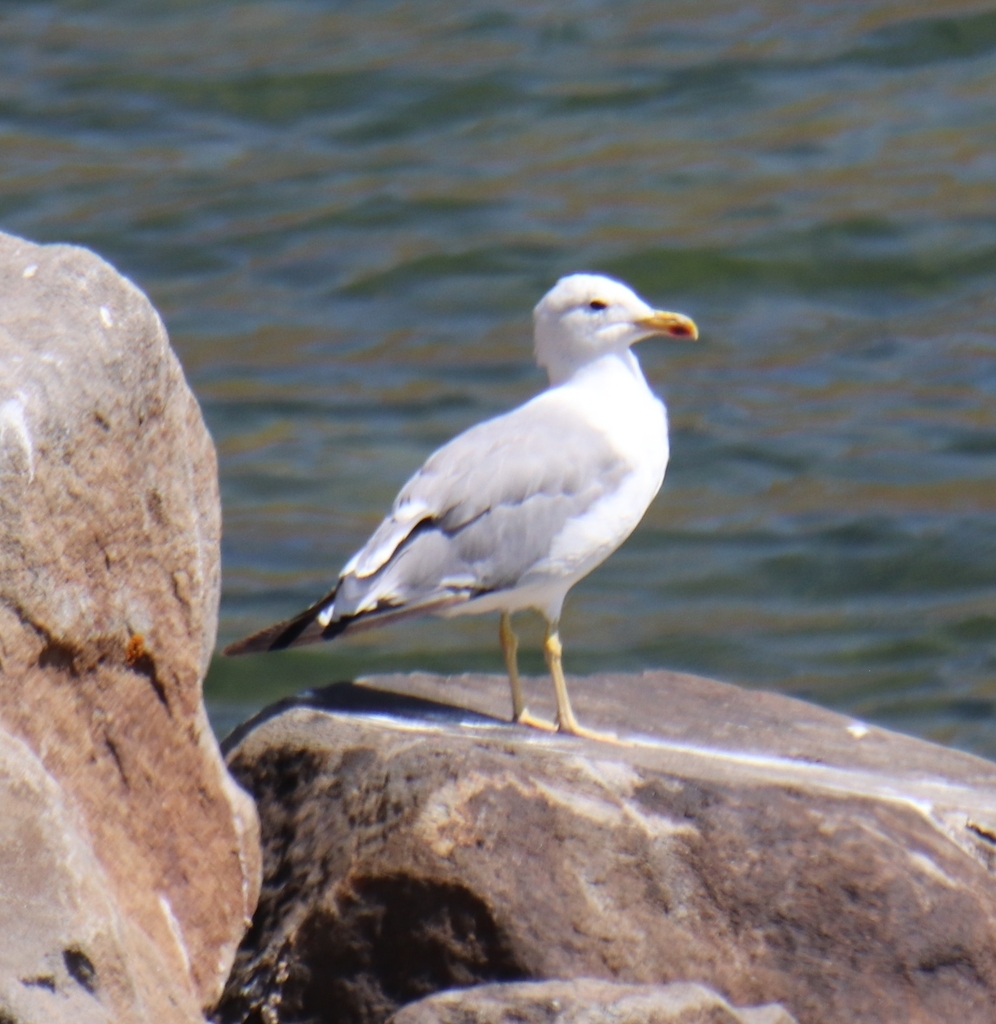
Armenian Gull
Photo © Roland Godon
Photo © Roland Godon — CC BY 4.0 — Source: iNaturalist #240262286Identification
The Armenian gull is a fairly large gull species, though it is on average the smallest of the "herring gull" complex, measuring 52 to 62 cm in length with a wingspan of 120 to 145 cm. It is superficially similar to yellow-legged gulls but is slightly smaller with a slightly darker grey back and distinctive dark eyes. The bill is short with a characteristic black band just before the tip, and features both black and red colouration near the tip. The area of black on the wingtips is more extensive than in related species, with smaller white spots. First-winter birds are mainly brown with a whitish rump, pale inner primary feathers, and a narrow, sharply defined black band on the tail.
Range & Habitat
The Armenian gull is found in the Caucasus and the Middle East, nesting beside mountain lakes in Georgia, Armenia, Turkey, and western Iran. The largest colonies are located at Lake Sevan and Lake Arpi in Armenia. As a partial migrant, many birds remain at their breeding sites year-round while others undertake seasonal movements. Wintering birds are found on the coasts of Turkey, Lebanon, and Israel, with smaller numbers reaching Cyprus, Egypt, and the Persian Gulf.
Behaviour & Diet
Armenian gulls breed in very dense colonies where nests are built close together on islands or lakeshores. The nest consists of a mound of vegetation constructed on the ground, with three eggs typically laid in late April. The tight spacing of nests within breeding colonies leads to frequent territorial conflicts among breeding birds. Like other gulls, Armenian gulls are opportunistic feeders, though specific dietary details are not extensively documented.
Best Time & Places to See It
For the best chance of observing Armenian gulls in breeding plumage and behaviour, visit Lake Sevan or Lake Arpi in Armenia during the breeding season in spring and early summer. Those interested in seeing wintering birds should visit coastal areas of Turkey, Lebanon, or Israel during the winter months. Cyprus, Egypt, and the Persian Gulf also host smaller wintering populations that may be encountered.
Photography Tips
The Armenian gull's distinctive features—its dark mantle, dark eye, short bill with the characteristic black band, and extensive black on the wingtips—make it an interesting photographic subject when compared with related gull species. During breeding season at Lake Sevan and Lake Arpi, dense colonies offer opportunities to capture colonial behaviour and territorial interactions. The contrast between adult plumage and first-winter birds' brown colouration provides varied compositional possibilities. Early morning light is ideal for capturing detail in the bird's darker plumage tones.
Tbilisi National Park
Tezami, Georgia
+63 birds+1 mammals
Where the Caucasus foothills descend toward Georgia's capital, pristine river valleys and limestone cliffs create a remarkable patchwork of habitats within striking distance of the city.…
VIEW NATIONAL PARKKolkheti National Park
Nigvziani, Georgia
+60 birds+1 mammals
Where the Caucasus descends to meet the Black Sea, a mosaic of wetlands, reed beds, and coastal lagoons creates one of the Mediterranean's most biodiverse refuges.…
VIEW NATIONAL PARKJavakheti National Park
Bozali, Georgia
+138 birds
Dawn breaks over a high-altitude plateau where volcanic peaks pierce the Caucasian sky, their slopes cloaked in alpine meadows that stretch toward horizons of impossible clarity.…
VIEW NATIONAL PARKKerkini Lake National Park
Serres, Greece
+291 birds+18 mammals
Where the Strymon River widens into a sprawling freshwater lake hemmed by the Rhodope Mountains, Kerkini National Park unfolds across northern Greece as one of southeastern…
VIEW NATIONAL PARKNo community photos yet. Log in to add the first one.
No community observations of this species yet.