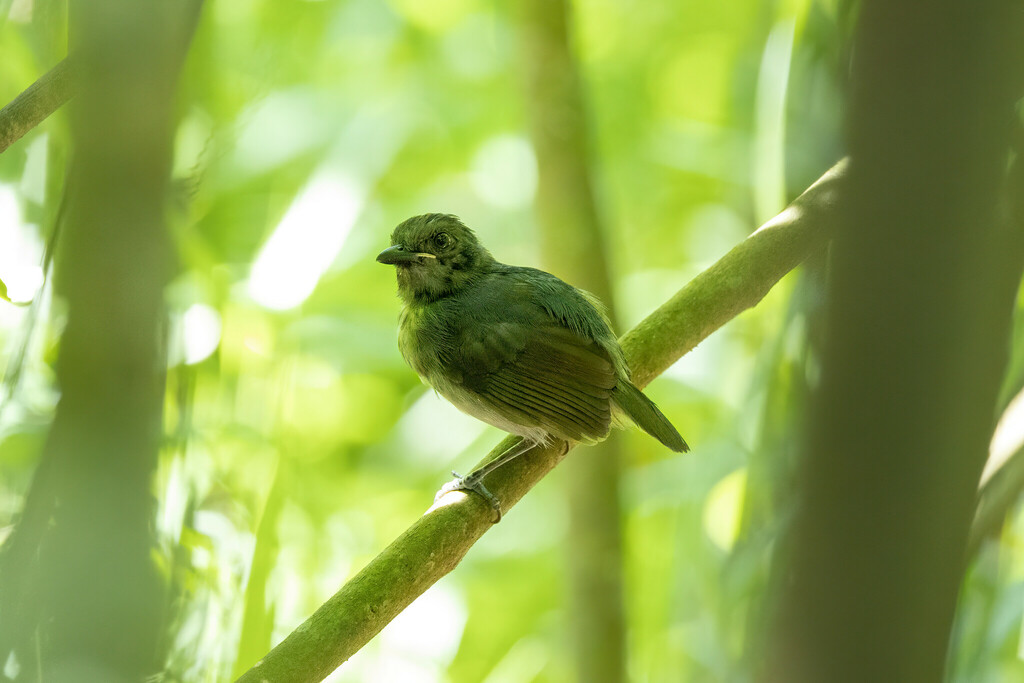
Ash-breasted Antbird
Photo © Thibaud Aronson
Photo © Thibaud Aronson — CC BY-SA 4.0 — Source: iNaturalist #143640233The ash-breasted antbird (Myrmoborus lugubris) is an insectivorous bird in subfamily Thamnophilinae of family Thamnophilidae, the "typical antbirds". It is found in Brazil, Colombia, Ecuador, and Peru. == Taxonomy and systematics == The ash-breasted antbird was described by the German ornithologist Jean Cabanis in 1847 and given the binomial name Myrmonax lugubris. Its current genus Myrmoborus was introduced in 1860. The ash-breasted antbird has these four subspecies: M. l. berlepschi (Hellmayr, 1910) M. l. stictopterus Todd, 1927 M. l. femininus (Hellmayr, 1910) M. l. lugubris (Cabanis, 1847) == Description == The ash-breasted antbird is 12 to 13.5 cm (4.7 to 5.3 in) long and weighs 20 to 23 g (0.71 to 0.81 oz). Adult males of the nominate subspecies M. l. lugubris have mostly gray upperparts with a whitish forehead. Their face and throat are black. Their underparts are grayish white. Adult females have mostly rufescent-tinged brown upperparts, wings, and tail with small buff tips on their wing coverts. Their throat is white and the rest of their underparts are mostly whitish with olivaceous flanks. Both sexes have a red iris and gray legs and feet. Males have a black bill; females have a black maxilla and a gray mandible.…
Amacayacu National Park
Leticia, Colombia
+567 birds+25 mammals
Where the Rio Amazonas curves through the tri-border region where Colombia, Peru, and Brazil converge, Amacayacu National Park sprawls across more than 5,250 square kilometres of…
VIEW NATIONAL PARKJaú National Park
Brazil
+354 birds+3 mammals
Vast floodplain forests and blackwater rivers define this remote corner of western Amazonas, where the Rio Negro and its tributaries have carved an intricate mosaic of…
VIEW NATIONAL PARKAnavilhanas National Park
Brazil
+468 birds+8 mammals
Across the Rio Negro in central Amazonas, an archipelago of over a thousand islands rises from the world's largest rainforest river system, creating a labyrinth of…
VIEW NATIONAL PARKNo community photos yet. Log in to add the first one.
No community observations of this species yet.