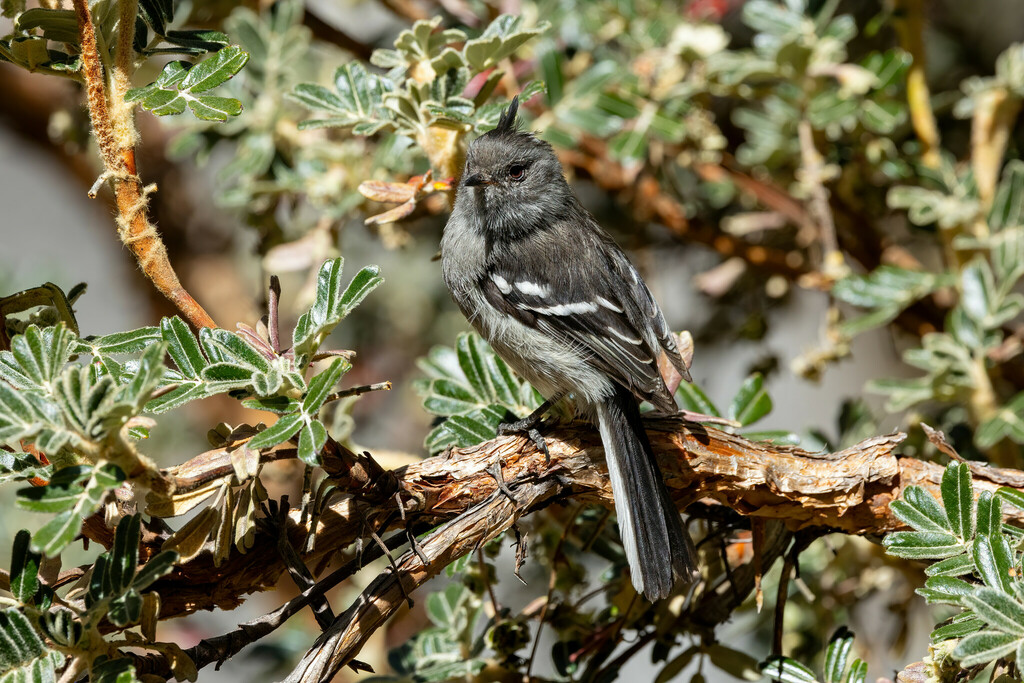
Ash-breasted Tit-Tyrant
Photo © Thibaud Aronson
Photo © Thibaud Aronson — CC BY-SA 4.0 — Source: iNaturalist photo #350015205Identification
The ash-breasted tit-tyrant is a small flycatcher, measuring 13–13.5 cm in length. Both sexes are identical in plumage. The most striking feature is the blackish crest formed by elongated feathers on the crown sides, contrasting sharply with a white crown and dark gray head. The upperparts are soft gray with faint blackish streaks, while the wings are blackish with whitish inner flight-feather edges and two prominent white wing bars across the coverts. The tail is black above and mostly white below. The underparts are characteristically pale: soft gray breast and flanks with whitish belly and undertail coverts. The subspecies A. a. bolivianus shows a blacker crown and whiter belly than the nominate form. All individuals have a hazel iris, black bill, and black legs.
Range & Habitat
This vulnerable species has a highly disjunct distribution in the Andes of Peru and Bolivia. The nominate subspecies occupies the western slope in northern Peru's La Libertad, Ancash, and Lima departments, while A. a. bolivianus is found in southeastern Peru (Cuzco and Apurímac) and northwestern Bolivia (La Paz). The ash-breasted tit-tyrant is restricted to high-altitude mountain groves and thickets dominated by Polylepis and Gynoxys trees and shrubs on steep, rocky, grassy slopes, typically between 3,700 and 4,600 meters elevation. It is a year-round resident with a small, severely fragmented range and an estimated population of only 150–700 mature individuals.
Behaviour & Diet
An active and restless forager, the ash-breasted tit-tyrant feeds singly, in pairs, or in small family groups, often joining mixed-species feeding flocks. Its diet consists mainly of insects, which it obtains by gleaning from perches on outer branches of Polylepis and Gynoxys, punctuated by short sallies to hover briefly; it rarely descends to the ground or climbs trunks. Its song is distinctive: a rising burry note followed by descending notes described as 'breeee djr-djr-djr', while its calls include a plaintive 'feeet', a soft trill, and 'pip' or 'peep' notes. Breeding occurs towards the end of the dry season, with active nests found in November and dependent young in December, though much remains unknown about its reproductive biology.
Best Time & Places to See It
Year-round residence means the ash-breasted tit-tyrant can be encountered throughout the year within its range, though it is very local and uncommon. It occurs in at least three national parks in Peru and one in Bolivia, though it is rare in Huascarán National Park. The species' highly fragmented distribution means birders should focus on appropriate high-altitude Polylepis-Gynoxys habitat in the departments mentioned. Locating this elusive tyrant requires patience, as it remains within its preferred thickets and groves; listening for its distinctive burry song and short calls will aid in detection.
Photography Tips
The ash-breasted tit-tyrant's small size and preference for dense, high-altitude scrub present significant photographic challenges. Position yourself near fruiting or flowering Polylepis and Gynoxys, where the bird forages actively, and listen for its diagnostic vocalizations to locate individuals. The bird's restless behavior and frequent short sallies offer brief opportunities for flight shots. Early morning light is essential at high elevation; bring telephoto lenses (at least 400–600 mm) and fast film or high ISO settings due to the montane vegetation's dappled lighting. The striking white wing bars and contrasting black-and-white crown are key identification features that photograph well; patience and multiple visits to known sites increase success rates considerably.
Nothing matches these filters.
No community photos yet. Log in to add the first one.
No community observations of this species yet.