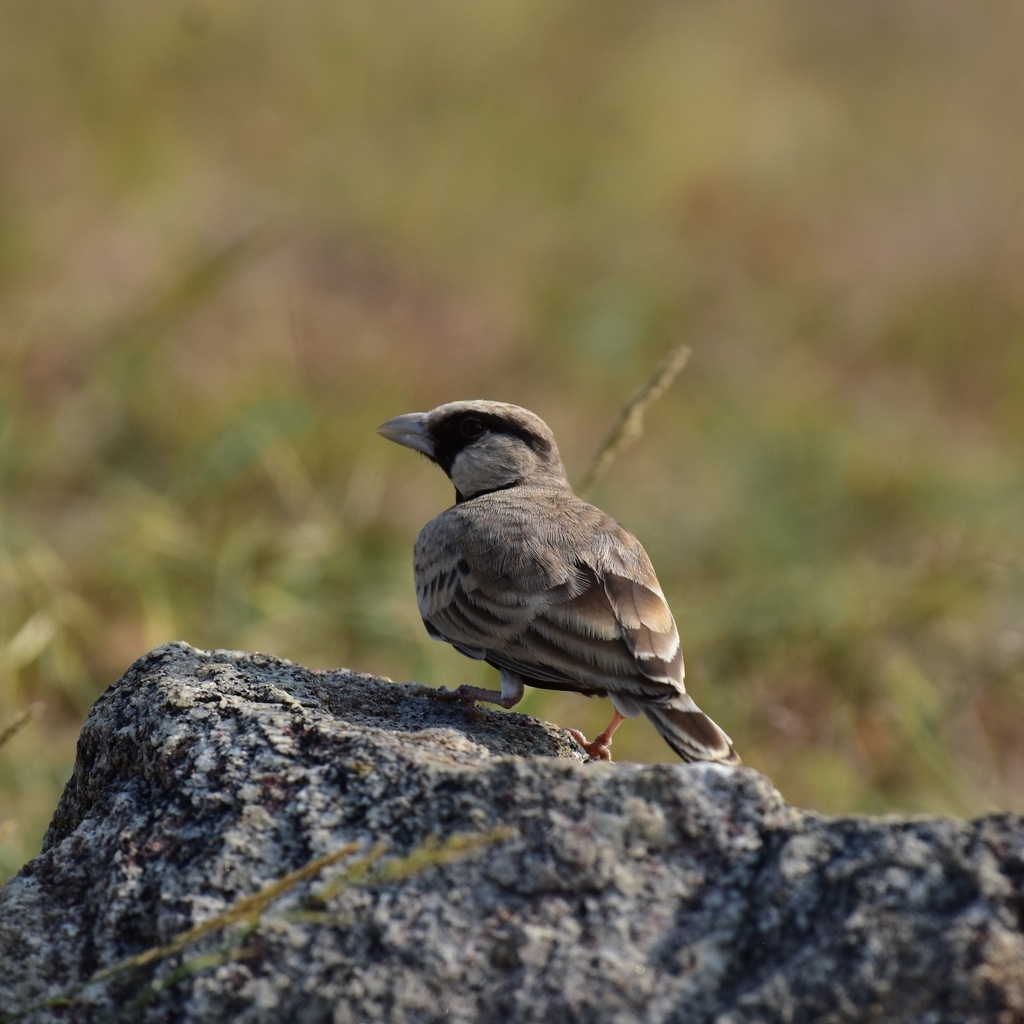
Ashy-crowned Sparrow-Lark
Photo © Renjith Jacob Mathews
Photo © Renjith Jacob Mathews — CC BY 4.0 — Source: iNaturalist #169947166Identification
The Ashy-crowned Sparrow-Lark is a small, sparrow-sized member of the lark family with a distinctive finch-like bill and notably short legs. Males are striking and unmistakable, featuring a contrasting black-and-white face pattern with a black chin, belly, lower lores and eye stripe, set against sandy-brown upperparts and an ashy (pale grey) crown. Females, by contrast, are pale brown and superficially resemble female House Sparrows, though they are stockier and shorter-necked with much shorter legs. These birds are typically seen on the ground rather than perched in trees or bushes, though they occasionally rest on wires.
Range & Habitat
This species is found across South Asia, from south of the Himalayas through the plains to Sri Lanka, extending west to the Indus River system and east to Assam. It is restricted to elevations below 1,000 metres and favours open land with bare ground, grass and scrub, including stubble fields, waste land, riverside sand and coastal tidal flats. The Ashy-crowned Sparrow-Lark avoids the interior desert zones, preferring more scattered vegetation, and withdraws from regions receiving heavy monsoon rainfall during that season. Its range overlaps partially with the similar Black-crowned Sparrow-Lark, though the two species are rarely found together in the same locations.
Behaviour & Diet
These larks are gregarious birds, found in pairs or small groups that form larger flocks during winter. They forage on the ground for seeds and insects, and readily consume fallen grain in cultivated fields. When threatened, they may crouch before taking flight, and at night they roost on the ground in small depressions they create in the soil. Males are most conspicuous during the breeding season, performing elaborate and highly visual display flights involving undulating, dive-bombing movements accompanied by a distinctive long descending whistle at each dive. The display includes soaring with chirruping calls, diving with partly closed wings, and rising in a glide before landing on a small mound to repeat the sequence.
Best Time & Places to See It
Breeding occurs irregularly and spreads across February to September in southern India and May to June in Sri Lanka, making these months the best for observing display behaviour. Look for this species in open plains with sparse vegetation, stubble fields, and coastal flats across its South Asian range. Males are most easily detected during breeding season through their distinctive song flights and long whistles, which make them conspicuous despite their small size. Winter months may offer better views of larger flocks in suitable open habitats.
Photography Tips
The male's striking black-and-white facial markings and contrasting plumage make them rewarding photographic subjects, especially during display flights when they are most active and vocal. Ground-level photography will be necessary, as these birds spend most of their time on the earth rather than elevated perches. The female's subtle pale-brown coloration requires careful exposure management to reveal detail against bare ground. Early morning visits to open plains and grasslands will maximize your chances of encountering birds before they retreat to shadier locations during the heat of the day, and male display flights offer dynamic photo opportunities during the breeding season.
Lunugamvehera National Park
Sri Lanka
+204 birds+14 mammals
Dry scrubland and shallow wetlands converge in Sri Lanka's southeastern lowlands, where Lunugamvehera National Park anchors one of the island's most ecologically vital landscapes. The park's…
VIEW NATIONAL PARKWasgamuwa National Park
Sri Lanka
+156 birds+8 mammals
Dry deciduous forest and open grassland sweep across the North Central lowlands where Wasgamuwa National Park protects one of Sri Lanka's largest remaining tracts of this…
VIEW NATIONAL PARKIndravati National Park
Bijapur, India
+41 birds
Where the Indravati River cuts through the elevated plateaus of central India, a landscape of deciduous forest and open woodland unfolds across Bijapur district in Chhattisgarh.…
VIEW NATIONAL PARKRanthambhore National Park
Sawai Madhopur, India
+294 birds+20 mammals
Granite ridges and ravines carved through the Aravalli Range frame this protected landscape in eastern Rajasthan, where deciduous forest mingles with open scrubland and seasonal water…
VIEW NATIONAL PARKKanha Tiger Reserve
Kanha Kisli F.V., India
+321 birds+23 mammals
Where sal forests give way to emerald meadows and crystalline streams carve through ancient valleys, one of India's finest wilderness reserves unfolds across the Maikal Range.…
VIEW NATIONAL PARKTadoba National Park
Palasgaon Singru, India
+270 birds+20 mammals
Where sal forests meet open grasslands and rocky outcrops rise from red laterite soil, central India's landscape unfolds in raw, untamed beauty. Ancient teak woodlands and…
VIEW NATIONAL PARKBandhavgarh National Park
Garhpuri, India
+285 birds+17 mammals
Where granite ridges rise dramatically above sal and bamboo forests, one of India's most pristine tiger reserves unfolds across the Vindhyan plateau. Ancient rock formations tower…
VIEW NATIONAL PARKPanna National Park
Badgadi Kalan, India
+271 birds+17 mammals
Where granite gorges slice through central India's Vindhyan plateau, a landscape of stark beauty unfolds across nearly six hundred square kilometers. The Ken River carves through…
VIEW NATIONAL PARKKeoladeo National Park
Shreenagar Rural, India
+326 birds+14 mammals
Where shallow wetlands shimmer beneath vast Rajasthani skies, one of Asia's finest bird sanctuaries pulses with extraordinary life. This former maharaja's hunting reserve, now spanning 29…
VIEW NATIONAL PARKBandipur National Park
Hirehalli, India
+302 birds+19 mammals
Where the Western Ghats descend into the Deccan plateau, ancient deciduous forests blanket a landscape carved by the Nugu River. Bandipur unfolds across 880 square kilometres…
VIEW NATIONAL PARKNagarahole Tiger Reserve
Nalkeri Forest, India
+323 birds+23 mammals
Where granite escarpments rise above dense deciduous forests and the Kabini River carves through pristine wilderness, one of India's most biodiverse landscapes unfolds across the Western…
VIEW NATIONAL PARKGir National Park
Asundrali, India
+258 birds+13 mammals
Dry deciduous forests cloak the rolling hills of western Gujarat where the Gir landscape rises as a final sanctuary for one of the world's rarest felids:…
VIEW NATIONAL PARKNo community photos yet. Log in to add the first one.
No community observations of this species yet.