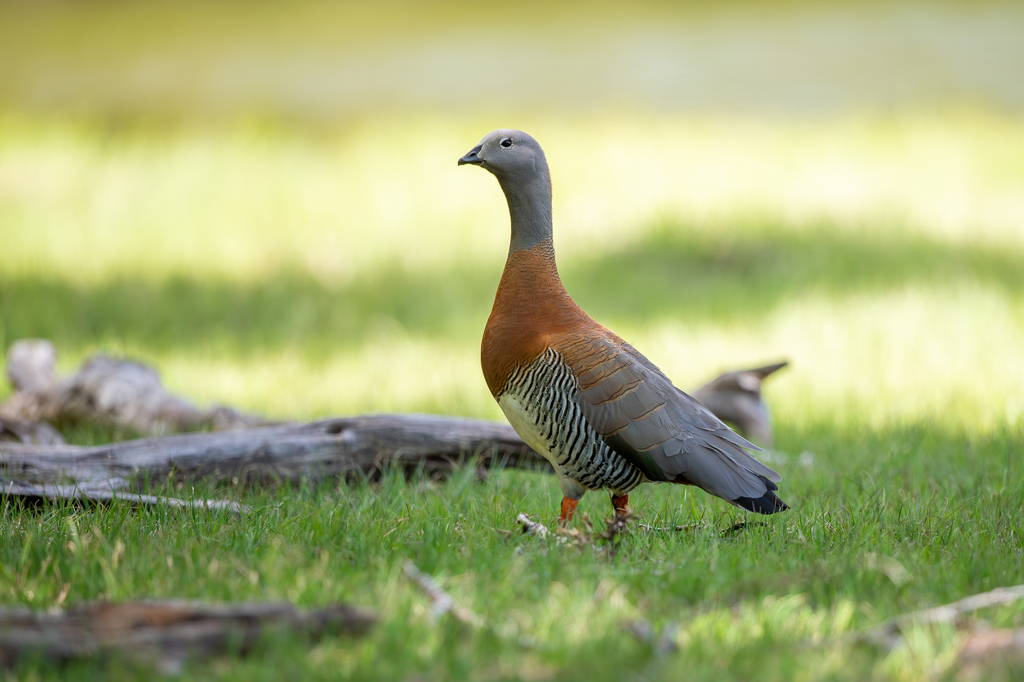
Ashy-headed Goose
Photo © miomorfo
Photo © miomorfo — CC BY 4.0 — Source: iNaturalist photo #340305488Identification
The ashy-headed goose is a medium-sized waterfowl measuring 50 to 60 cm in length, with males weighing 1.62 to 2.27 kg and females slightly lighter at 1.47 to 1.49 kg. Adults are distinctively marked with gray heads and necks contrasting sharply against chestnut upper backs and breasts featuring fine barring. The flanks display striking black and white barring, while the belly remains white. In flight, the species reveals bold white patches on the leading and trailing edges of blackish wings, along with a metallic green speculum. The bill is black, and the legs and feet are orange with black markings. Both sexes share identical plumage patterns. Juveniles appear duller in their rufous areas with stronger back and breast barring and a dark brownish speculum, making them distinguishable from adults.
Range & Habitat
This South American species is endemic to the southern cone region, ranging from central Chile and Buenos Aires Province in Argentina southward through Tierra del Fuego. Vagrant sightings occur on the Falkland Islands, where the species has also successfully bred. The ashy-headed goose shows distinct seasonal habitat preferences: during summer it primarily occupies clearings in damp forests of southern beech around lakes, marshes, inland islands, coastal areas, and higher ground. In winter, the species shifts to favoring open meadows and pastures.
Behaviour & Diet
The ashy-headed goose is almost entirely vegetarian. Winter diet studies conducted in Argentina documented the species feeding extensively in harvested agricultural fields, particularly of wheat, maize, sunflower, and sorghum. During the austral summer in Tierra del Fuego, the diet shifts to leaves and fleshy fruits, with red crowberry being the dominant fruit consumed. The breeding season extends from October or November through March in some areas. Nesting occurs singly or in small loose groups, with nests placed in tree hollows, on stumps, or in long grass and lined with down. Clutch sizes typically range from four to six eggs, and males attentively guard females throughout the approximately 30-day incubation period. Males produce soft, wigeon-like whistles while females make harsh cackling notes, allowing auditory species identification in the field.
Best Time & Places to See It
The ashy-headed goose can be found year-round across its range, though populations shift seasonally. The breeding season from October to March offers opportunities to observe nesting birds in southern Chile and Argentina, particularly around Tierra del Fuego's beech forests, lakes, and marshes. Winter months (May to August) provide excellent viewing possibilities on the Argentinian Pampas and in northern Chilean regions, where concentrations may reach as many as 150,000 birds in northeastern Argentina. The species remains relatively undisturbed at breeding grounds but may be wary in winter agricultural areas where it faces persecution from farmers.
Photography Tips
The ashy-headed goose's striking plumage makes it photogenic in varied lighting conditions. The contrast between gray heads and chestnut breasts provides excellent subject definition. In-flight photography rewards patient photographers, revealing the bold white wing patches and metallic green speculum that are diagnostic features. Winter habitat on open pampas offers fewer concealment opportunities, requiring careful approach techniques. The species' tendency to nest in loose groups during breeding season may provide opportunities for compositional shots showing multiple individuals. Listening for the distinctive male whistles and female cackling helps locate birds in denser vegetation or at greater distances.
Sea Lion Island
Sealion Island Settlement, Falkland Islands
+74 birds+3 mammals
Windswept tussock grasslands roll across volcanic terrain where Southern Ocean swells crash against rocky shores, creating one of the Falkland Islands' most dramatic wildlife theatres. This…
VIEW ISLAND & ARCHIPELAGOVolunteer Point
Stanley, Falkland Islands
+70 birds+3 mammals
Windswept grasslands meet volcanic black sand beaches where three penguin species converge in the South Atlantic's most theatrical wildlife theatre. This remote peninsula on East Falkland…
VIEW NATURE RESERVECabo de Hornos National Park
Cape Horn, Chile
+88 birds+9 mammals
Where the Andes plunge into the Southern Ocean and the Drake Passage churns between two continents, Cabo de Hornos National Park sprawls across one of Earth's…
VIEW NATIONAL PARKCorcovado National Park
Chaitén, Chile
+39 birds+1 mammals
Where temperate rainforest meets the raw Pacific coastline of Chilean Patagonia, Corcovado National Park sprawls across 6,585 square kilometres of some of South America's most pristine…
VIEW NATIONAL PARKTorres del Paine National Park
Torres del Paine, Chile
+143 birds+10 mammals
Where granite spires pierce the Patagonian sky, Torres del Paine commands one of South America's most dramatic landscapes. Across 4,106 square kilometres of southern Chile, jagged…
VIEW NATIONAL PARKLaja National Park Lagoon
Antuco, Chile
+123 birds+1 mammals
Where the Andes descend into the Biobío Region's temperate forests, a vast lagoon fills the caldera of the extinct Antuco volcano, cradled by steep native woodland…
VIEW NATIONAL PARKPuyehue National Park
Puyehue, Chile
+110 birds+4 mammals
Across the volcanic spine of the Los Lagos Region, where the Andes descend toward temperate rainforest, Puyehue National Park encompasses nearly 2,600 square kilometers of one…
VIEW NATIONAL PARKVicente Pérez Rosales National Park
Puerto Varas, Chile
+109 birds+8 mammals
Where the Andes descend toward the temperate rainforests of Chile's Lake District, nearly 4,641 square kilometers of pristine wilderness unfolds across Vicente Pérez Rosales National Park.…
VIEW NATIONAL PARKCerro Castillo National Park
Coyhaique, Chile
+89 birds+3 mammals
Granite peaks and windswept steppe converge across this vast Patagonian landscape, where the Andes' eastern flank drops into terrain sculpted by ice age glaciers and relentless…
VIEW NATIONAL PARKPatagonia National Park
Cochrane, Chile
+133 birds+8 mammals
Where the Andes meet the Patagonian steppe, vast grasslands and shrublands sweep across rolling terrain carved by ancient glaciation, their contours softened by distance and dramatic…
VIEW NATIONAL PARKReserva Nacional Magallanes
Punta Arenas, Chile
+78 birds+2 mammals
Where windswept steppe meets sub-Antarctic forest near the southern tip of continental South America, Reserva Nacional Magallanes unfolds across roughly 352 square kilometres of profound ecological…
VIEW NATIONAL PARKParque Provincial Península de Magallanes
Argentina
+125 birds+4 mammals
Granite peaks and windswept steppe converge across this 415-square-kilometre peninsula jutting into the cold Atlantic waters of southern Patagonia, where the Magallanes landscape embodies the raw,…
VIEW NATIONAL PARKParque Municipal Llao Llao
San Carlos de Bariloche, Argentina
+73 birds+1 mammals
Where the Andes meet the Patagonian lakes, granite peaks rise above temperate rainforest in a landscape of startling contrasts. Parque Municipal Llao Llao, sprawling across 23…
VIEW NATIONAL PARKMonte León National Park
Argentina
+100 birds+4 mammals
Where the Patagonian steppe meets the Atlantic, Monte León National Park protects a landscape of windswept coastal cliffs, rocky outcrops, and semi-arid grassland spanning over 1,200…
VIEW NATIONAL PARKLos Glaciares National Park
Argentina
+121 birds+3 mammals
Where granite peaks and sprawling ice fields dominate the landscape, Los Glaciares National Park encompasses over ten thousand square kilometres of Patagonian wilderness in southern Argentina.…
VIEW NATIONAL PARKPerito Moreno National Park
Argentina
+78 birds
Where the Patagonian steppe descends into a landscape carved by ancient ice, Perito Moreno National Park sprawls across nearly 1,590 square kilometres of some of South…
VIEW NATIONAL PARKNahuel Huapi National Park
Argentina
+124 birds+11 mammals
Where the Andes descend toward Patagonia, vast glacial lakes cut through a landscape of southern beech forest and granite peaks, creating one of South America's most…
VIEW NATIONAL PARKLanín National Park
Argentina
+128 birds+7 mammals
Where the volcanic spine of the Andes plunges into Patagonian steppe, Lanín National Park sprawls across nearly 4,700 square kilometers of one of Argentina's most visually…
VIEW NATIONAL PARKLago Puelo National Park
Argentina
+109 birds+1 mammals
Where temperate forests descend to crystalline waters in the foothills of the Andes, Lago Puelo National Park sprawls across nearly 300 square kilometers of pristine wilderness…
VIEW NATIONAL PARKLos Alerces National Park
Argentina
+84 birds+3 mammals
Where the temperate rainforests of southern Patagonia sweep down towards crystalline lakes, Los Alerces National Park unfolds across nearly 3,000 square kilometres of one of South…
VIEW NATIONAL PARKNo community photos yet. Log in to add the first one.
No community observations of this species yet.