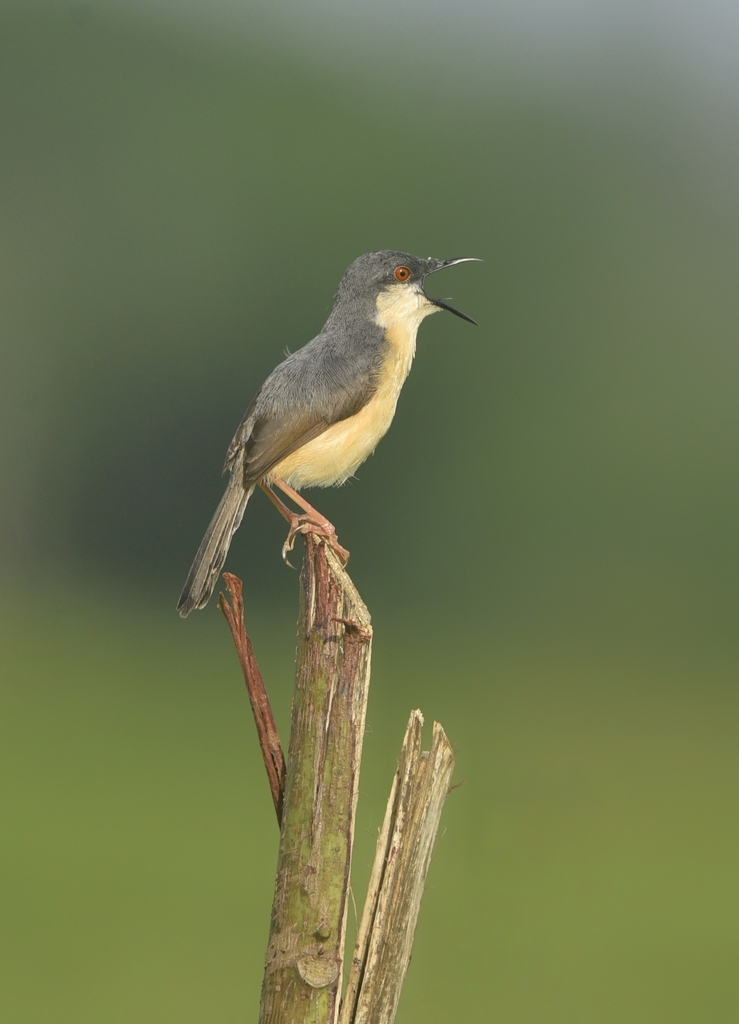
Ashy Prinia
Photo © Afsar Nayakkan
Photo © Afsar Nayakkan — CC BY 4.0 — Source: iNaturalist photo #323268843Identification
The Ashy Prinia is a small warbler, measuring 13–14 cm in length, with distinctive features that make it easy to identify in the field. It has short rounded wings, a longish graduated cream tail tipped with black subterminal spots, and characteristically holds its tail upright. The bird has strong legs adapted for clambering and hopping on the ground, and a short black bill. The crown is grey and the underparts are rufous in most plumages.
Northern populations show seasonal variation: in breeding plumage, adults are ash grey above with a black crown and cheek, coppery brown wings, and no supercilium; in non-breeding season, they develop a short white supercilium and a longer tail with warm brown upperparts. Southern and eastern populations retain their summer plumage year-round. The Sri Lankan endemic race is notably shorter-tailed, and juveniles in that population have yellowish underparts.
Range & Habitat
This resident breeder is found across most of the Indian subcontinent, including India, Nepal, Bangladesh, eastern Pakistan, Bhutan, Sri Lanka, and western Myanmar. The northern limits extend along the Himalayan foothills into the upper Indus river system, while the species is absent from the dry desert zones of western India. It is a common bird in urban gardens and farmlands throughout much of its range.
The Ashy Prinia favours dry open grassland, open woodland, scrub, and home gardens in cities. In Sri Lanka, populations are found mainly in the lowlands but range up into the hills to approximately 1600 m elevation.
Behaviour & Diet
Like most warblers, the Ashy Prinia is insectivorous. The bird is most easily distinguished by the loud snapping noise it produces during flight, likely caused by the beating of its wings against its constantly wagging tail. Its song is a repetitive tchup, tchup, tchup or zeet-zeet-zeet, with another call being a nasal tee-tee-tee. During fluttery display flights, males sing from the top of bushes with the tail held upright.
The Ashy Prinia exhibits the rare trait of biannual moult among passerines, with moults occurring in spring (April to May) and autumn (October to November). Birds remain in pairs but roost singly on branches of small trees or shrubs, moving through shrubbery and often visiting the ground.
Best Time & Places to See It
The Ashy Prinia is a common and resident bird, making it accessible year-round throughout its range. However, breeding season timing varies by location: in northern India, it occurs mainly from June to September; in Sri Lanka, primarily December to March or August to October; and in the Nilgiris, mainly May to June. Visit urban gardens, farmlands, scrubby areas, and open grasslands where the bird is most active and vocal.
Photography Tips
Photograph this species in open grasslands and gardens where it moves actively through low vegetation. The bird's upright tail and small size make it distinctive, but patience is essential as it often stays low in shrubbery. Early morning during breeding season offers the best opportunities, as males are vocal and make conspicuous fluttery display flights from exposed perches.
The loud snapping sounds during flight provide audio cues to locate the bird. Look for its characteristic tail-up posture and ground-hopping behaviour. In urban gardens, the bird is particularly accessible, offering chances to capture its grey crown, rufous underparts, and distinctive tail features.
Kanha Tiger Reserve
Minneriya National Park
Bandhavgarh National Park
Bandipur National Park
Banke National Park
Bardiya National Park
Chitwan National Park
Eravikulam National Park
Gir National Park
Nothing matches these filters.
No community photos yet. Log in to add the first one.
No community observations of this species yet.