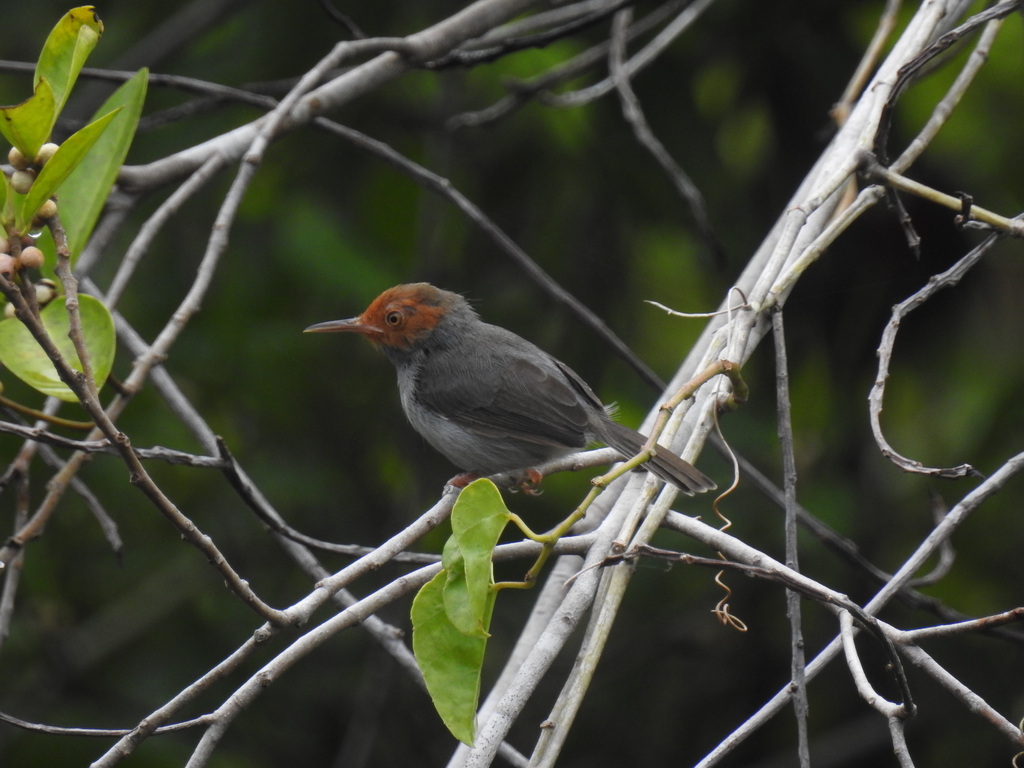
Ashy Tailorbird
Photo © Fajar Alfitrian
Photo © Fajar Alfitrian — CC0 1.0 — Source: iNaturalist #251984993Identification
The ashy tailorbird is a diminutive songbird, measuring just 7 cm in length and weighing around 12 g, making it easy to overlook in dense forest. The most distinctive feature is the long, slightly decurved bill, which is bark brown above and horn-coloured below. Sexual dimorphism is evident: males display a striking rufous-chestnut face, chin, and forecrown contrasting with an ashy grey back and upper wings. The throat is grey, gradually lightening through the breast to almost white on the belly, with a lighter grey tail. Females are more subdued, retaining the grey upperparts but with a white chin and throat, pale grey wash across the breast, and overall paler plumage. Juveniles lack the red facial markings and show olive-green upperparts instead. Subspecific variation occurs in head redness and back colouration across the range.
Range & Habitat
This Southeast Asian species has a wide but patchy distribution, ranging from southern Myanmar and southern Thailand through the Malay Peninsula and Singapore, and widely across the Greater Sunda Islands including Borneo, Sumatra, and Java. An isolated population persists in southern Vietnam and Cambodia, and the species reaches the Philippine island of Mapun near Borneo. The ashy tailorbird typically inhabits lowland forests close to the coast but has been recorded at elevations up to 900 m on Sumatra and Borneo. It occupies diverse forested habitats including mangrove forest, secondary forest, swamp forest, and scrubland, while on inshore and offshore islands it favours more open habitats.
Behaviour & Diet
Characteristically social, the ashy tailorbird forages in pairs and small family groups, working through both the forest canopy and undergrowth as well as forest edges. It is strictly insectivorous, taking ants, caterpillars, flies, and beetles. Like other tailorbirds, this species is a skilled architect, stitching together the two sides of a large leaf by pushing holes through the edges and binding them with plant fibres or spider silk to create a secure nest. Nesting sites are positioned low, typically no more than 1 m above the ground. Clutches contain two to three eggs. The species falls prey to at least the plaintive cuckoo as a brood parasite, and likely other cuckoo species also parasitize it.
Best Time & Places to See It
The ashy tailorbird's wide distribution and adaptability make it a realistic target for birders across much of Southeast Asia, particularly in lowland forested areas from Myanmar and Thailand through Malaysia and the Sunda Islands. Look in mangrove forests, secondary growth, and forest edges where pairs forage actively in vegetation at all levels. The species has proved remarkably adaptable to habitat conversion, and is among the more common birds found in palm oil plantations, offering alternative viewing opportunities where native forest access is limited. Patient observation of low vegetation and forest canopy will reward visitors with sightings of this active, vocal songbird.
Photography Tips
The ashy tailorbird's small size and active, restless behaviour demand patience and a fast shutter speed. Work with telephoto lenses (at least 300 mm equivalent) to maintain distance and avoid flushing foraging pairs. Early morning light through the canopy will illuminate the male's rufous facial markings beautifully, though the species' habit of foraging in dense vegetation often limits photographic opportunities. Focus on the distinctive long, decurved bill and the contrasting plumage to distinguish it from similar small passerines. Shooting in open secondary forest and at forest edges offers better conditions than dense primary forest, and palm plantations provide surprisingly accessible subjects given the species' adaptation to these habitats.
Gunung Mulu National Park
Hat Noppharat Thara-Mu Ko Phi Phi National Park
Kerinci Seblat National Park
Kuching Wetlands National Park
Penang National Park
Sembilang National Park
Taman Nasional Baluran
Taman Negara Bukit Lambir National Park
Taman Negara National Park
Nothing matches these filters.
No community photos yet. Log in to add the first one.
No community observations of this species yet.