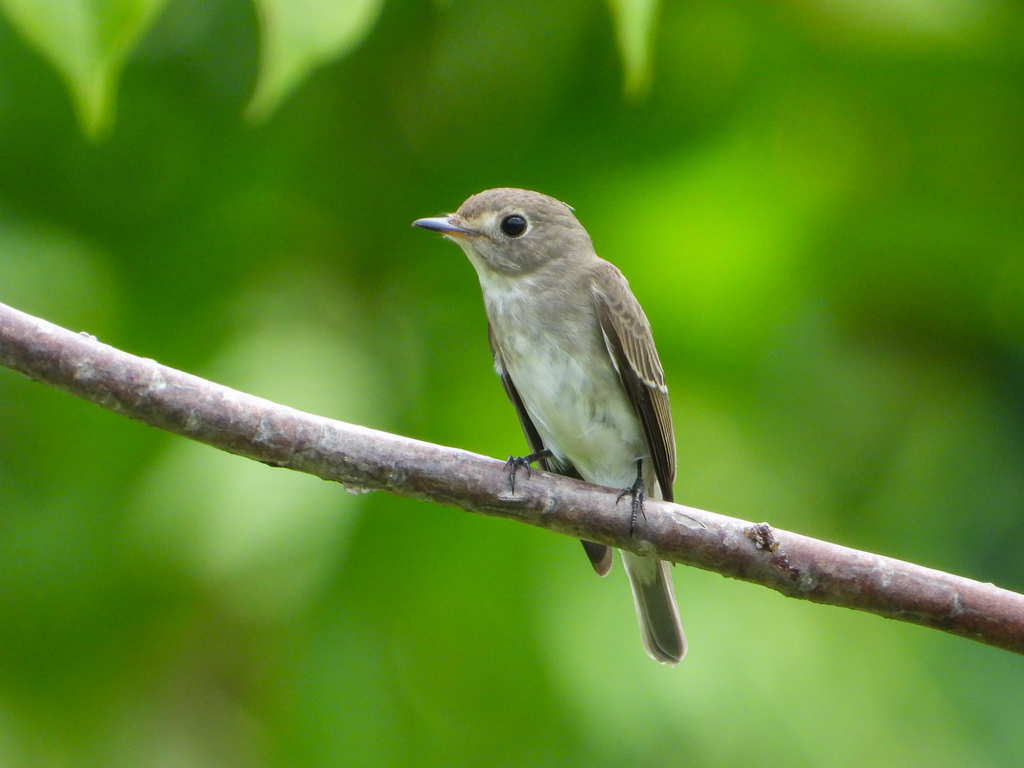
Asian Brown Flycatcher
Photo © James M. Maley
Photo © James M. Maley — CC BY 4.0 — Source: iNaturalist photo #432631440Identification
The Asian brown flycatcher is a small passerine measuring just 13 cm in length, including its characteristically cocked tail. It shares a similar body shape with the larger spotted flycatcher but is notably longer-tailed in proportion. The most distinctive feature is its relatively large, broad-based dark bill—an adaptation perfectly suited to its insectivorous lifestyle. Adults display grey-brown upperparts that gradually become greyer as their plumage ages, contrasting with whitish underparts and brown-tinged flanks. Younger birds are quite different in appearance, sporting scaly brown upperparts, head, and breast that help distinguish them from adults in the field.
Range & Habitat
This insectivorous species breeds across a broad swathe of Asia, from Japan and eastern Siberia south to the Himalayas. The common name references Dauria, an area of south-eastern Siberia named after a local nomadic tribe. True to its migratory nature, the Asian brown flycatcher abandons its breeding grounds each winter, migrating to tropical southern Asia where it is found from southern India and Sri Lanka eastward to Indonesia. Within its range, it favours open woodland and cultivated areas, making it a relatively common sight across suitable habitat.
Behaviour & Diet
As its name suggests, this species feeds exclusively on insects, sallying out from perches to snatch prey from the air with its broad-based bill. During the breeding season, males perform simple melodic songs as part of their courtship displays. The species nests in tree cavities, with females undertaking the incubation of clutches of four eggs. Like many wild birds, Asian brown flycatchers are parasitised by chewing lice, specifically the species Philopterus davuricae.
Best Time & Places to See It
The best opportunity to observe this species is within its breeding range during the spring and summer months in Japan, eastern Siberia, and the Himalayas, or in its wintering grounds across tropical southern Asia from autumn through early spring. Travellers should focus on open woodland and cultivated areas where the species is most commonly found. In Europe, sightings are extraordinarily rare, with only a handful of confirmed records from Britain, Denmark, and Sweden, making any sighting an exceptional event for local birdwatchers.
Photography Tips
Photographing Asian brown flycatchers requires patience and attention to subtle plumage details. Focus on capturing the distinctive large, broad-based bill and the cocked tail position that characterises the species. The contrast between grey-brown upperparts and whitish underparts should be clearly rendered, and photographers should take care to distinguish adults from younger birds with their scaly brown plumage. As an active insectivore, the species is often in motion; fast shutter speeds will help freeze its aerial feeding behaviour and characteristic perch-hunting technique.
Kanha Tiger Reserve
Minneriya National Park
Alaska Maritime National Wildlife Refuge
Baikal National Park
Bako National Park
Bandhavgarh National Park
Bandipur National Park
Bardiya National Park
Chitwan National Park
Nothing matches these filters.
No community photos yet. Log in to add the first one.
No community observations of this species yet.