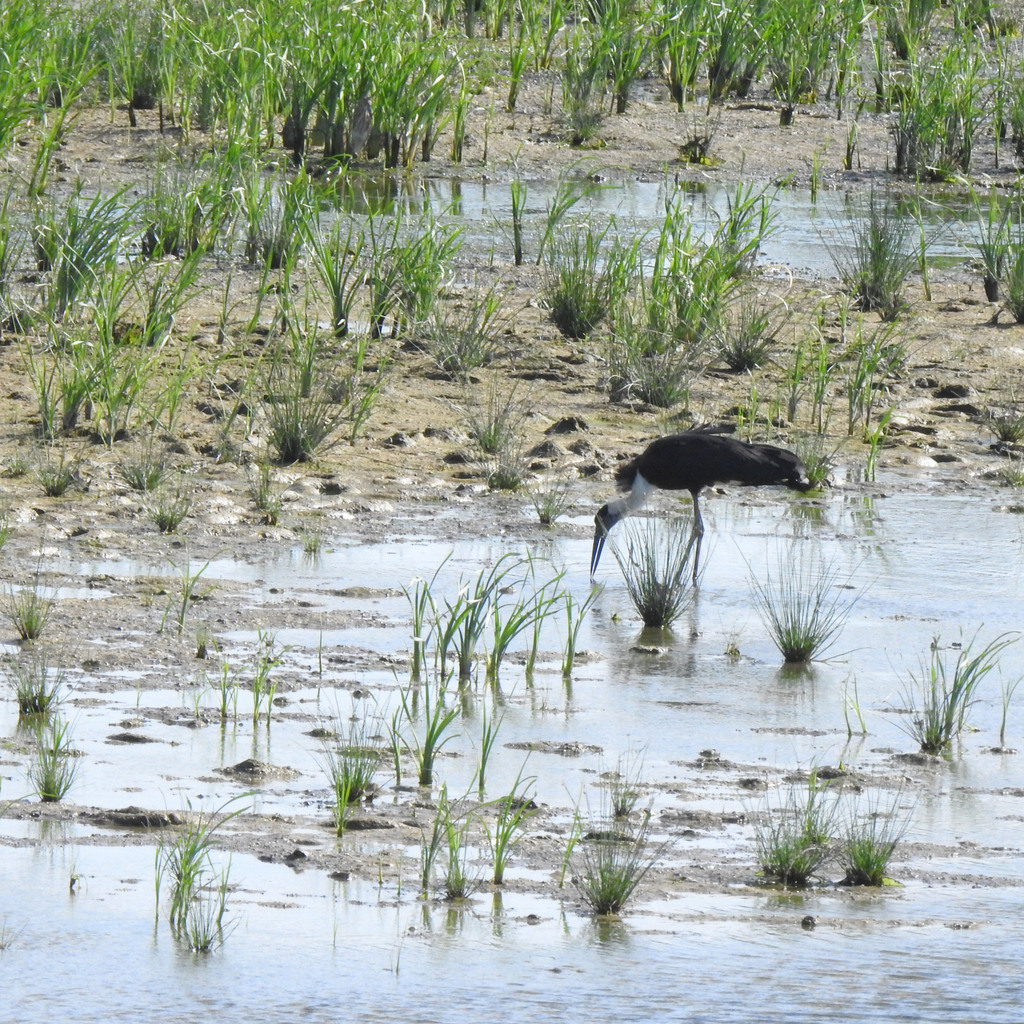
Asian Woolly-necked Stork
Photo © Paulmathi Vinod
Photo © Paulmathi Vinod — CC BY 4.0 — Source: iNaturalist #104638905Identification
The Asian woolly-necked stork is a medium-sized stork, standing 75–92 cm tall, with striking plumage that makes it unmistakable in the field. Its most distinctive feature is the downy white neck that gives the species its name, contrasting sharply with its otherwise glistening black body and black "skull cap". The lower belly and under-tail coverts are white, creating a bold two-tone appearance. The bird has deep crimson or wine-red eyes, long red legs, and a heavy blackish bill, though some individuals display dark-red bills with only the basal third black. In flight, look for the deeply forked white tail, usually concealed by black under-tail coverts. An extraordinary feature visible at close range is a narrow band of brilliant, unfeathered skin along the underside of the forearm—described as "neon orange-red" or "almost glowing"—revealed when the wings open during displays or flight. Juveniles are duller overall with a feathered forehead, sometimes streaked black-and-white, and fluffier neck feathers. Newly fledged young show a prominent white forehead mark. Males are thought to be slightly larger than females, but the sexes are otherwise identical.
Range & Habitat
This widespread tropical species breeds across Asia from India through Indochina, the Philippines, and the Malay Peninsula to Indonesia, with two recognised subspecies. The Asian woolly-necked stork is highly adaptable, occupying marshes within forests, agricultural areas, and freshwater wetlands. It nests in trees on agricultural fields and wetlands, on natural cliffs, and even on cell phone towers. The birds favour a diverse range of habitats including seasonal and perennial reservoirs, marshes, crop lands, irrigation canals, and rivers, though they are most commonly encountered in agricultural landscapes and wetlands outside protected areas.
In India, they prefer fallow fields during summer and monsoon seasons, shifting to natural freshwater wetlands in winter, and using irrigation canals when water levels drop. The species shows remarkable ecological flexibility, even visiting forest clearings with grassy and marshy areas in south-east Asia. Notably, the birds are attracted to fires in grasslands and crop fields, where they capture insects fleeing the flames. With the construction of new irrigation infrastructure, the species is expanding its range into increasingly arid regions, including the Thar Desert in Rajasthan.
Behaviour & Diet
Asian woolly-necked storks breed singly or in small loose colonies, building their nests in trees positioned along agricultural fields, wetlands, and irrigation canals. The species is a resident breeder across its range. During breeding displays, the bird erects the elongated, iridescent coppery-purple feathers on its fore-neck, creating an impressive visual signal. These storks are primarily insectivorous, particularly attracted to grassland and crop field fires where they can easily capture insects attempting to escape the flames. They also hunt in wetland habitats, and in coastal areas such as Sulawesi, they have been observed feeding on sea snakes, demonstrating their dietary opportunism and hunting prowess.
Best Time & Places to See It
The Asian woolly-necked stork is a resident breeder, present year-round across its Asian range, making it potentially viewable in any season. However, seasonal habitat use patterns suggest that birders should target freshwater wetlands during winter months when birds concentrate around reliable water sources, and agricultural areas with fallow fields during the summer and monsoon seasons. The species is widespread in agricultural landscapes across south Asia and Myanmar, where it is more frequently encountered outside protected areas. In India, the birds are particularly common in north Indian agroforestry landscapes, especially in Haryana, where they nest in trees bordering crop fields and irrigation canals. Watching grassland and crop field fires (where safe to do so) can provide excellent viewing opportunities, as storks gather in significant numbers to feed on displaced insects.
Photography Tips
The Asian woolly-necked stork's bold black-and-white plumage and distinctive features offer excellent photographic opportunities. The striking contrast between the glistening black back and white neck, belly, and forked tail creates strong compositional possibilities. To capture the bird's most spectacular feature—the vivid orange-red underwing skin—photograph birds in flight as they display with wings fully open, ideally with backlighting to enhance the luminous quality of the unfeathered skin band. The deep crimson eyes and red legs provide colour accents that stand out against the dark plumage. During breeding season, capture display sequences showing the erected coppery-purple fore-neck feathers. Early morning or late afternoon light will best reveal the iridescent qualities of the plumage. In agricultural landscapes, position yourself near irrigation canals, fallow fields, or burning grasslands where birds congregate in predictable locations, improving your chances of obtaining sharp, well-composed images.
Mapungubwe National Park
Musina Local Municipality, South Africa
+358 birds+29 mammals
Where the Limpopo River cuts through sandstone ridges at the convergence of South Africa, Botswana, and Zimbabwe, Mapungubwe National Park preserves a landscape of profound ecological…
VIEW NATIONAL PARKChobe National Park
Botswana
+446 birds+45 mammals
Where the Chobe River cuts a sinuous path through northern Botswana, the landscape transforms into one of Africa's most dynamic wetland-savanna mosaics. This national park encompasses…
VIEW NATIONAL PARKKhaudum National Park
Botswana
+213 birds+13 mammals
Where the Okavango's northern tributaries meander through miombo woodland and riverine forest, Khaudum National Park unfolds across a landscape of profound ecological richness and isolation. This…
VIEW NATIONAL PARKLunugamvehera National Park
Sri Lanka
+204 birds+14 mammals
Dry scrubland and shallow wetlands converge in Sri Lanka's southeastern lowlands, where Lunugamvehera National Park anchors one of the island's most ecologically vital landscapes. The park's…
VIEW NATIONAL PARKMinneriya National Park
Sri Lanka
+158 birds+9 mammals
Across the dry zone of Sri Lanka's North Central Province spreads a landscape of shallow tanks, grassland margins, and scattered dry forest—a mosaic of water and…
VIEW NATIONAL PARKWasgamuwa National Park
Sri Lanka
+156 birds+8 mammals
Dry deciduous forest and open grassland sweep across the North Central lowlands where Wasgamuwa National Park protects one of Sri Lanka's largest remaining tracts of this…
VIEW NATIONAL PARKAngamedilla National Park
Polonnaruwa, Sri Lanka
+40 birds+2 mammals
Ancient tanks and sal forests define this water-rich sanctuary in Sri Lanka's North Central heartland, where seasonal wetlands and dry deciduous woodland create a mosaic of…
VIEW NATIONAL PARKMaduru Oya National Park
Sri Lanka
+74 birds+1 mammals
Granite ridges rise abruptly from the humid lowlands of Sri Lanka's Uva Province, their weathered slopes clothed in dry monsoon forest and scattered woodland where deciduous…
VIEW NATIONAL PARKTsavo East National Park
Athi ward, Kenya
+468 birds+50 mammals
Across the semi-arid lowlands of southeastern Kenya, where acacia woodland fragments into scrubland and the landscape rolls toward the Indian Ocean horizon, lies one of Africa's…
VIEW NATIONAL PARKTsavo West National Park
Mwatate, Kenya
+513 birds+49 mammals
Where volcanic ridges and weathered lava flows meet the semi-arid lowlands of south-central Kenya, Tsavo West National Park unfolds across a landscape sculpted by fire and…
VIEW NATIONAL PARKOrang National Park
Rangagarapathar, India
+298 birds+1 mammals
Where the Brahmaputra's floodplains meet the foothills of Assam, Orang National Park unfolds across a mosaic of riverine grasslands, forests and wetlands that pulse with the…
VIEW NATIONAL PARKValmiki National Park
Ramnagar, India
+66 birds+6 mammals
Along Bihar's western frontier, where the Gandak River winds through subtropical forest and grassland, Valmiki National Park sprawls across terrain shaped by monsoon rains and seasonal…
VIEW NATIONAL PARKRanthambhore National Park
Sawai Madhopur, India
+294 birds+20 mammals
Granite ridges and ravines carved through the Aravalli Range frame this protected landscape in eastern Rajasthan, where deciduous forest mingles with open scrubland and seasonal water…
VIEW NATIONAL PARKKruger National Park
Ba-Phalaborwa Local Municipality, South Africa
+540 birds+91 mammals
Across the low-lying savanna of northeastern South Africa unfolds one of Africa's largest and most ecologically intact protected areas, where acacia woodlands merge into mopane scrub…
VIEW NATIONAL PARKIthala Game Reserve
uPhongolo Local Municipality, South Africa
+328 birds+26 mammals
Rolling thornbush savanna and acacia woodland dominate the landscape of this 494-square-kilometre national park in KwaZulu-Natal's uPhongolo Local Municipality, where granite outcrops punctuate grassland plateaus and…
VIEW NATIONAL PARKKanha Tiger Reserve
Kanha Kisli F.V., India
+321 birds+23 mammals
Where sal forests give way to emerald meadows and crystalline streams carve through ancient valleys, one of India's finest wilderness reserves unfolds across the Maikal Range.…
VIEW NATIONAL PARKTadoba National Park
Palasgaon Singru, India
+270 birds+20 mammals
Where sal forests meet open grasslands and rocky outcrops rise from red laterite soil, central India's landscape unfolds in raw, untamed beauty. Ancient teak woodlands and…
VIEW NATIONAL PARKBandhavgarh National Park
Garhpuri, India
+285 birds+17 mammals
Where granite ridges rise dramatically above sal and bamboo forests, one of India's most pristine tiger reserves unfolds across the Vindhyan plateau. Ancient rock formations tower…
VIEW NATIONAL PARKPanna National Park
Badgadi Kalan, India
+271 birds+17 mammals
Where granite gorges slice through central India's Vindhyan plateau, a landscape of stark beauty unfolds across nearly six hundred square kilometers. The Ken River carves through…
VIEW NATIONAL PARKKeoladeo National Park
Shreenagar Rural, India
+326 birds+14 mammals
Where shallow wetlands shimmer beneath vast Rajasthani skies, one of Asia's finest bird sanctuaries pulses with extraordinary life. This former maharaja's hunting reserve, now spanning 29…
VIEW NATIONAL PARKPeriyar National Park
Mlappara, India
+232 birds+4 mammals
Dawn breaks over mist-shrouded ridges where the Western Ghats tumble toward Kerala's spice-scented lowlands. Here, ancient tropical forests envelope a glittering artificial lake, creating a mosaic…
VIEW NATIONAL PARKPampadum Shola National Park
Vattavada, India
+258 birds+14 mammals
Where misty shola forests cling to the high plateaus of the Nilgiri Mountains, ancient evergreen remnants create a world apart. This 2,316-hectare reserve protects one of…
VIEW NATIONAL PARKKhaudum National Park
Namibia
+221 birds+13 mammals
Where the Kavango River flows through northeastern Namibia, vast miombo woodlands and riverine forests create one of southern Africa's most remote and biodiverse wilderness corridors. Khaudum…
VIEW NATIONAL PARKBwabwata National Park
Namibia
+377 birds+35 mammals
Where the Kavango River winds through northeastern Namibia, vast floodplains and dense riparian woodland create one of southern Africa's most ecologically dynamic protected landscapes. Spanning 14,249…
VIEW NATIONAL PARKEtosha National Park
Namibia
+356 birds+58 mammals
Across northern Namibia's stark semi-arid plateau, a vast shallow depression transforms seasonally into one of Africa's most dramatic wildlife theaters. Etosha National Park, encompassing more than…
VIEW NATIONAL PARKWest Bali National Park
Gerokgak, Indonesia
+240 birds+8 mammals
Across West Bali's northwestern reaches, where the Indian Ocean meets volcanic slopes and limestone cliffs plunge toward turquoise shallows, sprawls a protected realm of roughly 325…
VIEW NATIONAL PARKNairobi National Park
Nairobi, Kenya
+515 birds+35 mammals
Just minutes from Kenya's capital, where the Nairobi River winds through acacia woodland and open grassland, lies one of Africa's most paradoxical wildlife sanctuaries. The park's…
VIEW NATIONAL PARKLake Nakuru National Park
Nakuru West, Kenya
+494 birds+32 mammals
Alkaline waters ringed by acacia woodland and grassland create one of East Africa's most distinctive wetland ecosystems, where the interplay of geology and climate sustains a…
VIEW NATIONAL PARKMeru National Park
Igembe Central, Kenya
+408 birds+38 mammals
Granite outcrops and acacia woodland rise across the northern reaches of Meru, where semi-arid savanna transitions into drier scrubland under the fierce equatorial sun. The park's…
VIEW NATIONAL PARKArabuko Sokoke Forest Reserve
Kilifi, Kenya
+383 birds+29 mammals
Coastal forest rises from the Indian Ocean plains of Kilifi County, where sandy soils and seasonal rainfall have sculpted a woodland ecosystem unlike anywhere else on…
VIEW NATURE RESERVEWatamu Marine National Park
Dabaso ward, Kenya
+328 birds+12 mammals
Where mangrove channels meet coral gardens and sandy shallows blend into the warm waters of the Indian Ocean, Watamu Marine National Park unfolds across the Kilifi…
VIEW NATIONAL PARKNo community photos yet. Log in to add the first one.
No community observations of this species yet.