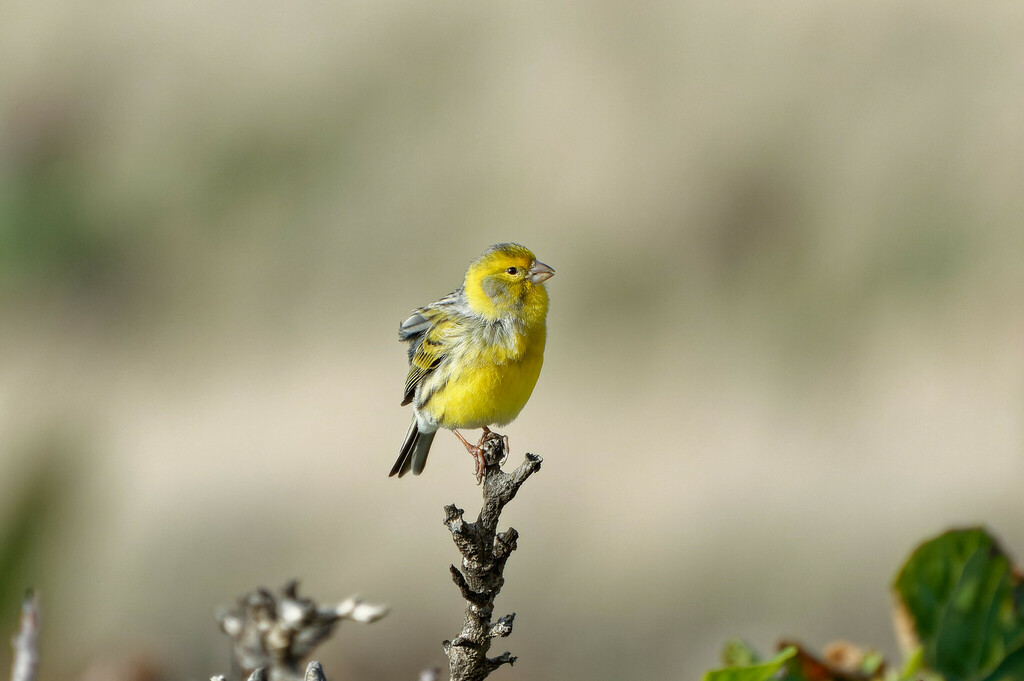
Atlantic Canary
Photo © Donald Davesne
Photo © Donald Davesne — CC BY 4.0 — Source: iNaturalist photo #256088587Identification
The Atlantic canary is a small finch measuring 10 to 12 cm in length with a wingspan of 21 to 23.7 cm. Males display a largely yellow-green head and underparts with a notably yellower forehead, face and supercilium, while the lower belly and undertail-coverts are whitish with dark streaks on the sides. The upperparts are grey-green with dark streaking and the rump is dull yellow. Females are similar but duller overall, with a greyer head and breast and less yellow underparts. Juvenile birds are largely brown with dark streaks. The species produces a silvery twittering song similar to that of the European serin and citril finch.
Range & Habitat
The Atlantic canary is endemic to the Canary Islands, Azores, and Madeira in the eastern Atlantic Ocean. In the Canary Islands, it is common on Tenerife, La Gomera, La Palma and El Hierro, but more local on Gran Canaria and rare on Lanzarote and Fuerteventura. It is common throughout Madeira and the Azores. The species occurs in diverse habitats ranging from pine and laurel forests to sand dunes, and is most abundant in semiopen areas with small trees such as orchards and copses. It readily inhabits man-made environments including parks and gardens, and can be found from sea-level to above 1,500 m in the Canary Islands.
Behaviour & Diet
The Atlantic canary is a gregarious species that often nests in groups, with each pair defending a small territory. The cup-shaped nest is built 1–6 m above ground in trees or bushes and constructed from twigs, grass, moss and other plant material lined with hair and feathers. Breeding occurs between January and July depending on location, with clutches of 3 to 4 eggs, occasionally 5, and 2–3 broods raised annually. Eggs are pale blue or blue-green with violet or reddish markings, incubated for 13–14 days, with young fledging after 14–21 days.
The Atlantic canary typically feeds in flocks, foraging on the ground or amongst low vegetation. Its diet consists mainly of seeds from weeds, grasses and figs, supplemented with other plant material and small insects.
Best Time & Places to See It
For the best chance of encountering Atlantic canaries, visit the Azores, where the species is common on all islands, or head to the Canary Islands, particularly Tenerife, La Gomera, La Palma and El Hierro where populations are well-established. Madeira, including Porto Santo and the Desertas Islands, also offers reliable sightings. The breeding season from March to June is particularly rewarding, as birds are more vocal and active during this period. Semiopen habitats with scattered trees, such as orchards and parks, offer the best viewing opportunities.
Photography Tips
The Atlantic canary's small size and active, gregarious nature present both challenges and opportunities for photographers. Search for birds in parks, gardens and orchards where they are habituated to human presence and therefore more approachable. Early morning often yields the most activity and better light for capturing the male's distinctive yellow-green plumage and bright forehead markings. Look for flocking birds on the ground or in low vegetation where they forage for seeds. During breeding season, patience near nesting territories may reward you with behavioural shots, though nests are typically well-hidden amongst foliage at heights of 3–4 m.
Teide Natural Monument
La Orotava, Spain
+41 birds+4 mammals
High on the volcanic slopes of Tenerife, where the landscape transforms from lush laurel forests into lunar terrain, the Teide Natural Monument preserves one of Spain's…
VIEW NATURE RESERVEPilancones Natural Park
Las Tederas, Spain
+30 birds
Where volcanic ridges and ravines carve through the northwestern interior of Gran Canaria, Pilancones Nature Park preserves one of the archipelago's most dramatic upland ecosystems. The…
VIEW NATURAL PARKTeide National Park
La Orotava, Spain
+83 birds+7 mammals
At nearly 3,900 metres, Spain's highest peak rises from the Canary Islands as a singular volcanic monument, its slopes sweeping through five distinct climate zones in…
VIEW NATIONAL PARKCaldera de Taburiente National Park
El Paso, Spain
+40 birds+1 mammals
Where volcanic ramparts rise nearly two kilometres above the Atlantic, Caldera de Taburiente reveals one of the Canary Islands' most dramatic geological narratives. This national park…
VIEW NATIONAL PARKGarajonay National Park
Hermigua, Spain
+68 birds+1 mammals
Laurel forests cloak the volcanic ridges of this Canarian national park, their evergreen canopy so dense that mist clings to the moss-draped branches even on cloudless…
VIEW NATIONAL PARKNo community photos yet. Log in to add the first one.
No community observations of this species yet.