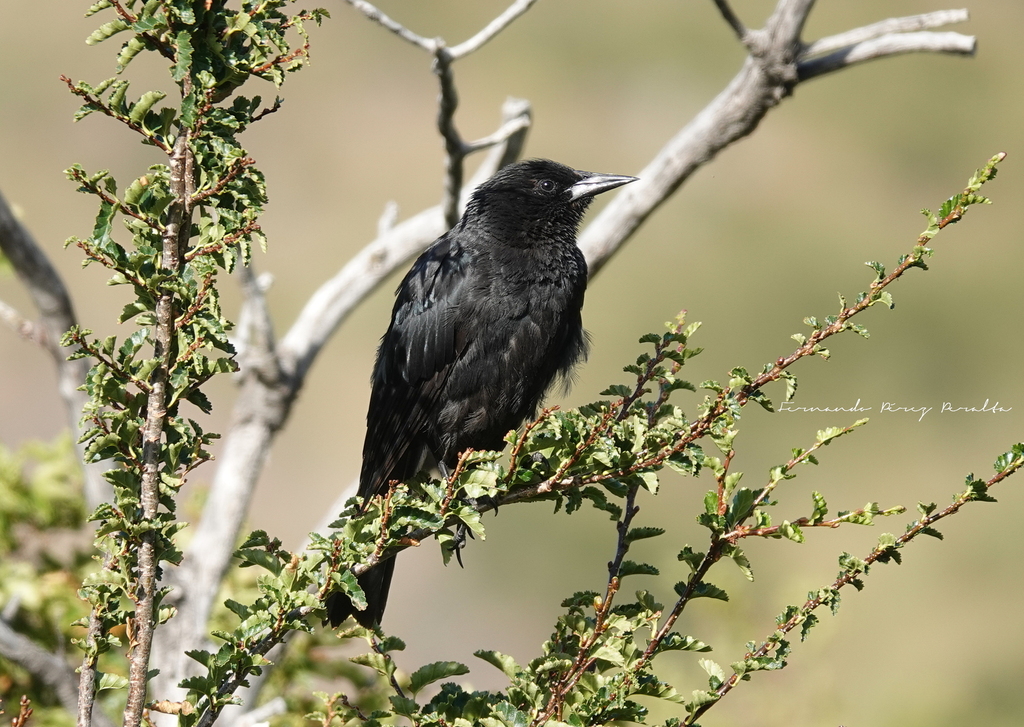
Austral Blackbird
Photo © Fernando Pérez Peralta
Photo © Fernando Pérez Peralta — CC0 1.0 — Source: iNaturalist photo #616244156Identification
The Austral Blackbird is unmistakable in its plumage: entirely black with a subtle bluish hint throughout. Look for the sharp, pointed beak and black legs. The eyes are dark black. Despite the all-black appearance, you may notice the head, chest, and wings have a slightly different texture due to missing pigmentation in these areas, giving a faintly matte quality compared to the rest of the body. When feeding on nectar, the bird's face and head become stained with yellow, creating a striking and temporary change in appearance that can aid in identification in the field.
Range & Habitat
This species is endemic to southern South America, found throughout Argentina and Chile. Birds are largely resident year-round, though some populations migrate to west-central Argentina and the Atlantic coast of Patagonia. The Austral Blackbird favors temperate forests, subtropical and tropical high-altitude shrublands, and degraded former forest areas. Look for them in woodlands, around lakeshores, beaches, rocky shores, and valley bottoms. They are commonly found in small, cohesive flocks of 6 to 20 individuals and prefer wooded settings to open land. National parks and protected areas throughout Chile and Argentina offer reliable viewing opportunities where habitat conditions support breeding and year-round residence.
Behaviour & Diet
These highly vocal birds are renowned for their varied and frequent singing and calling, often performing in small groups. They are skilled foragers with a diverse diet. They are particularly attracted to nectar and actively feed on a wide variety of flowering plants. They are omnivorous, also consuming seeds such as oats and wheat, wild fruits, and cultivated fruits including cherries and grapes. When feeding on nectar, the yellow pollen-rich liquid often coats the head and face, temporarily altering their appearance to observers.
Best Time & Places to See It
October through December marks the breeding season, when birds are most active and vocal, making this an excellent period for observation. Protected areas and national parks in Chile and Argentina, particularly those with appropriate forest and shrubland habitats, offer the best chances of encountering flocks. Early morning and late afternoon typically provide optimal viewing conditions. Search woodlands, forest edges, and rocky hillsides rather than open terrain. Small flocks are predictable in their preferred feeding and roosting areas, so patience in likely habitat patches will often yield sightings.
Photography Tips
The all-black plumage presents significant exposure challenges; meter off a mid-tone in the scene or use exposure compensation to avoid underexposure. The birds' preference for flocking means you may encounter several individuals simultaneously—use fast shutter speeds to freeze their active movements and frequent vocalizations. Capture birds while feeding on flowers, as the yellow nectar staining the face creates striking and diagnostic images. Early morning light on hillside perches will help reveal the subtle bluish sheen in the plumage. Include flowering plants or fruiting trees in composition to document their feeding behavior and the landscape they inhabit.
Chiloé National Park
Dalcahue, Chile
+122 birds+6 mammals
Temperate rainforest cloaks the Chiloé archipelago's northwestern reaches, where granite ridges thrust through dense, moisture-laden canopy and freshwater streams carve ravines toward the Pacific. Across approximately…
VIEW NATIONAL PARKAlerce Costero National Park
Corral, Chile
+34 birds
Where temperate rainforest descends to the Pacific coast in southern Chile, Alerce Costero National Park protects one of the continent's rarest and most ancient ecosystems across…
VIEW NATIONAL PARKCabo de Hornos National Park
Cape Horn, Chile
+88 birds+9 mammals
Where the Andes plunge into the Southern Ocean and the Drake Passage churns between two continents, Cabo de Hornos National Park sprawls across one of Earth's…
VIEW NATIONAL PARKCorcovado National Park
Chaitén, Chile
+39 birds+1 mammals
Where temperate rainforest meets the raw Pacific coastline of Chilean Patagonia, Corcovado National Park sprawls across 6,585 square kilometres of some of South America's most pristine…
VIEW NATIONAL PARKTorres del Paine National Park
Torres del Paine, Chile
+143 birds+10 mammals
Where granite spires pierce the Patagonian sky, Torres del Paine commands one of South America's most dramatic landscapes. Across 4,106 square kilometres of southern Chile, jagged…
VIEW NATIONAL PARKLaja National Park Lagoon
Antuco, Chile
+123 birds+1 mammals
Where the Andes descend into the Biobío Region's temperate forests, a vast lagoon fills the caldera of the extinct Antuco volcano, cradled by steep native woodland…
VIEW NATIONAL PARKPuyehue National Park
Puyehue, Chile
+110 birds+4 mammals
Across the volcanic spine of the Los Lagos Region, where the Andes descend toward temperate rainforest, Puyehue National Park encompasses nearly 2,600 square kilometers of one…
VIEW NATIONAL PARKVicente Pérez Rosales National Park
Puerto Varas, Chile
+109 birds+8 mammals
Where the Andes descend toward the temperate rainforests of Chile's Lake District, nearly 4,641 square kilometers of pristine wilderness unfolds across Vicente Pérez Rosales National Park.…
VIEW NATIONAL PARKCerro Castillo National Park
Coyhaique, Chile
+89 birds+3 mammals
Granite peaks and windswept steppe converge across this vast Patagonian landscape, where the Andes' eastern flank drops into terrain sculpted by ice age glaciers and relentless…
VIEW NATIONAL PARKPatagonia National Park
Cochrane, Chile
+133 birds+8 mammals
Where the Andes meet the Patagonian steppe, vast grasslands and shrublands sweep across rolling terrain carved by ancient glaciation, their contours softened by distance and dramatic…
VIEW NATIONAL PARKReserva Nacional Magallanes
Punta Arenas, Chile
+78 birds+2 mammals
Where windswept steppe meets sub-Antarctic forest near the southern tip of continental South America, Reserva Nacional Magallanes unfolds across roughly 352 square kilometres of profound ecological…
VIEW NATIONAL PARKParque Provincial Península de Magallanes
Argentina
+125 birds+4 mammals
Granite peaks and windswept steppe converge across this 415-square-kilometre peninsula jutting into the cold Atlantic waters of southern Patagonia, where the Magallanes landscape embodies the raw,…
VIEW NATIONAL PARKParque Municipal Llao Llao
San Carlos de Bariloche, Argentina
+73 birds+1 mammals
Where the Andes meet the Patagonian lakes, granite peaks rise above temperate rainforest in a landscape of startling contrasts. Parque Municipal Llao Llao, sprawling across 23…
VIEW NATIONAL PARKLos Glaciares National Park
Argentina
+121 birds+3 mammals
Where granite peaks and sprawling ice fields dominate the landscape, Los Glaciares National Park encompasses over ten thousand square kilometres of Patagonian wilderness in southern Argentina.…
VIEW NATIONAL PARKNahuel Huapi National Park
Argentina
+124 birds+11 mammals
Where the Andes descend toward Patagonia, vast glacial lakes cut through a landscape of southern beech forest and granite peaks, creating one of South America's most…
VIEW NATIONAL PARKLanín National Park
Argentina
+128 birds+7 mammals
Where the volcanic spine of the Andes plunges into Patagonian steppe, Lanín National Park sprawls across nearly 4,700 square kilometers of one of Argentina's most visually…
VIEW NATIONAL PARKLago Puelo National Park
Argentina
+109 birds+1 mammals
Where temperate forests descend to crystalline waters in the foothills of the Andes, Lago Puelo National Park sprawls across nearly 300 square kilometers of pristine wilderness…
VIEW NATIONAL PARKLos Alerces National Park
Argentina
+84 birds+3 mammals
Where the temperate rainforests of southern Patagonia sweep down towards crystalline lakes, Los Alerces National Park unfolds across nearly 3,000 square kilometres of one of South…
VIEW NATIONAL PARKNo community photos yet. Log in to add the first one.
No community observations of this species yet.