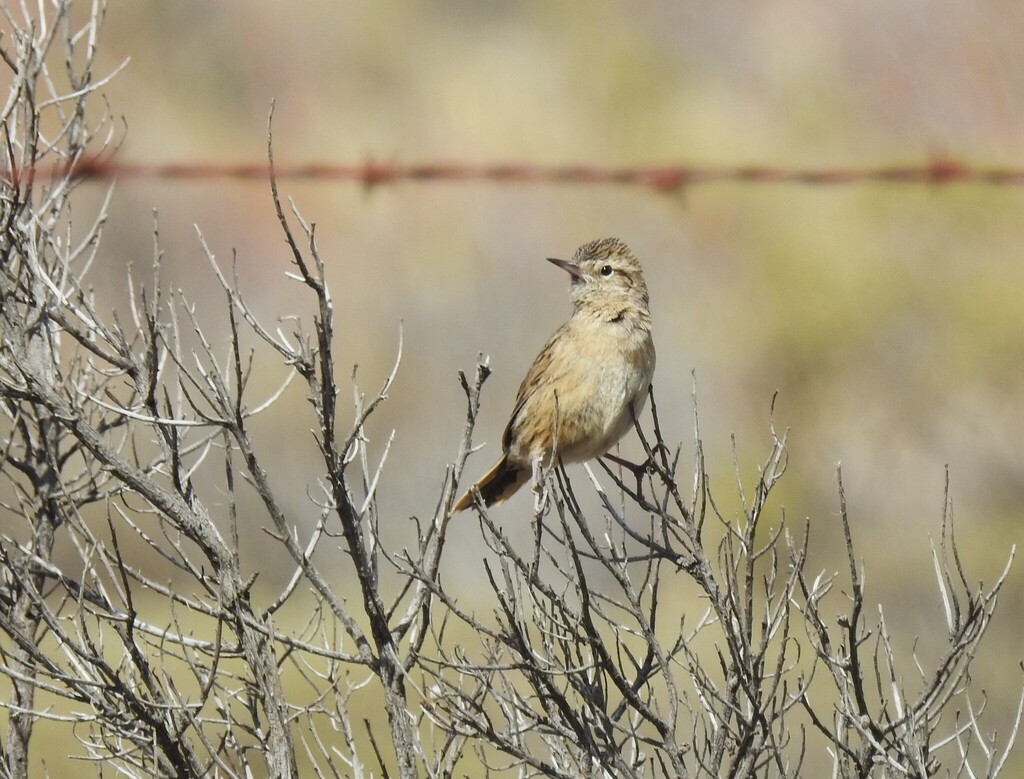
Austral Canastero
Photo © Julia Ariadna
Photo © Julia Ariadna — CC0 1.0 — Source: iNaturalist #311370289Identification
The Austral Canastero is a small passerine measuring 15.5 to 16.5 cm in length, weighing just 21 to 23 grams. It is the southernmost member of the canastero genus and belongs to a group of streaked canasteros characterized by drab, heavily marked plumage. The species has a sandy-brown crown, back, and rump with conspicuous blackish streaks, giving it a distinctly understated appearance. Its face is sandy brownish with a whitish or pale buff supercilium and dark dusky lores, while the chin is whitish, sometimes with a pale orange-rufous patch.
The throat, breast, and belly are whitish or very pale sandy brown with blackish streaks along the sides of the breast and flanks. The wings are brownish with cinnamon to brown coverts and dark flight feathers, while the tail is notably shorter than in many other canastero species. The bill is black with a whitish base to the mandible, the iris is black, and the legs are pink to dusky gray. Males and females share identical plumage, though significant individual variation occurs among birds. Juveniles display blackish-brown streaks on the breast and sides.
Range & Habitat
The Austral Canastero has a disjunct distribution across southern South America, occurring in both Chile and Argentina. In Chile, it ranges from the Coquimbo Region south through the Aysén Region, extending into southern Magallanes and Tierra del Fuego. Argentine populations are found from Neuquén Province southward through Chubut Province and into southern Santa Cruz Province and Tierra del Fuego.
The species primarily inhabits mesic shrub-steppe dominated by tallish shrubs and tussock grass, and also occurs in more open scrublands with less tussock grass and Nothofagus woodlands. It actively avoids grasslands lacking shrubs or trees. Elevationally, most birds range from sea level to approximately 200 meters, though occasional records exist up to 1,750 meters.
Behaviour & Diet
The Austral Canastero feeds exclusively on arthropods, foraging singly or in pairs by gleaning prey from the ground and shrubs, occasionally pushing into grass clumps to search for food. The northern population is at least partially migratory, with birds breeding in southern Chile and Argentina during the austral spring and summer—roughly October through February—before migrating north into central Chile after breeding, where they concentrate near the coast but are also found inland. The southern population appears to be resident year-round in southern Patagonia and Tierra del Fuego.
The species is believed to be monogamous. It constructs a distinctive globular nest made from thorny sticks with a side entrance, lined internally with soft plant material, typically placed inside or beneath a shrub. The clutch size consists of two eggs. The bird's song is a short, rising trill repeated several times with intervals of a few seconds, typically delivered from atop a small bush during morning and late afternoon hours in the breeding season. Its call is a very short metallic tick, repeated in loose series.
Best Time & Places to See It
The Austral Canastero is considered uncommon to locally common throughout its range and has been assessed as Least Concern since 2004, with a stable population across a large geographic range. The species is best sought during the austral spring and summer breeding season (October to February) in its core range throughout southern Patagonia and Tierra del Fuego, where the southern resident population is present year-round. Northern populations concentrate near the Chilean coast during non-breeding months.
Look for this species in shrub-steppe habitats and open scrublands with characteristic tussock grass and low to medium-height shrubs. Early morning and late afternoon visits to shrub-dominated areas increase the likelihood of encountering singing birds during the breeding season. The species' preference for mesic habitats with good shrub cover makes it most reliably found in well-vegetated areas rather than open grasslands.
Photography Tips
Photographing the Austral Canastero requires patience and attention to its behavior patterns. The bird sings predictably from atop small bushes during morning and late afternoon hours in the breeding season, providing predictable perching opportunities. Position yourself with good light behind or to the side of typical singing perches to capture the bird's subtle plumage details—the streaking on the crown, back, and flanks, and the pale supercilium are key identifying features worth highlighting.
The species' small size and preference for low shrub cover means that a telephoto lens is essential. Its drab coloration blends readily with sandy-brown shrub-steppe vegetation, so patience and careful scanning are required. Since the bird forages actively on the ground and in low vegetation, remain alert for movement in tussock grass and around the base of shrubs. The best photographs often come from watching a singing bird return repeatedly to favored perches, allowing you to anticipate its arrival and adjust your position and focus accordingly.
Torres del Paine National Park
Torres del Paine, Chile
+143 birds+10 mammals
Where granite spires pierce the Patagonian sky, Torres del Paine commands one of South America's most dramatic landscapes. Across 4,106 square kilometres of southern Chile, jagged…
VIEW NATIONAL PARKLaja National Park Lagoon
Antuco, Chile
+123 birds+1 mammals
Where the Andes descend into the Biobío Region's temperate forests, a vast lagoon fills the caldera of the extinct Antuco volcano, cradled by steep native woodland…
VIEW NATIONAL PARKVicente Pérez Rosales National Park
Puerto Varas, Chile
+109 birds+8 mammals
Where the Andes descend toward the temperate rainforests of Chile's Lake District, nearly 4,641 square kilometers of pristine wilderness unfolds across Vicente Pérez Rosales National Park.…
VIEW NATIONAL PARKCerro Castillo National Park
Coyhaique, Chile
+89 birds+3 mammals
Granite peaks and windswept steppe converge across this vast Patagonian landscape, where the Andes' eastern flank drops into terrain sculpted by ice age glaciers and relentless…
VIEW NATIONAL PARKPatagonia National Park
Cochrane, Chile
+133 birds+8 mammals
Where the Andes meet the Patagonian steppe, vast grasslands and shrublands sweep across rolling terrain carved by ancient glaciation, their contours softened by distance and dramatic…
VIEW NATIONAL PARKReserva Nacional Magallanes
Punta Arenas, Chile
+78 birds+2 mammals
Where windswept steppe meets sub-Antarctic forest near the southern tip of continental South America, Reserva Nacional Magallanes unfolds across roughly 352 square kilometres of profound ecological…
VIEW NATIONAL PARKParque Provincial Península de Magallanes
Argentina
+125 birds+4 mammals
Granite peaks and windswept steppe converge across this 415-square-kilometre peninsula jutting into the cold Atlantic waters of southern Patagonia, where the Magallanes landscape embodies the raw,…
VIEW NATIONAL PARKMonte León National Park
Argentina
+100 birds+4 mammals
Where the Patagonian steppe meets the Atlantic, Monte León National Park protects a landscape of windswept coastal cliffs, rocky outcrops, and semi-arid grassland spanning over 1,200…
VIEW NATIONAL PARKLos Glaciares National Park
Argentina
+121 birds+3 mammals
Where granite peaks and sprawling ice fields dominate the landscape, Los Glaciares National Park encompasses over ten thousand square kilometres of Patagonian wilderness in southern Argentina.…
VIEW NATIONAL PARKPerito Moreno National Park
Argentina
+78 birds
Where the Patagonian steppe descends into a landscape carved by ancient ice, Perito Moreno National Park sprawls across nearly 1,590 square kilometres of some of South…
VIEW NATIONAL PARKNahuel Huapi National Park
Argentina
+124 birds+11 mammals
Where the Andes descend toward Patagonia, vast glacial lakes cut through a landscape of southern beech forest and granite peaks, creating one of South America's most…
VIEW NATIONAL PARKLanín National Park
Argentina
+128 birds+7 mammals
Where the volcanic spine of the Andes plunges into Patagonian steppe, Lanín National Park sprawls across nearly 4,700 square kilometers of one of Argentina's most visually…
VIEW NATIONAL PARKLago Puelo National Park
Argentina
+109 birds+1 mammals
Where temperate forests descend to crystalline waters in the foothills of the Andes, Lago Puelo National Park sprawls across nearly 300 square kilometers of pristine wilderness…
VIEW NATIONAL PARKNo community photos yet. Log in to add the first one.
No community observations of this species yet.