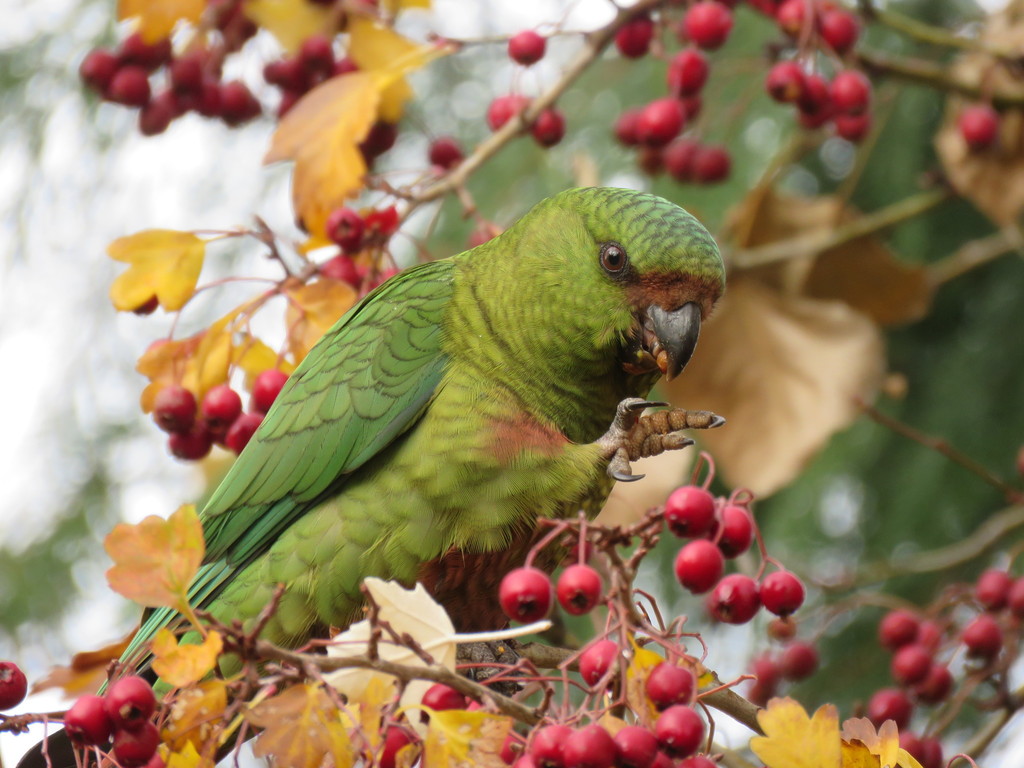
Austral Parakeet
Photo © Nicolas Olejnik
Photo © Nicolas Olejnik — CC BY 4.0 — Source: iNaturalist photo #198371460Identification
The Austral Parakeet is a small parrot measuring 28 to 36 cm in length, making it a compact but distinctive species. Adults of the nominate subspecies display a dull reddish forehead and lores set against an otherwise yellow-green face, with dull green upperparts. The underparts are yellowish green with a characteristic dull reddish patch on the belly, and dark feather edges create a scaly appearance across the body. The tail is dull reddish, while the wings are mostly green with bluish-green primaries. Both sexes are identical in plumage. Immature birds are similar to adults but show even duller red coloration on the face and belly. The smaller subspecies, E. f. minor, is darker overall than the nominate form, helping distinguish it in the field.
Range & Habitat
The Austral Parakeet holds the distinction of being the world's southernmost parrot species. The smaller subspecies E. f. minor inhabits southern Chile from the O'Higgins Region south to Aysén, and adjoining southwestern Argentina from Neuquén Province to northwestern Santa Cruz. The nominate subspecies ranges from where minor occurs almost to Cape Horn itself. Unconfirmed sightings in the Falkland Islands remain unverified. These parakeets primarily favor southern beech forest and woodlands dominated by oak and Drimys andina, but also adapt to semi-open areas, ranchlands, and cultivated zones. While mostly found near sea level in the far south, they range up to 2,000 meters elevation in northern portions of their range.
Behaviour & Diet
The Austral Parakeet is highly social, foraging in flocks that may number up to 100 individuals and sometimes including other bird species. In the southern part of its range, it is a year-round resident, while northern populations make elevational movements that respond more to weather and food availability than strict seasonality. The diet is diverse and includes seeds of grasses, bamboo, and Araucaria araucana, supplemented by fruits, berries, acorns, and leaf buds. In the northernmost Argentine range, they have been observed feeding on insect larvae. Breeding occurs during a season that includes December, with birds typically nesting in tree cavities, particularly favoring those in large dead oaks, though they occasionally construct twig nests in bamboo. Clutch sizes range from five to eight eggs, with an incubation period of approximately 26 days in captivity.
Best Time & Places to See It
The Austral Parakeet is considered common throughout its range, making it a reliable species for dedicated travelers. The best locations are in southern Chile and southwestern Argentina, particularly within protected national parks where much of their habitat is conserved. As year-round residents in the south, they can be found any time of year, though visiting during the breeding season (which includes December) may offer opportunities to observe nesting behavior. Look for them in beech forests, oak woodlands, and semi-open areas, particularly near sea level in the southernmost regions or at higher elevations in the north.
Photography Tips
The Austral Parakeet's gregarious nature makes it accessible to photographers, as flocks of up to 100 birds offer multiple subjects and behavioral opportunities. The subtle coloration—dull reds, yellows, and greens—can present challenges in flat light, so seek diffused morning or late afternoon light to reveal the scaly patterns and color nuances. Watch for feeding flocks moving through beech and oak forests, where they may pause long enough for detailed shots. Their nasal, grating calls make location easier; listen for the characteristic "grrreh-grrreh-grrreh" series mixed with higher-pitched "kreeh" notes to locate active birds. Photographing them in their natural forest habitat, particularly around dead oaks where they nest, adds ecological context to your images.
Chiloé National Park
Dalcahue, Chile
+122 birds+6 mammals
Temperate rainforest cloaks the Chiloé archipelago's northwestern reaches, where granite ridges thrust through dense, moisture-laden canopy and freshwater streams carve ravines toward the Pacific. Across approximately…
VIEW NATIONAL PARKAlerce Costero National Park
Corral, Chile
+34 birds
Where temperate rainforest descends to the Pacific coast in southern Chile, Alerce Costero National Park protects one of the continent's rarest and most ancient ecosystems across…
VIEW NATIONAL PARKCabo de Hornos National Park
Cape Horn, Chile
+88 birds+9 mammals
Where the Andes plunge into the Southern Ocean and the Drake Passage churns between two continents, Cabo de Hornos National Park sprawls across one of Earth's…
VIEW NATIONAL PARKCorcovado National Park
Chaitén, Chile
+39 birds+1 mammals
Where temperate rainforest meets the raw Pacific coastline of Chilean Patagonia, Corcovado National Park sprawls across 6,585 square kilometres of some of South America's most pristine…
VIEW NATIONAL PARKTorres del Paine National Park
Torres del Paine, Chile
+143 birds+10 mammals
Where granite spires pierce the Patagonian sky, Torres del Paine commands one of South America's most dramatic landscapes. Across 4,106 square kilometres of southern Chile, jagged…
VIEW NATIONAL PARKLaja National Park Lagoon
Antuco, Chile
+123 birds+1 mammals
Where the Andes descend into the Biobío Region's temperate forests, a vast lagoon fills the caldera of the extinct Antuco volcano, cradled by steep native woodland…
VIEW NATIONAL PARKPuyehue National Park
Puyehue, Chile
+110 birds+4 mammals
Across the volcanic spine of the Los Lagos Region, where the Andes descend toward temperate rainforest, Puyehue National Park encompasses nearly 2,600 square kilometers of one…
VIEW NATIONAL PARKCerro Castillo National Park
Coyhaique, Chile
+89 birds+3 mammals
Granite peaks and windswept steppe converge across this vast Patagonian landscape, where the Andes' eastern flank drops into terrain sculpted by ice age glaciers and relentless…
VIEW NATIONAL PARKPatagonia National Park
Cochrane, Chile
+133 birds+8 mammals
Where the Andes meet the Patagonian steppe, vast grasslands and shrublands sweep across rolling terrain carved by ancient glaciation, their contours softened by distance and dramatic…
VIEW NATIONAL PARKReserva Nacional Magallanes
Punta Arenas, Chile
+78 birds+2 mammals
Where windswept steppe meets sub-Antarctic forest near the southern tip of continental South America, Reserva Nacional Magallanes unfolds across roughly 352 square kilometres of profound ecological…
VIEW NATIONAL PARKParque Provincial Península de Magallanes
Argentina
+125 birds+4 mammals
Granite peaks and windswept steppe converge across this 415-square-kilometre peninsula jutting into the cold Atlantic waters of southern Patagonia, where the Magallanes landscape embodies the raw,…
VIEW NATIONAL PARKParque Municipal Llao Llao
San Carlos de Bariloche, Argentina
+73 birds+1 mammals
Where the Andes meet the Patagonian lakes, granite peaks rise above temperate rainforest in a landscape of startling contrasts. Parque Municipal Llao Llao, sprawling across 23…
VIEW NATIONAL PARKLos Glaciares National Park
Argentina
+121 birds+3 mammals
Where granite peaks and sprawling ice fields dominate the landscape, Los Glaciares National Park encompasses over ten thousand square kilometres of Patagonian wilderness in southern Argentina.…
VIEW NATIONAL PARKPerito Moreno National Park
Argentina
+78 birds
Where the Patagonian steppe descends into a landscape carved by ancient ice, Perito Moreno National Park sprawls across nearly 1,590 square kilometres of some of South…
VIEW NATIONAL PARKNahuel Huapi National Park
Argentina
+124 birds+11 mammals
Where the Andes descend toward Patagonia, vast glacial lakes cut through a landscape of southern beech forest and granite peaks, creating one of South America's most…
VIEW NATIONAL PARKLanín National Park
Argentina
+128 birds+7 mammals
Where the volcanic spine of the Andes plunges into Patagonian steppe, Lanín National Park sprawls across nearly 4,700 square kilometers of one of Argentina's most visually…
VIEW NATIONAL PARKLago Puelo National Park
Argentina
+109 birds+1 mammals
Where temperate forests descend to crystalline waters in the foothills of the Andes, Lago Puelo National Park sprawls across nearly 300 square kilometers of pristine wilderness…
VIEW NATIONAL PARKLos Alerces National Park
Argentina
+84 birds+3 mammals
Where the temperate rainforests of southern Patagonia sweep down towards crystalline lakes, Los Alerces National Park unfolds across nearly 3,000 square kilometres of one of South…
VIEW NATIONAL PARKNo community photos yet. Log in to add the first one.
No community observations of this species yet.