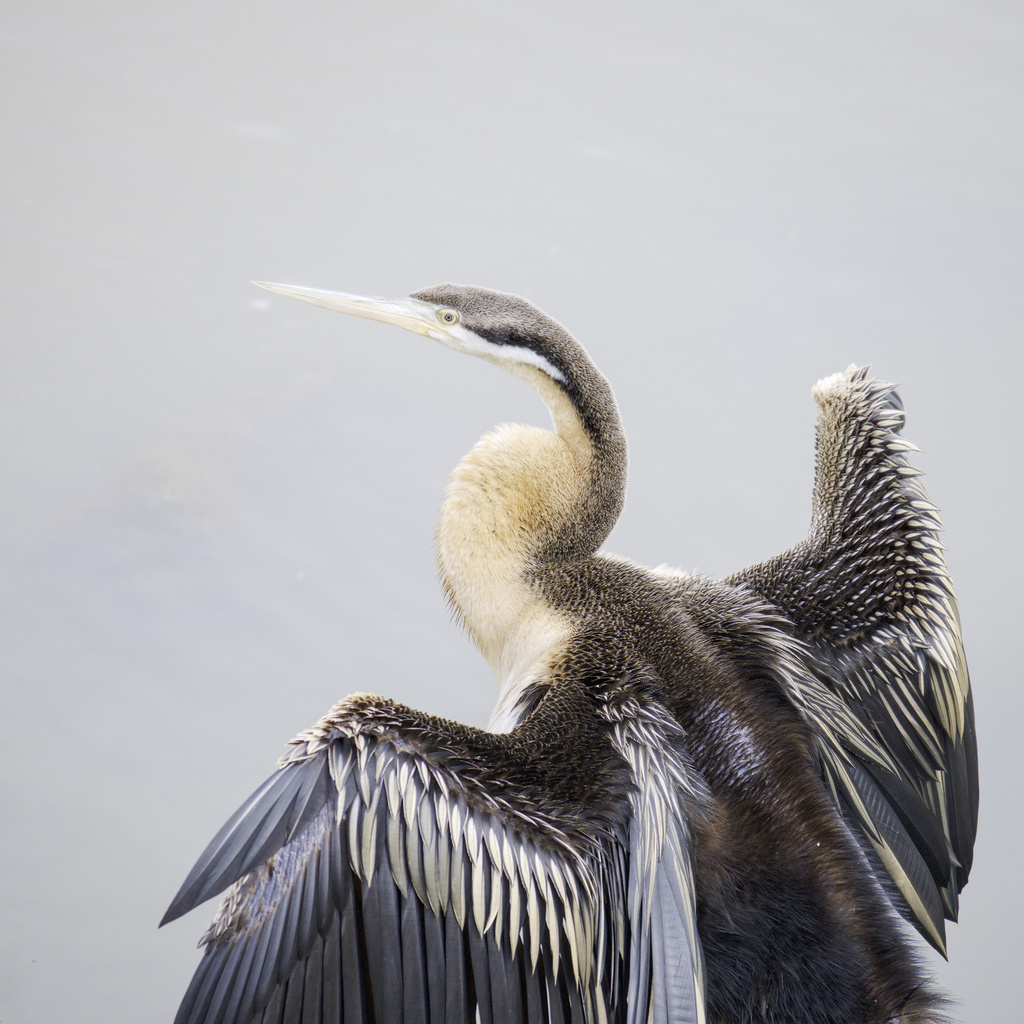
Australasian Darter
Photo © Thomas Jaeger
Photo © Thomas Jaeger — CC BY 4.0 — Source: iNaturalist #200783497Identification
The Australasian darter is a sleek, elongated waterbird measuring 86–94 cm in length, weighing around 2.6 kg. Its most distinctive feature is a snakelike slender neck that gives the species its alternative name, "snake-bird." Males are striking in black plumage with a white streak running down the side of the head and neck, while females display white underparts contrasting with darker upper parts. This streamlined build and serpentine neck are unmistakable in the field.
Range & Habitat
The Australasian darter inhabits freshwater and brackish wetlands across Australia, lowland New Guinea, New Britain, the Moluccas, and the Lesser Sunda Islands. It favours bodies of water deeper than 0.5 metres with fallen trees, logs, and vegetated banks that provide roosting and nesting sites. The species is absent from Australia's arid interior, including the Great Sandy and Great Victoria Deserts and the Nullarbor Plain, and appears only rarely in Tasmania. Less commonly, it ventures into inland saltwater environments.
Behaviour & Diet
Darters are pursuit predators that forage in water with minimal exposure, often showing only head and neck above the surface. Their feathers have unique water-absorption properties that reduce natural buoyancy, allowing extended underwater hunting. They consume a diverse diet of fish species—both native Australian smelt, bream, and perch, and introduced carp and goldfish—alongside freshwater turtles, crustaceans, and aquatic insects including water beetles, giant water bugs, and backswimmers. Breeding occurs once yearly, or occasionally twice during years with multiple floods. Nesting happens in spring (August–October) in southern regions and during wet seasons elsewhere. Darters construct large, stick-built dish-shaped nests lined with reeds and rushes, typically in partly submerged trees and often within cormorant colonies, where their larger nests and cleaner appearance distinguish them from their neighbours.
Best Time & Places to See It
Optimal viewing periods align with breeding seasons: August to October in southern Australia, January to April in the north, and corresponding wet seasons in New Guinea. Wetland reserves, river systems, and freshwater lakes across mainland Australia and lowland New Guinea offer the best opportunities. Patience is rewarded by watching these birds dive and surface with characteristic snake-necked movements as they hunt.
Photography Tips
Photograph darters early morning or late afternoon when light is soft and they are most active. Their dark plumage on males can challenge exposure metering; compensate slightly to retain detail in shadows. Capture the characteristic pose with only head and neck exposed during foraging, or the dramatic dive sequence. A telephoto lens (400mm+) is essential for maintaining distance without disturbing feeding birds. Position yourself with the sun behind you and water as a clean backdrop to emphasise the striking neck pattern and sleek profile.
Annan River (Yuku Baja-Muliku) National Park
Barrington Tops National Park
Belair National Park
Ben Boyd National Park
Blue Mountains National Park
Boodjamulla National Park
Bouddi National Park
Bribie Island National Park
Budj Bim National Park
Nothing matches these filters.
No community photos yet. Log in to add the first one.
No community observations of this species yet.