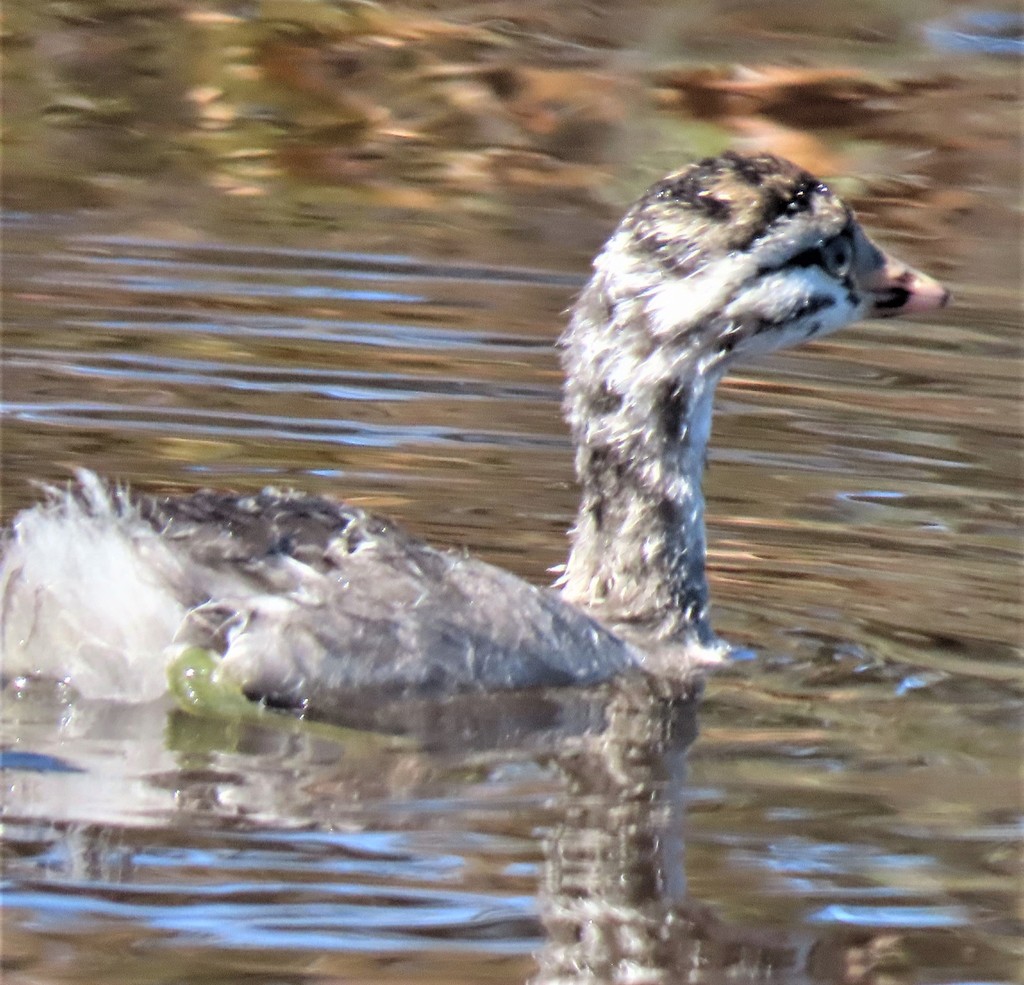
Australasian Grebe
Photo © pimelea
Photo © pimelea — CC BY 4.0 — Source: iNaturalist #105709363Identification
The Australasian grebe is one of the smallest members of the grebe family, measuring just 25–27 cm in length. In breeding plumage, both sexes are unmistakable: dark brown above with a glossy-black head and neck, adorned with a striking chestnut facial stripe that extends from behind the eye to the base of the neck. The yellow eye is highlighted by a prominent pale yellow face spot below, creating a distinctive facial pattern.
In non-breeding plumage, the bird becomes considerably duller, losing the chestnut stripe entirely. The face spot turns whiter, and the throat and front become grey-white. At this season, it bears similarity to the hoary-headed grebe, with which it shares much of its range, so careful attention to plumage details is essential for confident identification.
Range & Habitat
This small grebe is common throughout greater Australia, New Zealand, and nearby Pacific islands. Its range extends across multiple subspecies occupying Java, the Talaud and Sangihe Islands, New Guinea, the Solomon Islands, Vanuatu, New Caledonia, and Tasmania. The species favours fresh water environments, being regularly encountered on lakes and rivers across its extensive Australasian distribution.
Behaviour & Diet
The Australasian grebe is an excellent swimmer and diver, typically responding to alarm by diving immediately and swimming away underwater rather than taking flight. They are not strong flyers and will only fly distances at night, presumably to avoid predators. They show strong site fidelity, preferring to remain at their home base when food is sufficient.
Both parents raise the chicks cooperatively, though the male departs after a couple of months when the young are about three-quarters grown. Young grebes initially ride on their parents' backs, hidden between slightly raised wings. Around ten weeks of age, once chicks can dive and feed themselves, the mother may also leave, though she sometimes returns to check on them. Parents are highly protective, actively confronting and harassing other waterbirds such as ducks and herons by flapping wildly or splashing water at intruders.
Best Time & Places to See It
Look for Australasian grebes on freshwater lakes and rivers throughout Australia, Tasmania, and New Zealand. They are common waterbirds and can be found year-round in suitable habitat. Early morning often provides the best viewing opportunities, as grebes are most active during calmer conditions. Spring and summer are ideal for observing breeding adults in their striking breeding plumage and watching parental behaviour.
Photography Tips
Position yourself quietly at the water's edge to avoid alarming these wary birds, as they will immediately dive when disturbed. Shooting in early morning light will showcase the glossy-black head and chestnut facial stripe to best effect. During breeding season, focus on capturing the distinctive facial markings and the intimate moments of chicks riding on parents' backs. Use a longer lens to maintain distance and patience—your reward will be intimate portraits of one of Australasia's most charming waterbirds.
Bald Rock National Park
Belair National Park
Ben Boyd National Park
Blue Mountains National Park
Boodjamulla National Park
Bribie Island National Park
Budj Bim National Park
Cania Gorge National Park
Cape Range National Park
Nothing matches these filters.
No community photos yet. Log in to add the first one.
No community observations of this species yet.