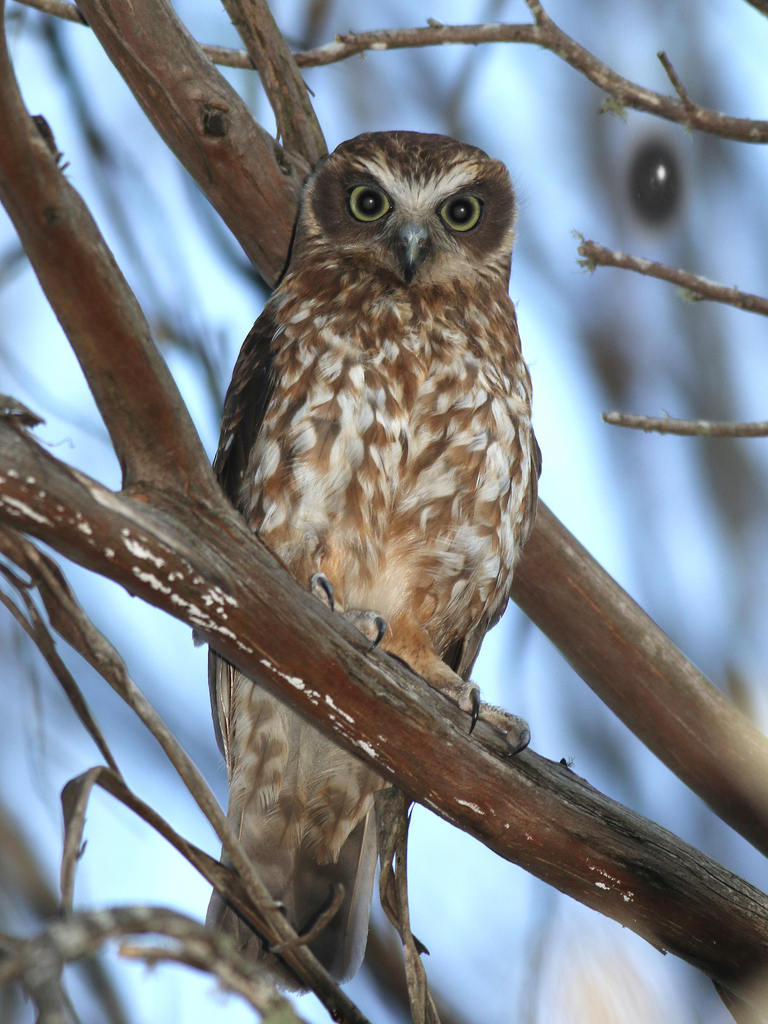
Australian Boobook
Photo © Lachlan Copeland
Photo © Lachlan Copeland — CC BY-SA 4.0 — Source: iNaturalist photo #482281934Identification
The Australian boobook is the smallest owl on the Australian mainland, measuring 27 to 36 centimetres in length. It is characterized by predominantly dark-brown plumage with prominent pale spots, and distinctive grey-green or yellow-green eyes. This compact, spotted appearance makes it identifiable among Australian owls, though its small size and nocturnal habits mean it is often heard rather than seen.
Range & Habitat
The Australian boobook is native to mainland Australia, southern New Guinea, the island of Timor, and the Sunda Islands. Eight subspecies are currently recognized across this broad geographic range. The species inhabits areas where it can roost in tree foliage, retiring to secluded spots during daylight hours. It was not formally recognized as distinct from New Zealand's morepork until 1999, though taxonomic complexities have continued, with three further subspecies reclassified as separate species in 2019 based on distinctive calls and genetic evidence.
Behaviour & Diet
The Australian boobook is generally nocturnal, though it may occasionally be active at dawn and dusk. It feeds primarily on insects and small vertebrates, hunting by pouncing on prey from tree perches—a characteristic hunting technique that exploits its arboreal habitat. Breeding occurs from late winter to early summer, with the species using tree hollows as nesting sites, an adaptation that suits its woodland and forest environments.
Best Time & Places to See It
The Australian boobook is most readily detected by its distinctive two-tone "boo-book" call, from which its common name derives. Dawn and dusk are the best times to listen for this call and potentially observe the bird, though genuinely nocturnal observations require patience and appropriate equipment. The species' large range and apparently stable population mean it occurs widely across suitable habitats throughout mainland Australia and nearby regions.
Photography Tips
Photographing the Australian boobook presents challenges due to its small size, nocturnal habits, and preference for secluded roosts in dense foliage. Locating roosting birds by day requires careful searching of tree cavities and sheltered branches. Night photography is possible but demands specialized equipment including infrared or thermal imaging capability. Listening for the characteristic call at dusk may help locate active birds, though approaching closely enough for photography remains difficult. Patient observation of suitable woodland habitats during dawn and dusk hours offers the best opportunity for field photography.
Alpine National Park
Bald Rock National Park
Barrington Tops National Park
Belair National Park
Ben Boyd National Park
Blue Mountains National Park
Boodjamulla National Park
Bouddi National Park
Bribie Island National Park
Nothing matches these filters.
No community photos yet. Log in to add the first one.
No community observations of this species yet.