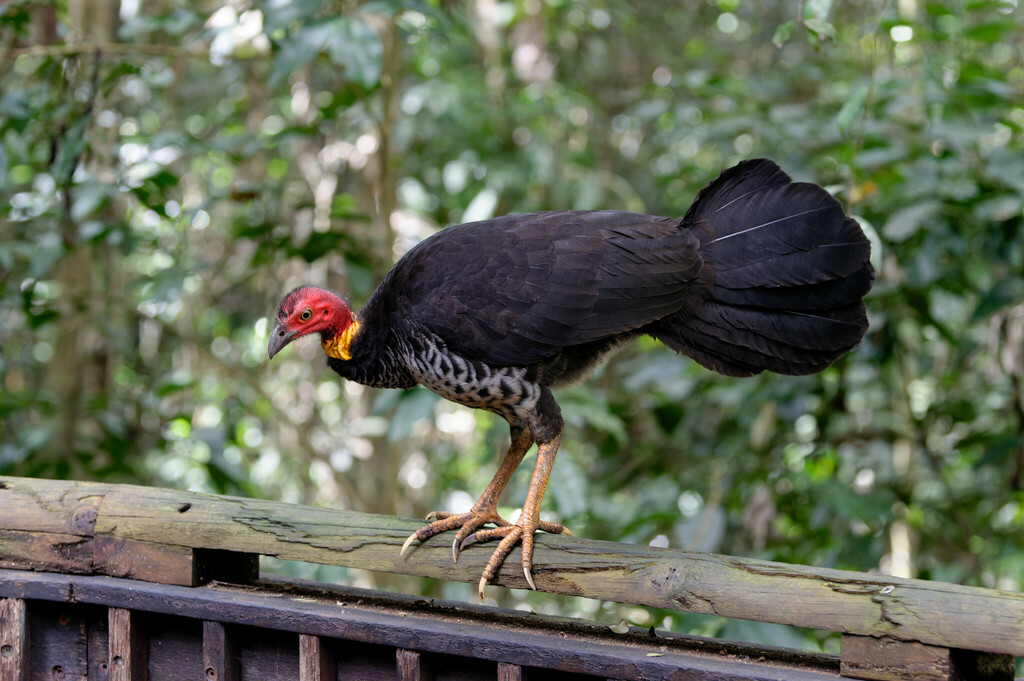
Australian Brushturkey
Photo © Donald Davesne
Photo © Donald Davesne — CC BY 4.0 — Source: iNaturalist photo #333405133Identification
The Australian brushturkey is a large, distinctive bird measuring 60–75 cm in length with a wingspan of about 85 cm, making it the largest living member of the megapode family. It is unmistakable in appearance, featuring predominantly black plumage contrasted by a bare red head and a prominent, fan-like tail flattened sideways. The nominate subspecies displays a yellow wattle, while the smaller northern subspecies (A. l. purpureicollis) from Cape York Peninsula has a purple wattle instead.
During breeding season, males undergo striking changes: their wattles enlarge dramatically and swing from side to side as they move, while their heads and wattles become much brighter. The underside of the body is sprinkled with white feathers, more pronounced in older individuals. Despite its name, the brushturkey is not closely related to the American turkey, but rather to the wattled brushturkey, Waigeo brushturkey, and malleefowl. The bird is a clumsy flyer, unable to sustain long flights and preferring to take to the air only when threatened or to roost in trees.
Range & Habitat
The Australian brushturkey ranges along the eastern coast of Australia, extending from the tip of Cape York in the north to approximately Wollongong on the south coast of New South Wales. It has also been introduced to Kangaroo Island in South Australia. The species inhabits rainforests and wet sclerophyll forests, as well as drier scrubs and open areas across both mountainous and lowland regions.
In the northern reaches of its range, the brushturkey is most commonly found at higher altitudes, moving to lowland areas during winter. In the south, it is equally at home in mountain and lowland environments. Remarkably, brushturkeys have adapted well to human-modified landscapes and are now common in urban environments, frequently seen in suburban backyards in major cities such as Brisbane and Sydney.
Behaviour & Diet
The Australian brushturkey is famous for its extraordinary mound-building reproductive strategy. Males construct large nests from leaves, compostable material, and earth, measuring 1 to 1.5 metres high and up to 4 metres across. A dominant male tends the mound and receives successive local females for mating and egg-laying. The male tirelessly collects nesting material from the surrounding area while fiercely defending his mound against rival males, a demanding effort that eventually leads to his replacement by a stronger competitor.
Eggs are incubated by the heat generated from the composting mound, with males carefully regulating temperature between 33–35 °C by adding or removing material. Clutches average 16–24 large white eggs, laid between September and March, though a single mound may contain up to 50 eggs from multiple females. Young brushturkeys are fully fledged at hatching and can fly within hours once their feathers dry. Chicks are entirely independent from birth, resulting in high mortality rates. In urban settings, brushturkeys show little fear of humans and readily raid compost bins and picnic areas for food.
Best Time & Places to See It
Brushturkeys are fairly common throughout their range and can be reliably encountered in suitable habitats from Far North Queensland to New South Wales. They are particularly abundant and easily observed in suburban gardens and parks in Brisbane and Sydney, where their habituation to humans makes them accessible to nature enthusiasts and photographers.
The breeding season from September to March offers excellent opportunities to observe male behaviour as they actively tend their mounds and defend territories. National parks within the species' range, as well as urban green spaces, provide good viewing opportunities, though birds in more urbanised areas display noticeably reduced wariness compared to those in national parks.
Photography Tips
The brushturkey's striking colouration—black plumage contrasting with its bare red head and prominent tail—makes it highly photogenic. Photograph males during breeding season when their wattles are enlarged and most brightly coloured, and when their behavioural activity around the mound is highest. The characteristic sideways swing of the wattle as males run provides dynamic action shots.
Urban populations are considerably less wary than their park-dwelling counterparts, making suburban gardens and backyards excellent locations for close approach and detailed portraiture. Capture the bird's characteristic posture with its distinctive fan-like tail, and if possible, document mound-building behaviour and temperature-checking activities where males insert their beaks into the nest material. Early morning and late afternoon light will best highlight the red head and bring out the subtle white underside plumage.
Cania Gorge National Park
Australia
+131 birds+7 mammals
Where sandstone ridges rise above the Queensland inland plains, Cania Gorge National Park carves a compelling landscape across 51 square kilometres of dry eucalypt woodland and…
VIEW NATIONAL PARKCarnarvon National Park
Philadelphia, Australia
+179 birds+17 mammals
Across 15,000 square kilometres of inland Queensland, rugged sandstone plateaus rise above eucalypt woodlands and open grasslands, carved by creeks that have worn deep gorges into…
VIEW NATIONAL PARKMount Coolum National Park
Sunshine Coast, Australia
+124 birds+3 mammals
Rising abruptly from the hinterland plateau of Queensland's Sunshine Coast, Mount Coolum commands attention as a distinctive volcanic remnant clothed in open eucalypt woodland and heathland…
VIEW NATIONAL PARKNerang National Park
Gold Coast, Australia
+126 birds+13 mammals
Steep subtropical rainforest clads the hinterland ridges of southeast Queensland's Gold Coast, where Nerang National Park sprawls across 34 square kilometres of protected bushland between the…
VIEW NATIONAL PARKBunya Mountains National Park
Australia
+149 birds+11 mammals
Where subtropical rainforest meets open eucalyptus woodland on the elevated plateau of southeastern Queensland, Bunya Mountains National Park unfolds across 483 square kilometres of some of…
VIEW NATIONAL PARKHerberton Range National Park
Australia
+115 birds+10 mammals
Rainforest-clad ridges and rocky outcrops define this 324-square-kilometre reserve in far north Queensland, where the mountainous terrain of the Herberton Range rises through layered eucalypt woodland…
VIEW NATIONAL PARKDaintree National Park
Dedin, Australia
+362 birds+37 mammals
Daintree National Park is one of the world’s oldest and most biologically diverse tropical rainforests, protecting an extraordinary landscape where ancient forests meet the Great Barrier…
VIEW NATIONAL PARKSpringbrook National Park
Australia
+195 birds+25 mammals
Subtropical rainforest meets open eucalypt woodland across a mountainous terrain where the McPherson Range rises sharply from the Queensland coast, creating a patchwork of microclimates and…
VIEW NATIONAL PARKLamington National Park
Australia
+227 birds+24 mammals
Where subtropical rainforest rises steeply from the Queensland coast, Lamington National Park spreads across 541 square kilometres of one of Australia's most biodiverse mountain landscapes. The…
VIEW NATIONAL PARKSydney Harbour National Park
Sydney, Australia
+203 birds+26 mammals
Where Sydney Harbour's sheltered waters meet the sandstone headlands of New South Wales, a mosaic of coastal heathland, eucalyptus woodland and rocky shores creates one of…
VIEW NATIONAL PARKRoyal National Park
Sydney, Australia
+296 birds+46 mammals
Where sandstone ridges plunge toward the Tasman Sea, Royal National Park unfolds across 343 square kilometres of southeastern Australian coastal wilderness. The park's defining character emerges…
VIEW NATIONAL PARKLockyer National Park
Australia
+130 birds+5 mammals
Steep ridges and weathered escarpments rise from the Brisbane Valley in southeastern Queensland, where Lockyer National Park sprawls across 267 square kilometres of eucalypt woodland and…
VIEW NATIONAL PARKGheebulum Kunungai National Park
Moreton Island, Australia
+168 birds+7 mammals
Sand dunes rise and fall across Moreton Island's eastern shore, a landscape sculpted by wind and ocean currents into one of Australia's most dynamic coastal ecosystems.…
VIEW NATIONAL PARKEndeavour River National Park
Philadelphia, Australia
+203 birds+1 mammals
Where the Endeavour River winds through northeastern Queensland's tropical lowlands, a compact mosaic of rainforest, open woodland, and riverine corridor creates one of Australia's most ecologically…
VIEW NATIONAL PARKGirraween National Park
Australia
+193 birds+21 mammals
Granite boulders rise like the bones of the earth across these 278 square kilometres of southeastern Queensland, where the Great Dividing Range descends towards the coastal…
VIEW NATIONAL PARKMorton National Park
Australia
+253 birds+57 mammals
Across nearly 4,800 square kilometers of New South Wales's Southern Tablelands, rugged sandstone plateaus rise above sheltered valleys where cool-climate eucalypt woodland meets grassy heath and…
VIEW NATIONAL PARKHeathcote National Park
Sydney, Australia
+119 birds+16 mammals
Sandstone ridges and eucalypt woodlands rise from the Cumberland Plain southwest of Sydney, where Heathcote National Park unfolds across 82 square kilometres of bushland shaped by…
VIEW NATIONAL PARKGlass House Mountains National Park
Australia
+151 birds+8 mammals
Conical peaks of volcanic origin rise dramatically from the coastal lowlands of southeastern Queensland, their weathered slopes cloaked in eucalyptus woodland and open sclerophyll forest that…
VIEW NATIONAL PARKBribie Island National Park
Brisbane, Australia
+284 birds+20 mammals
Across tidal flats and shallow waterways north of Brisbane, Bribie Island National Park spreads across nearly four hundred square kilometres of subtropical coastal wilderness—a patchwork of…
VIEW NATIONAL PARKFlinders Chase National Park
Australia
+142 birds+14 mammals
Granite ridges and windswept mallee scrubland define this 1,630-square-kilometre expanse on Kangaroo Island, where ancient rock formations rise abruptly from coastal heathland and woodland mosaics. The…
VIEW NATIONAL PARKWhitsunday Islands National Park
Whitsundays, Australia
+163 birds+9 mammals
Crystalline waters lap against seventy-four islands where rainforest canopies tumble down to pristine beaches and coral gardens flourish in the shallows. This archipelago off Queensland's coast…
VIEW NATIONAL PARKGreat Sandy National Park
Australia
+306 birds+40 mammals
Where coastal dunes rise inland from the Queensland coastline, Great Sandy National Park encompasses a landscape of remarkable ecological diversity shaped by subtropical humid conditions year-round.…
VIEW NATIONAL PARKGirringun National Park
Australia
+231 birds+10 mammals
Where granite gorges cleave through subtropical woodland in North Queensland, Girringun National Park unfolds across rugged terrain shaped by millions of years of weathering and erosion.…
VIEW NATIONAL PARKWooroonooran National Park
Australia
+240 birds+28 mammals
Where the Great Dividing Range rises sharply inland from Queensland's tropical coast, Wooroonooran National Park encompasses a landscape of steep, forested gorges and cascading waterways carved…
VIEW NATIONAL PARKNoosa National Park
Marcus Beach, Australia
+216 birds+8 mammals
Subtropical eucalypt woodland and open forest meet coastal heathland along the Noosa Peninsula, where the temperate waters of the Tasman current moderate the Queensland climate into…
VIEW NATIONAL PARKBlue Mountains National Park
Australia
+220 birds+43 mammals
Dramatic sandstone cliffs rise in tiers across this mountainous plateau west of Sydney, their rust-coloured faces weathered into amphitheatres and gorges where eucalyptus forest clings to…
VIEW NATIONAL PARKBouddi National Park
Gosford, Australia
+147 birds+17 mammals
Sandstone ridges rise sharply from the Tasman Sea along the central New South Wales coast, their weathered faces etched by millennia of salt spray and storm…
VIEW NATIONAL PARKKu-ring-gai Chase National Park
Sydney, Australia
+216 birds+39 mammals
Where Hawkesbury sandstone cliffs plunge toward sheltered bays and creeks, Ku-ring-gai Chase National Park unfolds across rugged terrain just north of Sydney, a mosaic of eucalyptus…
VIEW NATIONAL PARKBarrington Tops National Park
Australia
+175 birds+47 mammals
Where the New England Plateau rises above the Hunter Valley, temperate rainforest cloaks the highest reaches of Barrington Tops, its dense canopy fed by year-round precipitation…
VIEW NATIONAL PARKDorrigo National Park
Gleniffer, Australia
+172 birds+17 mammals
Where subtropical rainforest transitions into cool temperate woodland, Dorrigo National Park rises across the volcanic tablelands of far northern New South Wales, cloaked in the perpetually…
VIEW NATIONAL PARKOxley Wild Rivers National Park
Australia
+202 birds+45 mammals
Where the New England Tablelands descend toward the coast, river gorges carve through temperate forests in a landscape of dramatic geological contrast. Oxley Wild Rivers National…
VIEW NATIONAL PARKNew England National Park
Australia
+169 birds+35 mammals
Temperate eucalypt woodlands and cool rainforest pockets define this upland reserve where granite peaks rise above the New England Plateau in northeastern New South Wales. Here,…
VIEW NATIONAL PARKNo community photos yet. Log in to add the first one.
No community observations of this species yet.