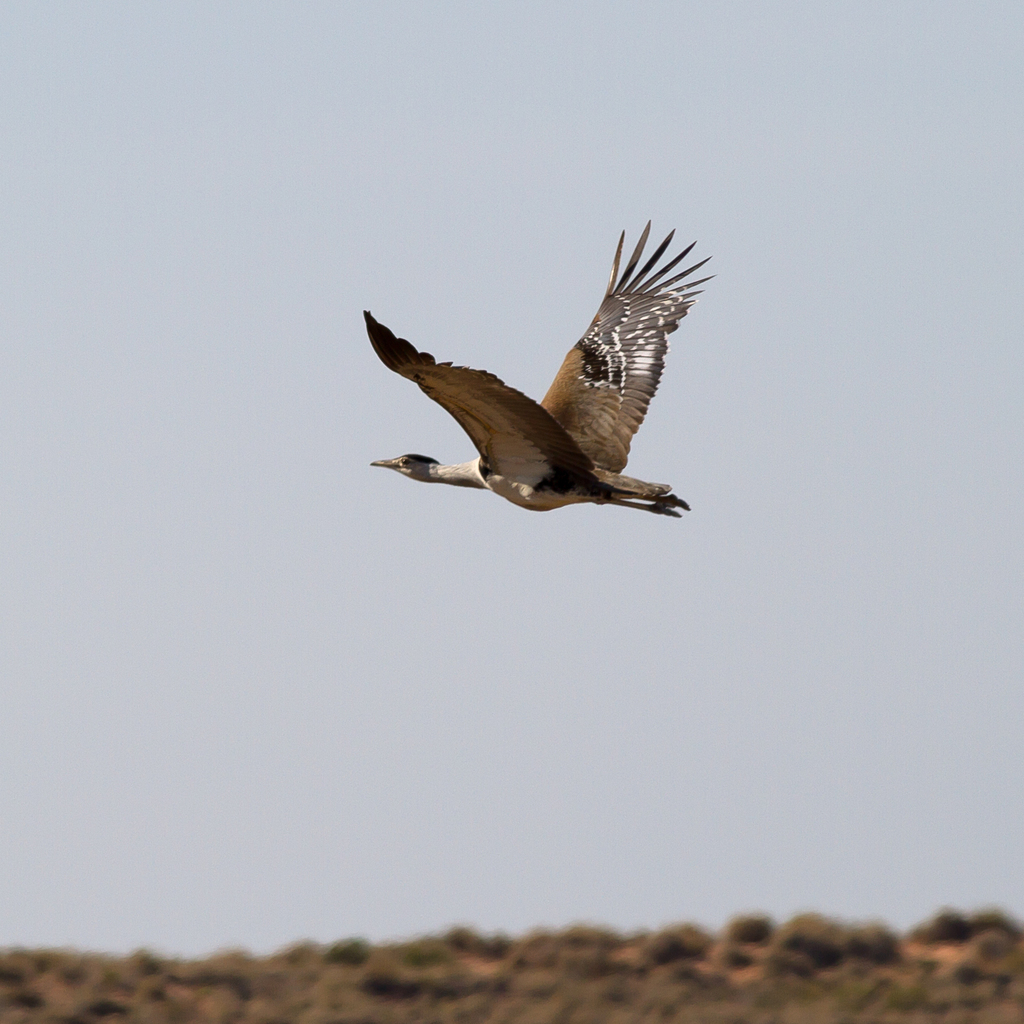
Australian Bustard
Photo © Kym Nicolson
Photo © Kym Nicolson — CC BY 4.0 — Source: iNaturalist #73092859Identification
The Australian bustard is Australia's largest living flying bird and the smallest species within the genus Ardeotis. Males stand up to 1.2 metres tall with a wingspan reaching 2.3 metres, while females are noticeably smaller at around 80 centimetres with a 1.8-metre wingspan. Both sexes share similar plumage: a black crown and nape, pale grey front neck, and brown wings and upper body. A distinctive black band of feathers separates the white abdomen from the light grey neck. The wing coverts display striking black and white patterning, particularly visible in flight. Look for long yellow to cream-coloured legs, a white iris, and a whitish to brown beak.
Range & Habitat
This large terrestrial bird inhabits grasslands, woodlands, and open agricultural country across northern Australia and southern New Guinea. Once widespread and common across Australia's open plains, the species has become rare in regions converted to farming. Today it maintains populations in suitable habitats throughout its remaining range, favouring the expansive open country where it can be spotted striding across the landscape.
Behaviour & Diet
Australian bustards are mostly terrestrial, typically seen walking slowly alone or in pairs across open plains. They are nomadic, flying considerable distances to areas where food becomes plentiful. When disturbed, they adopt a cryptic posture with neck erect and bill pointed upward, stalking gradually away or running before taking flight as a last resort. They roost at high points on open plains or in trees when available. The species is omnivorous, feeding mainly on plant fruits and seeds but also consuming invertebrates such as crickets and grasshoppers, as well as small mammals, birds, and reptiles. During breeding season, males perform conspicuous and loud displays, expanding a throat sac to reveal longer feathers like a swaying skirt while striding about with head held high, wings pointed downward, and tail arched over the back, emitting deep roaring calls transliterated as 'who-o-o-o'.
Best Time & Places to See It
Greater numbers of Australian bustards are visible during the breeding season. Look for them in open grasslands and woodland areas across northern Australia and southern New Guinea, where they can be spotted walking slowly across plains or performing their impressive breeding displays. Early morning and late afternoon often provide the best viewing opportunities in suitable habitats.
Photography Tips
Photograph these shy birds from a distance and approach slowly to avoid flushing them into flight. The bird's distinctive long legs and upright posture make striking compositional elements. Capture the black and white wing covert patterning during flight or at rest. Males in breeding display offer dramatic photographic opportunities, with their inflated throat sac and arched tail creating visually impressive poses. The contrast between the pale neck, black breast band, and white abdomen provides excellent colour composition. Early light on open plains will best showcase their terrestrial habitat and characteristic slow, deliberate gait.
Boodjamulla National Park
Cape Range National Park
Carnarvon National Park
Daintree National Park
Endeavour River National Park
Girringun National Park
Great Sandy National Park
Kakadu National Park
Kalbarri National Park
Nothing matches these filters.
No community photos yet. Log in to add the first one.
No community observations of this species yet.