Australian Crake
Photo © John Cull
Photo © John Cull — CC0 1.0 — Source: iNaturalist #154392373Identification
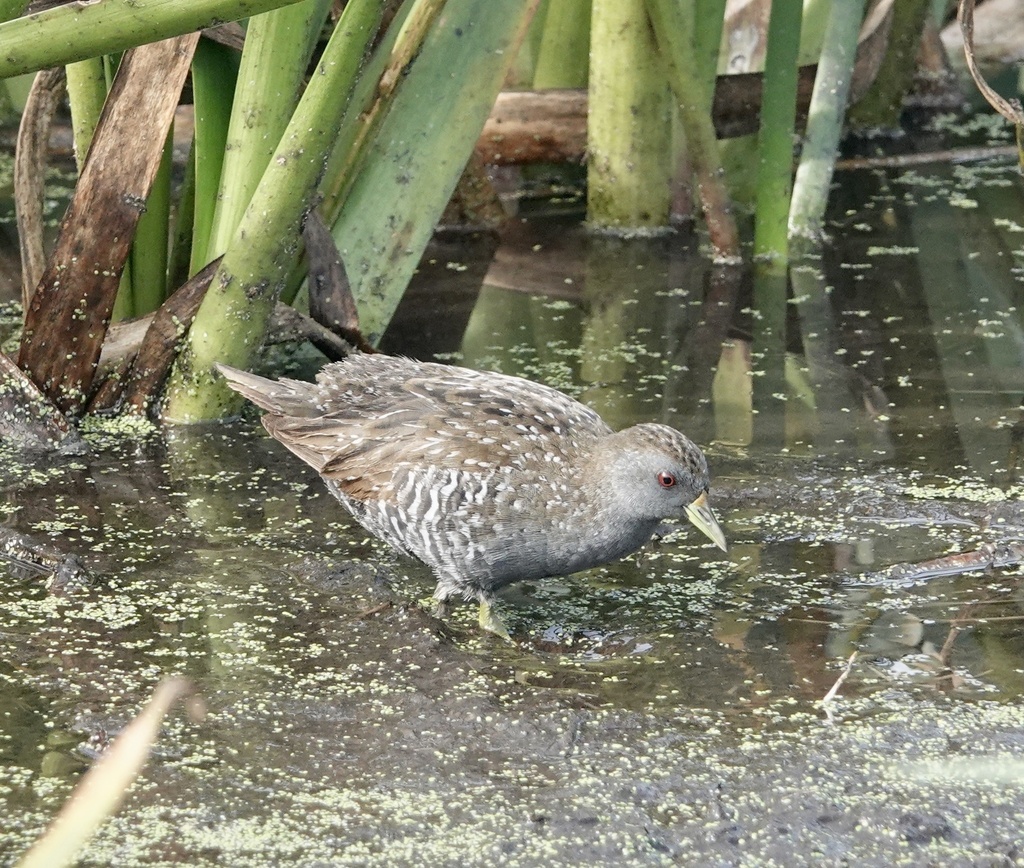
The Australian crake is a compact rail measuring 19–23 cm in length, with a wingspan of 27–33 cm and weighing 55–70 g. It shares similarities with Baillon's crake but is stockier and considerably darker overall. The most distinctive feature is its sooty face paired with a steel-blue or dark grey breast, belly, and throat. Its brown upperparts are heavily streaked with black and white, while the flanks display bold black and white barring. When the tail is cocked, the shorter black undertail coverts and longer white undertail coverts form a striking upside-down V shape. The outermost primary feathers have a conspicuous white leading edge visible in flight. The bill is yellow-green with a red base on the upper mandible, while the legs, feet, and distinctive red iris are also yellow-green. Females are slightly smaller and paler than males, with a brown stripe across the upper lores and more defined white spots on the breast and neck. Juveniles lack the steel-blue plumage, instead showing brown and white speckled underparts with a brown iris and no red on the bill.
Range & Habitat
The Australian crake is endemic to Australia, distributed throughout southeast and Western Australia, with less common populations in Tasmania and the tropical north. The species inhabits both coastal and inland freshwater, brackish, marine, and terrestrial environments, showing a strong preference for densely vegetated marshes, swamps, estuaries, and saltmarshes supporting lignum, chenopods, rushes, and sedges. Notably, its range is dynamic and dependent on water conditions; following periods of heavy rainfall, populations can extend inland to unexpected locations such as the Alice Springs region.
Behaviour & Diet
Australian crakes forage in pairs, family groups, or occasionally in large congregations of up to 100 individuals when food is abundant. They favour densely vegetated areas among reeds, on mudflats, and in shallow water (less than 5 cm deep). Their diet is diverse, encompassing aquatic plants, algae, seeds, molluscs, crustaceans, spiders, tadpoles, and insects including earwigs, grasshoppers, beetles, flies, butterflies, and ants. They forage by probing the ground, wading, swimming, and submerging their heads underwater, often knocking larger food items against the ground at the water's edge.
Best Time & Places to See It
Breeding occurs between August and February, making this period potentially rewarding for observation. The species' presence is strongly linked to wetland conditions, so areas with reliable freshwater or brackish marshes and estuaries throughout southeast and Western Australia offer the best opportunities. Following significant rainfall events, inland wetland areas may temporarily support populations, expanding viewing possibilities beyond coastal regions.
Photography Tips
The Australian crake's preference for densely vegetated wetlands and shallow water habitats makes photography challenging but rewarding. Early morning and late evening visits to marshes and estuaries may yield better light and activity levels. Focus on capturing the distinctive upside-down V pattern of the undertail coverts when the bird cocks its tail, as well as the white leading edge of the primary feathers in flight. The contrast between the sooty face and steel-blue breast provides striking compositional opportunities. Patient observation in small family groups is often more productive than searching for individuals in thick vegetation.
Chiltern-Mt Pilot National Park
Australia
+229 birds+12 mammals
Granite ridges and eucalyptus woodlands define this 869-square-kilometre park straddling the border between Victoria and New South Wales, where rugged terrain rises sharply from gentler foothill…
VIEW NATIONAL PARKIkara-Flinders Ranges National Park
Australia
+149 birds+10 mammals
Where ancient quartzite ridges rise across the semi-arid heart of South Australia, Ikara-Flinders Ranges National Park unfolds across nearly two thousand square kilometres of one of…
VIEW NATIONAL PARKRoyal National Park
Sydney, Australia
+296 birds+46 mammals
Where sandstone ridges plunge toward the Tasman Sea, Royal National Park unfolds across 343 square kilometres of southeastern Australian coastal wilderness. The park's defining character emerges…
VIEW NATIONAL PARKLincoln National Park
Australia
+149 birds+5 mammals
Across the mid-north of South Australia, where the landscape transitions from coastal lowlands toward semi-arid interior plains, sprawls a wilderness of 2,671 square kilometres where red-earth…
VIEW NATIONAL PARKMorton National Park
Australia
+253 birds+57 mammals
Across nearly 4,800 square kilometers of New South Wales's Southern Tablelands, rugged sandstone plateaus rise above sheltered valleys where cool-climate eucalypt woodland meets grassy heath and…
VIEW NATIONAL PARKFlinders Chase National Park
Australia
+142 birds+14 mammals
Granite ridges and windswept mallee scrubland define this 1,630-square-kilometre expanse on Kangaroo Island, where ancient rock formations rise abruptly from coastal heathland and woodland mosaics. The…
VIEW NATIONAL PARKWilsons Promontory National Park
Australia
+210 birds+21 mammals
Where granite headlands plunge toward Bass Strait, Wilson's Promontory National Park sprawls across nearly 1,300 square kilometers of southeastern Victoria's most rugged coastal wilderness. The park's…
VIEW NATIONAL PARKGreat Sandy National Park
Australia
+306 birds+40 mammals
Where coastal dunes rise inland from the Queensland coastline, Great Sandy National Park encompasses a landscape of remarkable ecological diversity shaped by subtropical humid conditions year-round.…
VIEW NATIONAL PARKKosciuszko National Park
Australia
+211 birds+52 mammals
Where the Great Dividing Range reaches its highest peaks in southeastern Australia, Kosciuszko National Park encompasses a landscape of windswept plateaus, rocky ridges, and deep river…
VIEW NATIONAL PARKMungo National Park
Australia
+135 birds+7 mammals
Across the semi-arid inland plains of New South Wales, where sparse shrubland and scattered grassland stretch beneath enormous skies, lies a landscape shaped by ancient geological…
VIEW NATIONAL PARKBen Boyd National Park
Eden, Australia
+255 birds+47 mammals
Where the temperate forests of the far south coast meet towering sea cliffs, Ben Boyd National Park unveils one of New South Wales' most dramatic coastal…
VIEW NATIONAL PARKGrampians National Park
Australia
+214 birds+18 mammals
Where sandstone ridges rise above the Western District of Victoria, Grampians National Park unfolds across rolling terrain sculpted by ancient geology and sustained by a temperate…
VIEW NATIONAL PARKGreat Otway National Park
Australia
+255 birds+42 mammals
Temperate rainforest and wet eucalyptus woodland cloak the ridges and gullies of Victoria's Great Otway National Park, where persistent moisture and mild year-round temperatures sustain a…
VIEW NATIONAL PARKMurray-Sunset National Park
Australia
+205 birds+2 mammals
Across the semi-arid borderlands of northwestern Victoria, where the Murray River defines the state's edge, sprawls a landscape of remarkable resilience and subtle beauty. Murray-Sunset National…
VIEW NATIONAL PARKPort Campbell National Park
Port Campbell, Australia
+170 birds+7 mammals
Dramatic sea cliffs rise from churning waters along Victoria's southwestern coast, where sandstone and limestone formations tower over a hundred metres above the Southern Ocean. Port…
VIEW NATIONAL PARKCoorong National Park
Australia
+217 birds+15 mammals
Where the Murray River meets the Southern Ocean, a chain of shallow lagoons stretches across the South Australian coast, separated from the sea by a ribbon…
VIEW NATIONAL PARKKalbarri National Park
Australia
+157 birds+6 mammals
Where ochre cliffs and weathered gorges slice through Western Australia's semi-arid interior, Kalbarri National Park reveals a landscape shaped by millions of years of erosion and…
VIEW NATIONAL PARKCape Range National Park
Australia
+159 birds+15 mammals
Where arid limestone ridges plunge toward turquoise waters, Cape Range National Park frames one of Australia's most dramatic desert-ocean interfaces. The park's spine—a stark, weathered range…
VIEW NATIONAL PARKNo community photos yet. Log in to add the first one.
No community observations of this species yet.