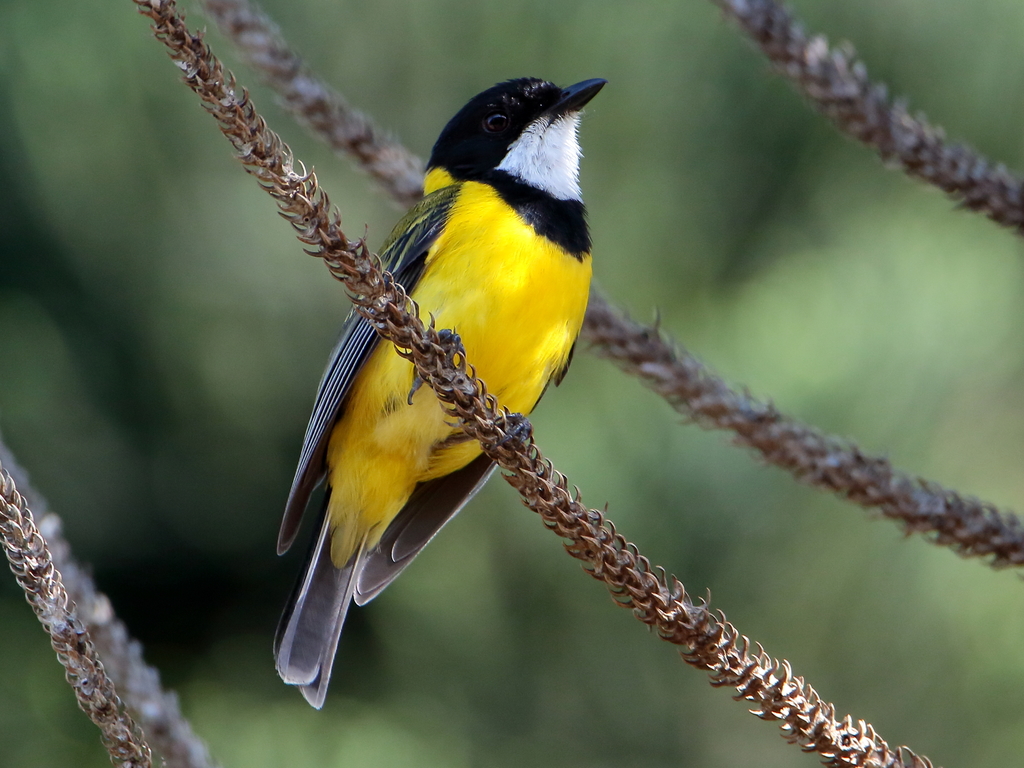
Australian Golden Whistler
Photo © Graham Winterflood
Photo © Graham Winterflood — CC BY-SA 4.0 — Source: iNaturalist photo #57385236Identification
The Australian golden whistler is a striking and colourful passerine with marked sexual dimorphism. Males are unmistakable: they display a bright yellow underside and nape contrasting sharply with an olive-green back and wings, a black head and chest-band, and a distinctive white throat. Females are overall dull brownish-grey, though some individuals show yellowish undertail coverts. Both sexes share a black bill, dark legs, and red-brown eyes. The species is renowned for its strong, musical voice. Subspecific variation exists across the bird's range, most notably in the Norfolk golden whistler, where males resemble females of the nominate race, and the Lord Howe golden whistler, which displays duller yellow plumage tinged with olive.
Range & Habitat
The Australian golden whistler is found across most of Australia except the interior and northern regions, inhabiting forest, woodland, mallee, mangrove and scrub. The species exhibits complex taxonomy with seven recognised subspecies distributed across different regions: southwestern Australia, south-central Australia, Tasmania, southeastern Australia, eastern Australia, and two island populations on Lord Howe Island and Norfolk Island. Most populations are resident year-round, though some birds in southeastern Australia migrate northward during winter.
The species thrives in almost any wooded habitat, with a particular preference for dense forests. It typically forages alone at the lower to middle tree level, though it readily participates in mixed-species feeding flocks when encountered.
Behaviour & Diet
Australian golden whistlers breed between September and January, with both male and female participating in nest construction and parental duties. The nest is a shallow bowl constructed from twigs, grass, and bark, bound together with spider web. Only one brood is raised per season, and both partners share incubation and chick-rearing responsibilities. Eggs hatch after 15 days, and young fledge approximately 12 days later.
The species feeds on berries, insects, spiders, and other small arthropods, typically foraging in the lower to middle tree canopy either singly or within mixed feeding flocks.
Best Time & Places to See It
The Australian golden whistler is generally common to fairly common throughout its range and is considered of least concern for conservation. The breeding season from September to January offers excellent opportunities for observation, as birds are active and vocal. Eastern Australia, particularly the Wet Tropics region of Queensland and areas southward to New South Wales, offers reliable sightings, as do southeastern populations in Victoria. The species' preference for dense forest and wooded habitats means searchers should focus on such areas for best results.
Photography Tips
Photographing male Australian golden whistlers is rewarding due to their striking plumage: the contrast between the black head and chest-band against bright yellow underparts makes for compelling images. Position yourself at lower to middle canopy height where birds typically forage, and use patient stalking or waiting near food sources such as berry-laden trees. Early morning during the breeding season provides optimal lighting and increased bird activity. The species' tendency to join mixed feeding flocks can facilitate multiple sightings. For the best colour saturation, photograph males in dappled light that highlights their distinctive yellow and black markings without harsh shadows.
Alpine National Park
Bald Rock National Park
Barrington Tops National Park
Belair National Park
Ben Boyd National Park
Blue Mountains National Park
Bouddi National Park
Bribie Island National Park
Budawang National Park
Nothing matches these filters.
No community photos yet. Log in to add the first one.
No community observations of this species yet.