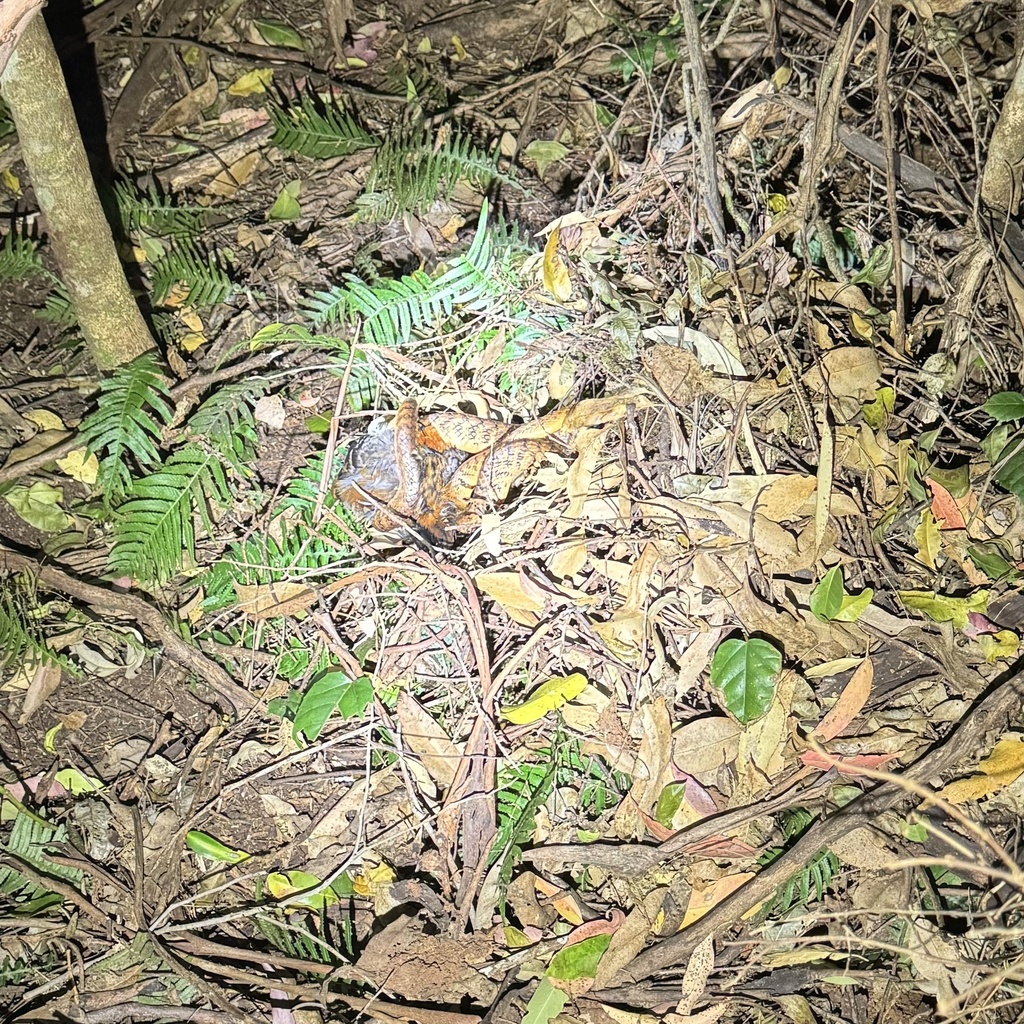
Australian Logrunner
Photo © Sockrosma
Photo © Sockrosma — CC BY 4.0 — Source: iNaturalist #239119318Identification
The Australian logrunner is a distinctive small forest bird immediately recognisable by its unusual tail structure. Its most striking feature is the stiffened, spine-like rachis (central shafts) that protrude from the tail feathers, giving the bird its alternative names of spine-tail or spine-tailed logrunner. The tail itself is short, less than four inches in length, with the characteristic spines almost entirely lacking the usual barbs found on feathers. The bird's plumage is modest but consistent: the head and back display a reddish-brown colour, while the wings are predominantly black. The tail is dark brown, and the wing-coverts are tipped with grey. A distinctive grey eyebrow stripe and grey ear-coverts frame the face. The throat, breast and abdomen are white, though females notably have an orange-rufous throat. Males are noticeably larger than females, providing another clue for field identification.
Range & Habitat
This species is endemic to south-eastern Australia, with its range extending from the Illawarra district in New South Wales north to the Bunya Mountains in Queensland. The Australian logrunner is a bird of the rainforest floor, thriving in the rich, leafy understory of temperate, subtropical and tropical moist lowland forests. It requires dense forest habitat characterised by abundant leaf litter, scattered logs, forest debris, ferns, vines and saplings—the accumulated detritus that makes for ideal foraging ground.
Behaviour & Diet
The logrunner's most remarkable characteristic is its unique foraging technique, which has shaped its entire anatomy. Using its spiny tail as a brace and support, the bird props itself against the ground and uses its powerful hind legs to scrape and throw leaf debris aside with distinctive sideways sweeping motions. Once larger debris is cleared, it scratches the exposed soil in search of food, creating characteristic 'soup-plate' depressions about 150 millimetres in diameter across the forest floor. This specialised behaviour is made possible by the bird's short, broad pelvis and stout femur with strongly developed projections that support the heavy musculature required. The logrunner feeds primarily on insects and other invertebrates uncovered during this energetic foraging. These are noisy, vocal birds, particularly in the morning, with loud songs and calls believed to serve territorial or sexual functions. They live in pairs or small groups, defending their territories aggressively and forming monogamous, permanent bonds.
Best Time & Places to See It
Listen for the logrunner's loud morning calls and songs in rainforest habitats throughout its range. The bird's terrestrial lifestyle and preference for dense undergrowth means it can be challenging to spot visually, but its vocal nature makes it easier to locate. Early morning excursions through suitable rainforest habitat offer the best chance of encountering this species. Breeding appears to occur at varying times depending on location, though most commonly between May and August or July and December, making these potentially rewarding periods for observation and photography.
Photography Tips
Patience and keen listening are essential when photographing the Australian logrunner. Position yourself in appropriate rainforest habitat and locate birds by their distinctive loud calls, particularly in the early morning. The forest floor setting and the bird's preference for dense vegetation present challenges; a telephoto lens will be valuable for capturing images from distance. Focus on the bird's unique tail structure—the protruding spines are a diagnostic and striking feature that makes compelling photographs. If fortunate enough to observe foraging behaviour, the characteristic scraping and leaf-throwing actions make for distinctive and behavioural images that illustrate this bird's remarkable adaptations.
Springbrook National Park
Australia
+195 birds+25 mammals
Subtropical rainforest meets open eucalypt woodland across a mountainous terrain where the McPherson Range rises sharply from the Queensland coast, creating a patchwork of microclimates and…
VIEW NATIONAL PARKLamington National Park
Australia
+227 birds+24 mammals
Where subtropical rainforest rises steeply from the Queensland coast, Lamington National Park spreads across 541 square kilometres of one of Australia's most biodiverse mountain landscapes. The…
VIEW NATIONAL PARKRoyal National Park
Sydney, Australia
+296 birds+46 mammals
Where sandstone ridges plunge toward the Tasman Sea, Royal National Park unfolds across 343 square kilometres of southeastern Australian coastal wilderness. The park's defining character emerges…
VIEW NATIONAL PARKMorton National Park
Australia
+253 birds+57 mammals
Across nearly 4,800 square kilometers of New South Wales's Southern Tablelands, rugged sandstone plateaus rise above sheltered valleys where cool-climate eucalypt woodland meets grassy heath and…
VIEW NATIONAL PARKGlass House Mountains National Park
Australia
+151 birds+8 mammals
Conical peaks of volcanic origin rise dramatically from the coastal lowlands of southeastern Queensland, their weathered slopes cloaked in eucalyptus woodland and open sclerophyll forest that…
VIEW NATIONAL PARKBribie Island National Park
Brisbane, Australia
+284 birds+20 mammals
Across tidal flats and shallow waterways north of Brisbane, Bribie Island National Park spreads across nearly four hundred square kilometres of subtropical coastal wilderness—a patchwork of…
VIEW NATIONAL PARKNoosa National Park
Marcus Beach, Australia
+216 birds+8 mammals
Subtropical eucalypt woodland and open forest meet coastal heathland along the Noosa Peninsula, where the temperate waters of the Tasman current moderate the Queensland climate into…
VIEW NATIONAL PARKBarrington Tops National Park
Australia
+175 birds+47 mammals
Where the New England Plateau rises above the Hunter Valley, temperate rainforest cloaks the highest reaches of Barrington Tops, its dense canopy fed by year-round precipitation…
VIEW NATIONAL PARKDorrigo National Park
Gleniffer, Australia
+172 birds+17 mammals
Where subtropical rainforest transitions into cool temperate woodland, Dorrigo National Park rises across the volcanic tablelands of far northern New South Wales, cloaked in the perpetually…
VIEW NATIONAL PARKOxley Wild Rivers National Park
Australia
+202 birds+45 mammals
Where the New England Tablelands descend toward the coast, river gorges carve through temperate forests in a landscape of dramatic geological contrast. Oxley Wild Rivers National…
VIEW NATIONAL PARKNew England National Park
Australia
+169 birds+35 mammals
Temperate eucalypt woodlands and cool rainforest pockets define this upland reserve where granite peaks rise above the New England Plateau in northeastern New South Wales. Here,…
VIEW NATIONAL PARKNo community photos yet. Log in to add the first one.
No community observations of this species yet.