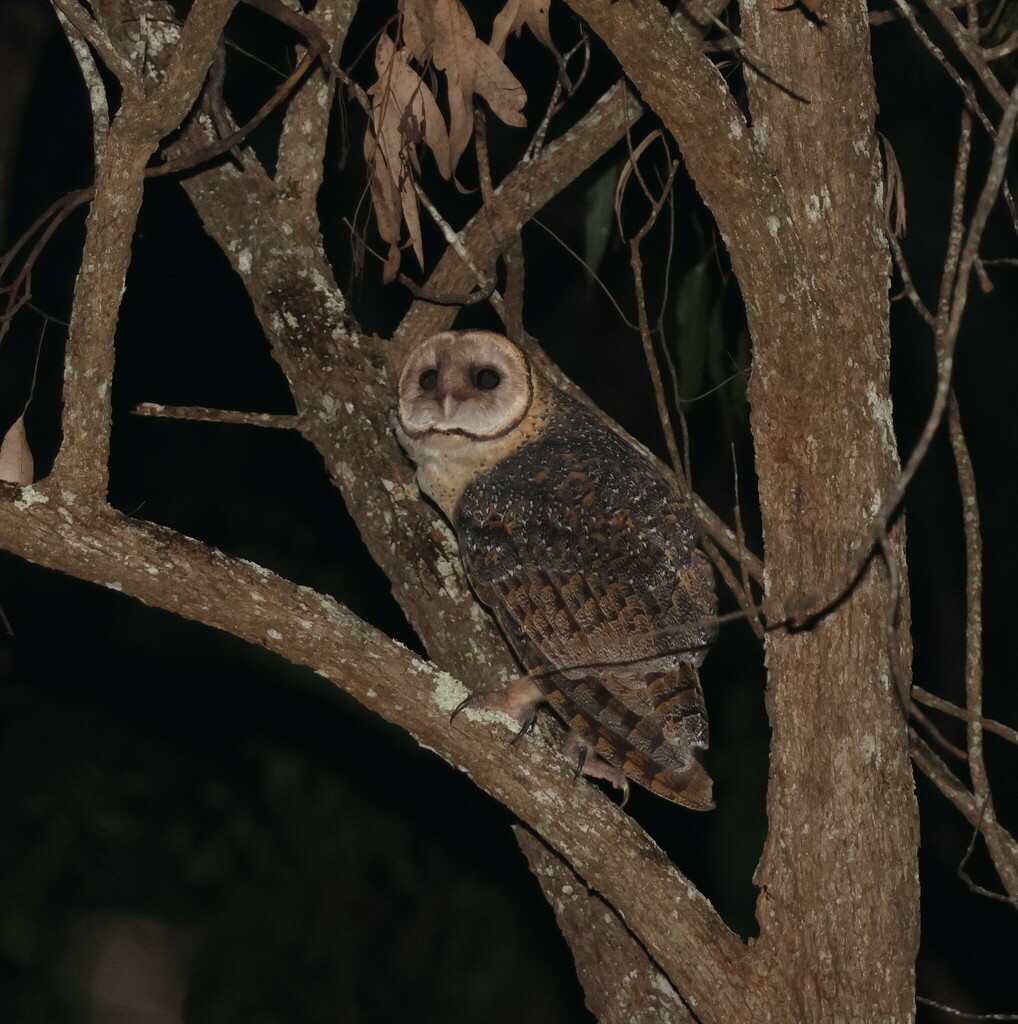
Australian Masked Owl
Photo © Greg Tasney
Photo © Greg Tasney — CC BY-SA 4.0 — Source: iNaturalist #197418029Identification
The Australian masked owl is instantly recognisable by its striking white, heart-shaped facial mask surrounded by brown feathers—a characteristic feature of the barn-owl family. The dorsal plumage is predominantly brown with light grey spots on the upper back, while the underparts are white with brown spotting. Dark brown to black eyes peer from within the distinctive mask. This species exhibits marked sexual dimorphism: females are noticeably larger and darker than males. Males weigh 420–800 g with lengths of 330–410 mm, while females are substantially heavier at 545–1,260 g and measure 390–500 mm in length. Southern female masked owls may have wingspans reaching up to 1,280 mm. Notably, the Tasmanian subspecies is the largest of all barn-owls, even exceeding the greater sooty owl in size and weight.
Range & Habitat
The Australian masked owl inhabits Southern New Guinea and the non-desert regions of Australia, including Tasmania and the Tiwi Islands. On mainland Australia, they seldom venture more than 300 km inland. These owls favour timbered areas with shrub understoreys, where they roost and nest in large tree hollows positioned near foraging grounds. Some populations, particularly in caves and rock crevices, have adapted to alternative nesting sites. The species is strongly territorial and may remain within the same established breeding area for extended periods.
Behaviour & Diet
Strictly nocturnal, the Australian masked owl is a versatile hunter with a diverse diet. Prey includes rodents, small dasyurids, possums, bandicoots, rabbits, bats, birds, reptiles and insects. While primarily foraging for terrestrial prey on the ground, they also hunt from trees and in flight. Radio telemetry studies suggest their home range may be as large as 19–23 km². Breeding occurs opportunistically when conditions favour it, with activity possible throughout the year. Females lay two or three eggs in nest sites lined with soil, mulch or sand, while males provision the incubating female. Young fledge at two to three months old but remain dependent on parental feeding for a further month before independence.
Best Time & Places to See It
Since masked owls breed whenever conditions permit rather than following a fixed seasonal calendar, the best viewing opportunities depend on local breeding activity and prey availability. Timbered areas within 300 km of Australia's coast, particularly in NSW and Victoria where populations persist, offer the greatest chances of encounters. Tasmania supports notably robust populations. Nocturnal surveys in suitable habitat—particularly near known roost trees—offer the best prospects. Listen for their calls during night drives through appropriate woodland regions.
Photography Tips
Photographing this nocturnal species presents significant challenges. Night-vision or thermal equipment may be necessary for documentation. Position yourself near known roost or nesting trees during twilight hours when owls become active. The distinctive white facial mask and dark eye provide excellent subjects for close-up portraiture if access to roosting birds can be safely achieved. Patience and knowledge of local populations, ideally gained through consultation with regional wildlife authorities, are essential for successful encounters.
Cania Gorge National Park
Australia
+131 birds+7 mammals
Where sandstone ridges rise above the Queensland inland plains, Cania Gorge National Park carves a compelling landscape across 51 square kilometres of dry eucalypt woodland and…
VIEW NATIONAL PARKCarnarvon National Park
Philadelphia, Australia
+179 birds+17 mammals
Across 15,000 square kilometres of inland Queensland, rugged sandstone plateaus rise above eucalypt woodlands and open grasslands, carved by creeks that have worn deep gorges into…
VIEW NATIONAL PARKKakadu National Park
Kakadu, Australia
+273 birds+46 mammals
Kakadu National Park is Australia’s largest national park and one of the world’s most remarkable protected areas, covering nearly 20,000 square kilometres in the tropical north…
VIEW NATIONAL PARKLower Glenelg National Park
Australia
+161 birds+12 mammals
Where the Glenelg River carves through southeastern Victoria's limestone country, Lower Glenelg National Park unfolds across nearly 800 square kilometres of river gorge, eucalypt woodland, and…
VIEW NATIONAL PARKLamington National Park
Australia
+227 birds+24 mammals
Where subtropical rainforest rises steeply from the Queensland coast, Lamington National Park spreads across 541 square kilometres of one of Australia's most biodiverse mountain landscapes. The…
VIEW NATIONAL PARKRoyal National Park
Sydney, Australia
+296 birds+46 mammals
Where sandstone ridges plunge toward the Tasman Sea, Royal National Park unfolds across 343 square kilometres of southeastern Australian coastal wilderness. The park's defining character emerges…
VIEW NATIONAL PARKBald Rock National Park
Australia
+122 birds+15 mammals
Granite peaks and weathered stone dominate the landscape of this 202-square-kilometre national park in inland New South Wales, where rugged tors and rocky outcrops rise dramatically…
VIEW NATIONAL PARKGirraween National Park
Australia
+193 birds+21 mammals
Granite boulders rise like the bones of the earth across these 278 square kilometres of southeastern Queensland, where the Great Dividing Range descends towards the coastal…
VIEW NATIONAL PARKMorton National Park
Australia
+253 birds+57 mammals
Across nearly 4,800 square kilometers of New South Wales's Southern Tablelands, rugged sandstone plateaus rise above sheltered valleys where cool-climate eucalypt woodland meets grassy heath and…
VIEW NATIONAL PARKHeathcote National Park
Sydney, Australia
+119 birds+16 mammals
Sandstone ridges and eucalypt woodlands rise from the Cumberland Plain southwest of Sydney, where Heathcote National Park unfolds across 82 square kilometres of bushland shaped by…
VIEW NATIONAL PARKGlass House Mountains National Park
Australia
+151 birds+8 mammals
Conical peaks of volcanic origin rise dramatically from the coastal lowlands of southeastern Queensland, their weathered slopes cloaked in eucalyptus woodland and open sclerophyll forest that…
VIEW NATIONAL PARKBribie Island National Park
Brisbane, Australia
+284 birds+20 mammals
Across tidal flats and shallow waterways north of Brisbane, Bribie Island National Park spreads across nearly four hundred square kilometres of subtropical coastal wilderness—a patchwork of…
VIEW NATIONAL PARKGreat Sandy National Park
Australia
+306 birds+40 mammals
Where coastal dunes rise inland from the Queensland coastline, Great Sandy National Park encompasses a landscape of remarkable ecological diversity shaped by subtropical humid conditions year-round.…
VIEW NATIONAL PARKBlue Mountains National Park
Australia
+220 birds+43 mammals
Dramatic sandstone cliffs rise in tiers across this mountainous plateau west of Sydney, their rust-coloured faces weathered into amphitheatres and gorges where eucalyptus forest clings to…
VIEW NATIONAL PARKKu-ring-gai Chase National Park
Sydney, Australia
+216 birds+39 mammals
Where Hawkesbury sandstone cliffs plunge toward sheltered bays and creeks, Ku-ring-gai Chase National Park unfolds across rugged terrain just north of Sydney, a mosaic of eucalyptus…
VIEW NATIONAL PARKBarrington Tops National Park
Australia
+175 birds+47 mammals
Where the New England Plateau rises above the Hunter Valley, temperate rainforest cloaks the highest reaches of Barrington Tops, its dense canopy fed by year-round precipitation…
VIEW NATIONAL PARKOxley Wild Rivers National Park
Australia
+202 birds+45 mammals
Where the New England Tablelands descend toward the coast, river gorges carve through temperate forests in a landscape of dramatic geological contrast. Oxley Wild Rivers National…
VIEW NATIONAL PARKNew England National Park
Australia
+169 birds+35 mammals
Temperate eucalypt woodlands and cool rainforest pockets define this upland reserve where granite peaks rise above the New England Plateau in northeastern New South Wales. Here,…
VIEW NATIONAL PARKBudawang National Park
Australia
+80 birds+17 mammals
Rugged sandstone ridges rise dramatically across the New South Wales Southern Tablelands, their weathered faces sculpted by millennia of wind and water into a landscape of…
VIEW NATIONAL PARKBen Boyd National Park
Eden, Australia
+255 birds+47 mammals
Where the temperate forests of the far south coast meet towering sea cliffs, Ben Boyd National Park unveils one of New South Wales' most dramatic coastal…
VIEW NATIONAL PARKCradle Mountain-Lake St Clair National Park
Australia
+72 birds+8 mammals
Where glacial valleys plunge between quartzite peaks, Tasmania's Cradle Mountain-Lake St Clair National Park unfolds as a temperate wilderness of uncommon grandeur. The park's terrain ranges…
VIEW NATIONAL PARKNo community photos yet. Log in to add the first one.
No community observations of this species yet.