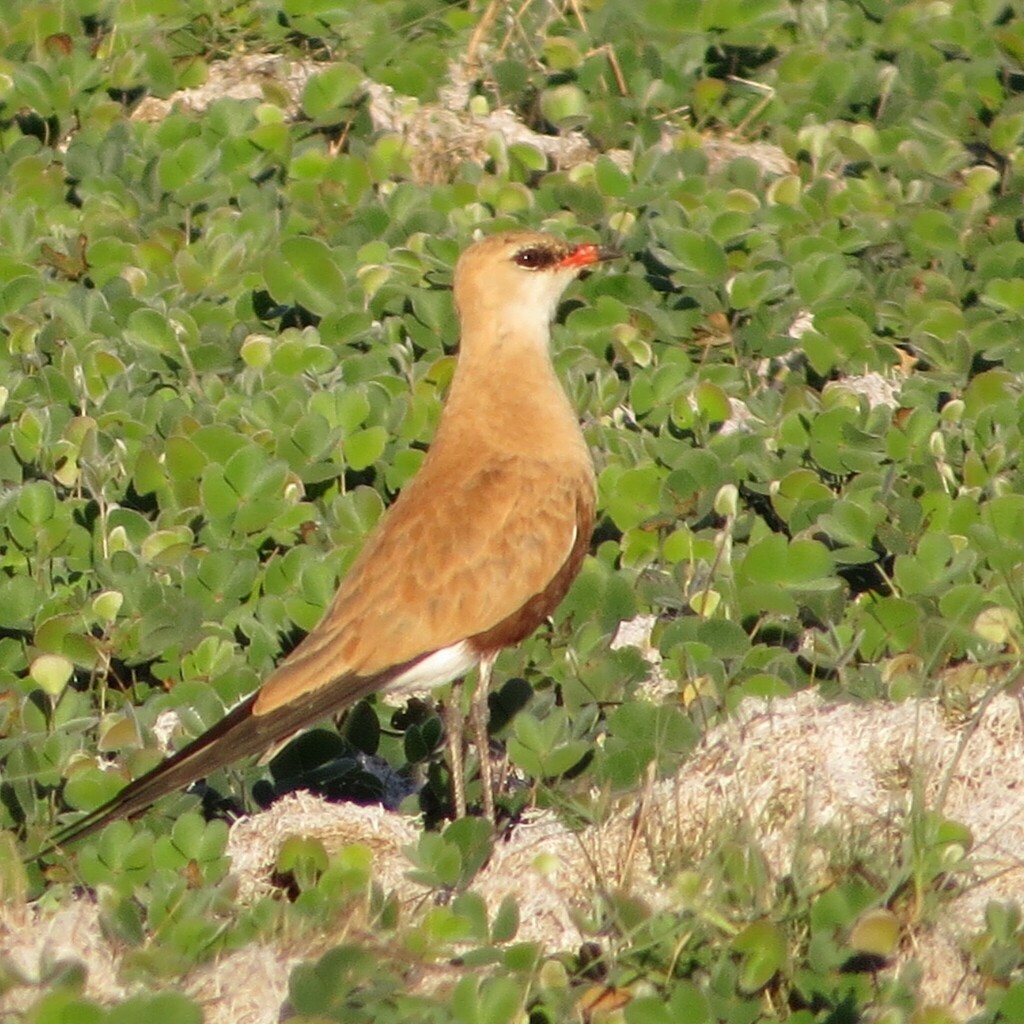
Australian Pratincole
Photo © pimelea
Photo © pimelea — CC BY 4.0 — Source: iNaturalist #207130280Identification
The Australian Pratincole is a medium-sized, slender shorebird measuring 19–24 cm in length with a wingspan of 50–60 cm. It is characterized by long legs, long pointed wings, and a distinctive short decurved bill. In breeding plumage, the head, neck, breast and upperparts are sandy brown, with pointed black wings and a striking black loral stripe. The chin and throat are white, the bill is bright red with a black base, and legs are grey to black. In flight, look for the square-cut tail with white upper-tail coverts and sides. Non-breeding and juvenile birds are duller, with grey-brown upperparts and a fainter loral stripe. The Australian Pratincole is slightly smaller and slimmer than the Oriental Pratincole, with proportionally longer legs.
Range & Habitat
This species breeds across Australia's interior, from south-western Queensland through northern Victoria and central Australia to the Kimberley region of Western Australia. During winter, birds migrate to northern Australia, Indonesia (Java and Sulawesi), southern Borneo, and New Guinea. The Australian population is estimated at 60,000 individuals. The Australian Pratincole favours treeless, open and sparsely wooded plains, grasslands, claypans and gibberstone in arid and semi-arid regions. Birds also frequent the margins of wetlands, creeks, river beds, bore drains, lagoons, springs and sewage farms.
Behaviour & Diet
These nomadic shorebirds are highly migratory, gathering in flocks to move between breeding and wintering grounds, with continuous calling heard within flocks. They are monogamous, with pairs remaining bonded through the breeding season. Their diet consists mainly of insects, spiders and centipedes, caught either by hawking in flight or picked from the ground. They actively forage throughout the day, with peaks at dawn and dusk, using a characteristic stalking-and-dart technique sometimes with one wing outspread. The species requires regular access to drinking water for thermoregulation and possesses salt glands allowing them to drink both saline and ephemeral water sources.
Best Time & Places to See It
Timing depends on location: in southern breeding grounds (south-western Queensland to northern Victoria, central Australia and Kimberley), visit during spring and summer months. For winter observations, travel to northern Australia, or further afield to Indonesia and New Guinea. Look for them in arid and semi-arid plains, grasslands and around wetland margins. Although common across their range, their occurrence is unpredictable and varies by location and season, making specific sightings variable year to year.
Photography Tips
The Australian Pratincole's long pointed wings and distinctive flight silhouette make it rewarding to photograph in flight, particularly the contrasting sandy-brown body against black outer wings and white tail sides. Capture breeding birds to showcase the bright red bill and black loral stripe, most visible in good side-lighting. Early morning and dusk, when foraging activity peaks, offer the best opportunities for action shots of ground-feeding behaviour. The birds' ground-nesting sites during breeding season require careful, ethical approach—photograph from distance using telephoto lenses to avoid disturbance. Their nomadic nature and seasonal unpredictability means persistence and local knowledge are essential for successful encounters.
Kakadu National Park
Kakadu, Australia
+273 birds+46 mammals
Kakadu National Park is Australia’s largest national park and one of the world’s most remarkable protected areas, covering nearly 20,000 square kilometres in the tropical north…
VIEW NATIONAL PARKDaintree National Park
Dedin, Australia
+362 birds+37 mammals
Daintree National Park is one of the world’s oldest and most biologically diverse tropical rainforests, protecting an extraordinary landscape where ancient forests meet the Great Barrier…
VIEW NATIONAL PARKVulkathunha-Gammon Ranges National Park
Australia
+97 birds+8 mammals
Granite ridges and quartzite peaks rise abruptly from the red earth of South Australia's mid-north, their steep slopes carved into gorges where seasonal waterfalls cascade through…
VIEW NATIONAL PARKRinyirru National Park
Lakefield, Australia
+258 birds+7 mammals
Where the savanna grasslands of far north Queensland meet seasonal wetlands and eucalypt woodlands, Rinyirru National Park sprawls across more than 12,500 square kilometres of rugged,…
VIEW NATIONAL PARKWest Bali National Park
Gerokgak, Indonesia
+240 birds+8 mammals
Across West Bali's northwestern reaches, where the Indian Ocean meets volcanic slopes and limestone cliffs plunge toward turquoise shallows, sprawls a protected realm of roughly 325…
VIEW NATIONAL PARKGrampians National Park
Australia
+214 birds+18 mammals
Where sandstone ridges rise above the Western District of Victoria, Grampians National Park unfolds across rolling terrain sculpted by ancient geology and sustained by a temperate…
VIEW NATIONAL PARKMurray-Sunset National Park
Australia
+205 birds+2 mammals
Across the semi-arid borderlands of northwestern Victoria, where the Murray River defines the state's edge, sprawls a landscape of remarkable resilience and subtle beauty. Murray-Sunset National…
VIEW NATIONAL PARKNo community photos yet. Log in to add the first one.
No community observations of this species yet.