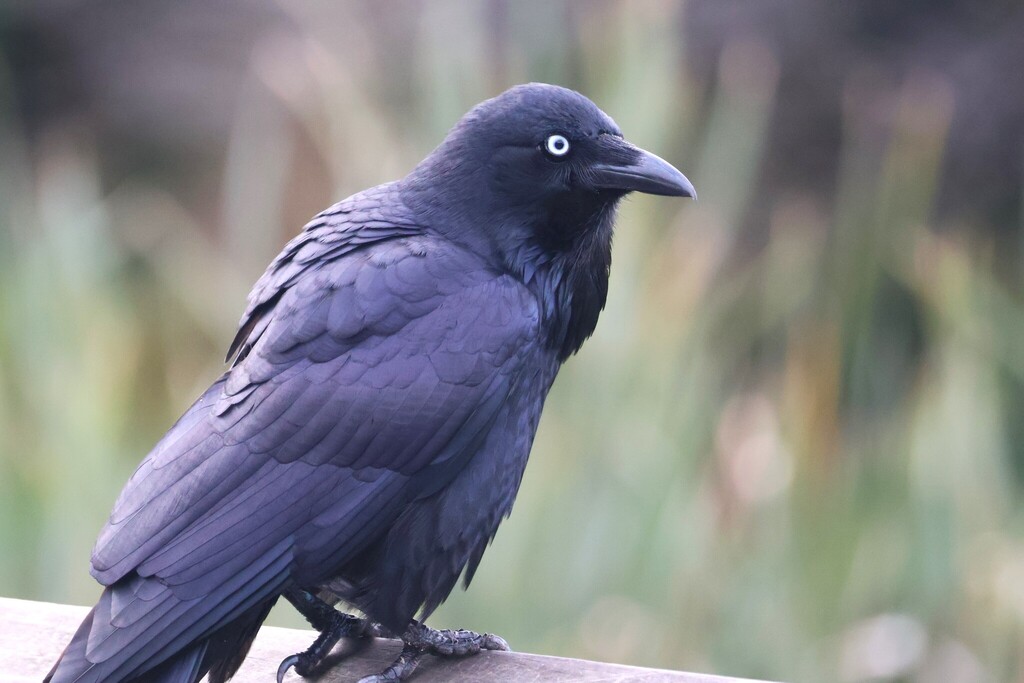
Australian Raven
Photo © Astrid Osborne
Photo © Astrid Osborne — CC0 1.0 — Source: iNaturalist photo #519206204Identification
The Australian raven is a large black corvid measuring 46–53 centimetres in length, with entirely black plumage, beak, and mouth. Its upperparts display a distinctive glossy sheen with purple-blue and greenish iridescence, while the black feathers have grey bases. Strong, greyish-black legs and feet support this robust bird.
The most reliable field mark distinguishing it from related Australian corvids is the presence of long chest feathers, or throat hackles, which are especially prominent in mature individuals. Eye colour varies with age: hatchlings and young birds have dark brown irises until about fifteen months, then develop hazel coloration with a blue inner rim until roughly 2.5 to 3 years of age, when older birds and subadults acquire distinctive white irises.
Range & Habitat
The Australian raven is native to Australia and has proven highly adaptable to human environments. It frequents open woodlands and transitional zones, as well as urban and suburban settings, making it commonly sighted in major cities including Sydney, Canberra, Perth, Adelaide, and Brisbane.
This species is territorial, with pairs typically bonding for life. Breeding occurs between July and September with remarkable consistency across its range. Nests are bowl-shaped structures of sticks, usually positioned high in trees, though birds occasionally utilize man-made structures such as windmills or buildings. Two recognized subspecies exist, showing slight differences in vocalizations and genetic divergence.
Behaviour & Diet
The Australian raven is an omnivorous and opportunistic feeder, consuming a wide variety of plant and animal material including fruits, seeds, lizards, chicks of other bird species, and small mammals. In urban areas, it readily scavenges human food waste from bins and disposal sites, consuming produce, meats, seafood, and eggs.
In eastern Australia, ravens are often found near sheep farms, though reports of lamb predation are exceedingly rare; ravens typically investigate afterbirth from ewes. Like vultures on other continents, these birds provide valuable environmental services by consuming carrion and reducing potentially dangerous pathogens, including scavenging deceased farm animals and newborn mammalian faeces.
Best Time & Places to See It
Australian ravens are year-round residents and commonly observed in major cities and towns across their range. Urban parks, open woodlands, and farmland offer reliable viewing opportunities. The species' bold and adaptable nature means encounters are frequent in populated areas, making it an accessible species for travellers and photographers in Australian cities and surrounding countryside.
Photography Tips
The glossy purple-blue and greenish sheen of the upperparts is best captured in bright, direct sunlight, which brings out the iridescent quality of the plumage. Position yourself to photograph the distinctive long throat hackles of mature birds, as these are the key identifying features.
Eye colour variation provides excellent compositional opportunities—seek out birds of different ages to document the progression from dark brown to hazel with blue inner rims to white irises. Urban settings offer accessible shooting opportunities, with birds often habituated to human presence, allowing closer approach than in wilder habitats.
Alpine National Park
Bald Rock National Park
Barrington Tops National Park
Belair National Park
Ben Boyd National Park
Blue Mountains National Park
Boodjamulla National Park
Bouddi National Park
Bunya Mountains National Park
Nothing matches these filters.
No community photos yet. Log in to add the first one.
No community observations of this species yet.