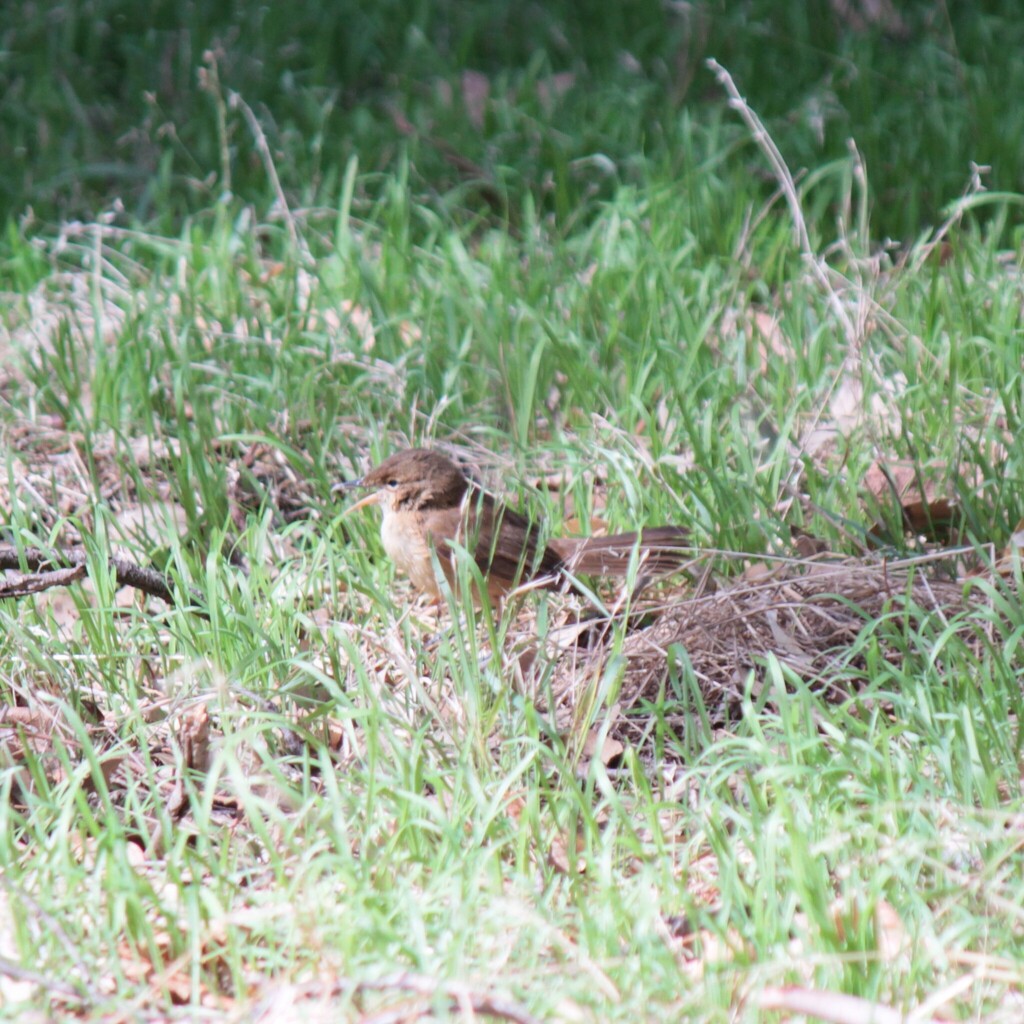
Australian Reed Warbler
Photo © A.J. Anderson
Photo © A.J. Anderson — CC BY 4.0 — Source: iNaturalist #348914875Identification
The Australian reed warbler is a long, slender warbler measuring 15–18 cm with characteristically drab brown plumage. In fresh plumage, russet-brown colouring extends from the crowned head to the back, with rufous uppertail-coverts and duller rufous-brown underparts. A pale throat and chin contrast subtly with the rest of the body. An indistinct pale brown supercilium runs from near the bill to the ear-coverts, and the crown feathers are slightly elongated, often raised into a distinctive crest during singing. The long, thin bill (17–23 mm) shows a slight downward curve with a small hook at the tip. Worn plumage appears greyer or olive-tinged on the upperparts with faded underparts. Sexes are monomorphic, though juveniles show yellowish-brownish uppertail-coverts and underparts.
Range & Habitat
This is Australia's only native Acrocephalus species and has also been recorded in Papua New Guinea and nearby islands. Two subspecies are recognised: the nominate race inhabits East and Southeast Australia including Tasmania, while the darker subspecies gouldi occurs in North and Southwest Australia. Australian reed warblers favour dense wetland vegetation in fresh, brackish and saltwater environments. They frequent reeds (Phragmites), reedmace (Typha) and rushes (Juncus), where they are often observed perched sideways along reed stems. They occasionally venture into shrublands and riparian woodlands adjacent to water bodies.
Behaviour & Diet
Unlike all other Acrocephalus species, the Australian reed warbler is migratory, breeding in Southeast and Southwest Australia during October to December before returning to overwinter grounds in Eastern and Northern Australia. Males arrive at breeding grounds from July onwards. The species produces loud, varied song described as a sweet melodious warble with rich fluty notes interspersed with hard metallic sounds, arranged in short repeated sequences separated by 3–5 second intervals. Song functions as a sexually selected trait to advertise male fitness and establish breeding territories.
Australian reed warblers forage mainly individually or in pairs, gleaning insects and spiders from dense riparian vegetation and surrounding shrubs. Occasionally they consume molluscs and seeds, and may forage on open mud near reeds. Breeding pairs are socially monogamous within each season, with both sexes building deep cup nests from dead and fresh vegetation. The species is known to engage in extra-pair copulations, and the same pairings do not typically repeat across seasons.
Best Time & Places to See It
For breeding birds, visit Southeast or Southwest Australia during October to December. Birds returning to northern and eastern overwinter grounds can be observed from January onwards. Search dense reed beds, reedmace stands and rush vegetation in wetlands, whether natural or man-made. Listen for their loud, characteristic song—an excellent aid to locating this rather inconspicuous bird among dense vegetation.
Photography Tips
Frame your subject perched sideways along a reed stem, a characteristic pose for this species. Position yourself low and shoot upward to capture the bird against clear sky, which will emphasize the russet-brown plumage and elongated crown crest. Early morning light reveals the subtle distinctions between the warmer rufous tones of fresh plumage and the greyer worn plumage. During breeding season, photograph singing males to capture the raised crest. Use fast shutter speeds when tracking birds moving through dense vegetation, and focus on the head and eye to ensure sharpness in this slender species.
Barrington Tops National Park
Belair National Park
Ben Boyd National Park
Blue Mountains National Park
Boodjamulla National Park
Bribie Island National Park
Budj Bim National Park
Carnarvon National Park
Chiltern-Mt Pilot National Park
Nothing matches these filters.
No community photos yet. Log in to add the first one.
No community observations of this species yet.