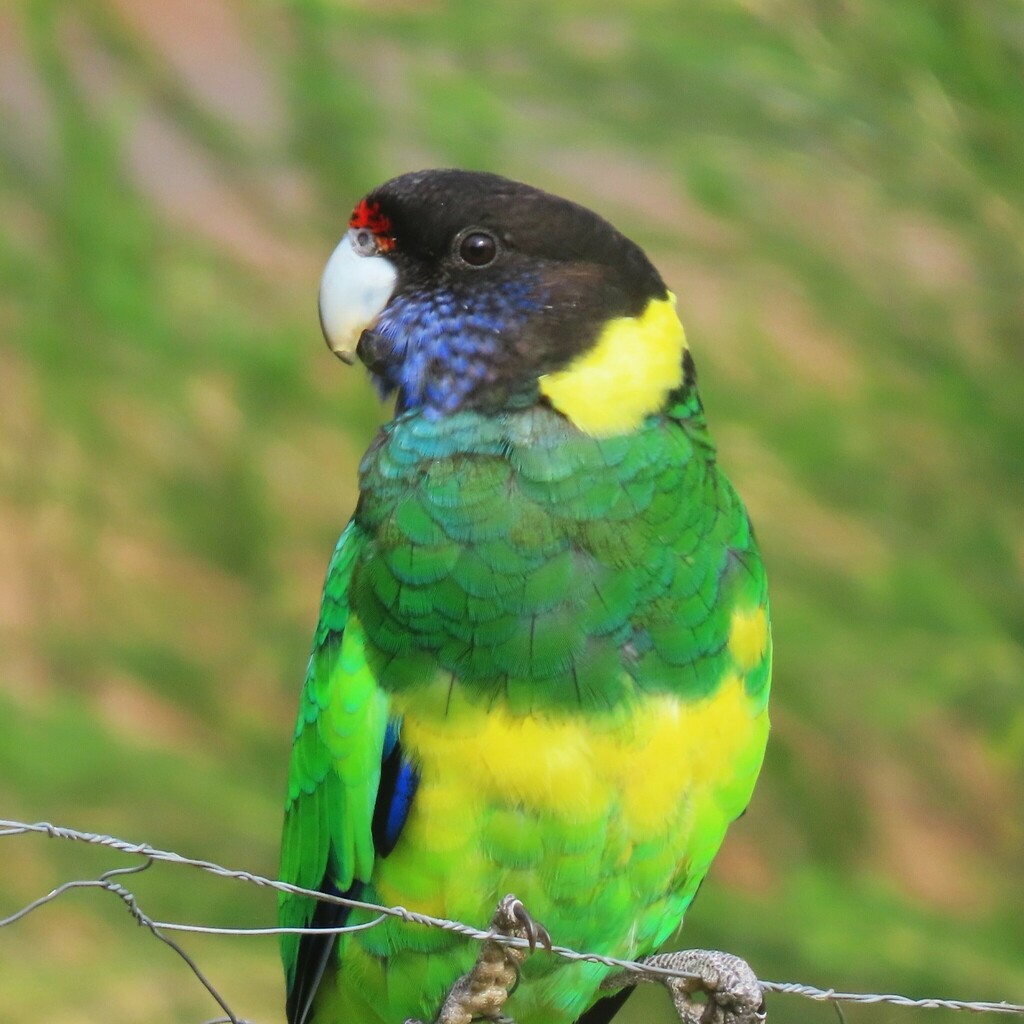
Australian Ringneck
Photo © pimelea
Photo © pimelea — CC BY 4.0 — Source: iNaturalist #206936390Identification
The Australian ringneck is a medium-sized parrot, around 33 cm (13 in) long, distinguished by its characteristic yellow ring around the hindneck—a feature shared by all four subspecies. The basic plumage is predominantly green, with wings and tail displaying a mixture of green and blue. Beyond these shared traits, the subspecies vary considerably in coloration, making field identification dependent on location.
The western subspecies (B. z. zonarius and B. z. semitorquatus) feature a dull black head, brilliant green back and wings, and bluish-green throat and breast. The key difference between them is that zonarius has a yellow abdomen while semitorquatus has a green abdomen and a prominent crimson frontal band. The eastern subspecies (B. z. barnardi and B. z. macgillivrayi) are characterized by bright green crowns and napes with blushed cheek-patches. Barnardi displays a deep blackish-blue back with turquoise-green underparts and an orange-yellow abdominal band, while macgillivrayi is generally pale green with a uniform pale yellow abdominal band.
Range & Habitat
The Australian ringneck is endemic to Australia and has adapted to all conditions except extreme tropical and highland areas. The four recognized subspecies each occupy distinct ranges across the continent, allowing travellers to encounter different color variants depending on their location.
The species favors eucalypt woodlands and eucalypt-lined watercourses, making these habitats the most reliable places to locate them during a visit.
Behaviour & Diet
Australian ringnecks are active during daylight hours and are highly gregarious birds. Depending on local conditions, populations may be resident or nomadic. The species is vocal, with calls described as either "ringing" or "strident" depending on the subspecies—most famously, the Twenty-eight parrot's call sounds like its name, an onomatopoeic description that delights many observers.
These parrots have an opportunistic diet, feeding on nectar, insects, seeds, fruit, and native and introduced bulbs. They are known to damage orchard-grown fruit and are sometimes considered agricultural pests. Breeding occurs seasonally, with northern populations beginning in June or July, while central and southern populations breed from August to December, depending on climatic conditions. Nests are established in tree-trunk hollows, where females typically lay four or five white oval eggs.
Best Time & Places to See It
The Australian ringneck's year-round presence across suitable habitat makes it accessible to travellers throughout the year, though breeding season (June to December, depending on region) offers opportunities to observe nesting and fledgling behavior. Since the species is gregarious and active during the day, early morning visits to eucalypt woodlands and eucalypt-lined watercourses will yield the best viewing opportunities.
Photography Tips
The distinct subspecies variations make comparative photography rewarding if you can visit multiple regions. The bright plumage—particularly the brilliant greens, blues, and yellow neckring—photograph well in natural light. Capture the birds in flight to showcase the blue in their wings and tails, or photograph them perched among eucalypt foliage for habitat context. Early morning light will illuminate the subtle color differences between subspecies most effectively. Listen for their distinctive calls, as these vocalizations often precede visual sightings and can alert you to nearby flocks.
Uluru-Kata Tjuta National Park
Petermann, Australia
+146 birds+10 mammals
Uluru-Kata Tjuta National Park is one of Australia’s most iconic protected areas, renowned for its breathtaking desert landscapes, extraordinary geological formations, and deep cultural significance. Located…
VIEW NATIONAL PARKIkara-Flinders Ranges National Park
Australia
+149 birds+10 mammals
Where ancient quartzite ridges rise across the semi-arid heart of South Australia, Ikara-Flinders Ranges National Park unfolds across nearly two thousand square kilometres of one of…
VIEW NATIONAL PARKLittle Desert National Park
Australia
+200 birds+11 mammals
Across northwestern Victoria's semi-arid interior, sandstone ridges and heathland plateaus rise from red earth in a landscape sculpted by fire and drought rather than water. Little…
VIEW NATIONAL PARKLincoln National Park
Australia
+149 birds+5 mammals
Across the mid-north of South Australia, where the landscape transitions from coastal lowlands toward semi-arid interior plains, sprawls a wilderness of 2,671 square kilometres where red-earth…
VIEW NATIONAL PARKCoffin Bay National Park
Australia
+143 birds+5 mammals
Across South Australia's Eyre Peninsula, where limestone headlands rise above turquoise shallows and eucalypt woodland gives way to coastal heath, lies a 1,319-square-kilometre sanctuary shaped by…
VIEW NATIONAL PARKVulkathunha-Gammon Ranges National Park
Australia
+97 birds+8 mammals
Granite ridges and quartzite peaks rise abruptly from the red earth of South Australia's mid-north, their steep slopes carved into gorges where seasonal waterfalls cascade through…
VIEW NATIONAL PARKInnes National Park
Barcelona, Australia
+141 birds+10 mammals
Granite ridges and weathered stone outcrops rise across South Australia's Fleurieu Peninsula, defining a landscape where ancient rock formations meet open eucalypt woodland and heathland scrub.…
VIEW NATIONAL PARKSundown National Park
Australia
+211 birds+9 mammals
Granite ridges and eucalypt woodlands define this 305-square-kilometre expanse of southeastern Queensland, where the landscape descends from sandstone plateaus into open forests and grassy clearings that…
VIEW NATIONAL PARKFitzgerald River National Park
Fitzgerald River National Park, Australia
+209 birds+11 mammals
Where granite peaks rise above windswept heathlands and pristine river systems carve through untamed wilderness, one of Australia's most biodiverse landscapes unfolds across the southwestern corner…
VIEW NATIONAL PARKMungo National Park
Australia
+135 birds+7 mammals
Across the semi-arid inland plains of New South Wales, where sparse shrubland and scattered grassland stretch beneath enormous skies, lies a landscape shaped by ancient geological…
VIEW NATIONAL PARKWarrumbungle National Park
Coonabarabran, Australia
+183 birds+22 mammals
Volcanic peaks and weathered ridges rise abruptly from the inland tablelands of central New South Wales, their exposed rock faces glowing ochre and rust in the…
VIEW NATIONAL PARKMurray-Sunset National Park
Australia
+205 birds+2 mammals
Across the semi-arid borderlands of northwestern Victoria, where the Murray River defines the state's edge, sprawls a landscape of remarkable resilience and subtle beauty. Murray-Sunset National…
VIEW NATIONAL PARKCoorong National Park
Australia
+217 birds+15 mammals
Where the Murray River meets the Southern Ocean, a chain of shallow lagoons stretches across the South Australian coast, separated from the sea by a ribbon…
VIEW NATIONAL PARKKalbarri National Park
Australia
+157 birds+6 mammals
Where ochre cliffs and weathered gorges slice through Western Australia's semi-arid interior, Kalbarri National Park reveals a landscape shaped by millions of years of erosion and…
VIEW NATIONAL PARKKarijini National Park
Australia
+117 birds+5 mammals
Ochre ridges and rust-coloured gorges slice through the Pilbara's ancient landscape, where Karijini National Park sprawls across a wilderness of iron-rich plateaus and plunging ravines carved…
VIEW NATIONAL PARKNambung National Park
Grey, Australia
+124 birds+2 mammals
Where limestone pinnacles rise like sharpened teeth from golden sand, Nambung National Park unveils one of Western Australia's most distinctive landscapes. The Pinnacles Desert, the park's…
VIEW NATIONAL PARKCape Range National Park
Australia
+159 birds+15 mammals
Where arid limestone ridges plunge toward turquoise waters, Cape Range National Park frames one of Australia's most dramatic desert-ocean interfaces. The park's spine—a stark, weathered range…
VIEW NATIONAL PARKStirling Range National Park
Australia
+149 birds+7 mammals
Where ancient quartzite ranges rise abruptly from the southwestern Australian plateau, Stirling Range National Park unfolds as a realm of dramatic escarpments, deep valleys, and surprising…
VIEW NATIONAL PARKNo community photos yet. Log in to add the first one.
No community observations of this species yet.