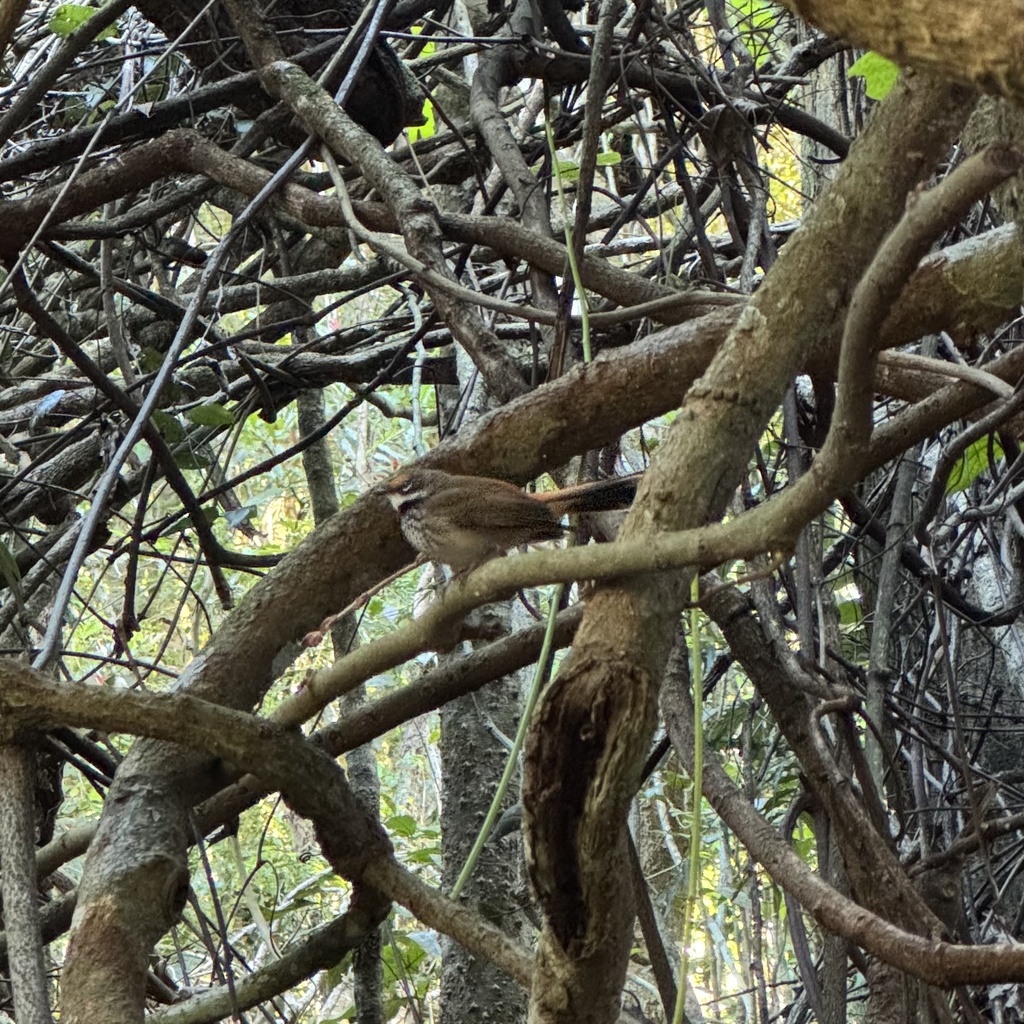
Australian Rufous Fantail
Photo © Sockrosma
Photo © Sockrosma — CC BY 4.0 — Source: iNaturalist #238891512Identification
The Australian rufous fantail is a small passerine, typically 14.5–18.5 cm in length with a wingspan of 18–22.5 cm, weighing around 10 grams. Males and females are identical in plumage, though females tend to be slightly smaller. This species is unmistakable in the field: it displays a richly reddish-brown forehead across the eyes, with a distinctive white arc marking just below each eye. The crown, nape, and upper back transition from olive to warm reddish-brown tones, contrasting sharply with a long, blackish-brown, fan-shaped tail—the source of its common name. A defining feature is the striking black and white breast pattern: a bold black bar crosses the upper breast, with the lower breast off-white and marked with black scale-like spotting that gradually fades toward the pale abdomen. Black ear-coverts sit just below and behind the eyes. The tail base is notably paler, often white-tipped, creating strong visual contrast against the darker tail feathers. Eyes, bill, and feet are brown.
Range & Habitat
The Australian rufous fantail is endemic to Australia, with two recognized subspecies reflecting its broad distribution. The subspecies R. r. intermedia occurs across Cape York Peninsula and northeastern to southeastern Queensland, while R. r. rufifrons inhabits southeastern South Australia through to northeastern New South Wales. The species is strongly migratory, breeding across south-eastern Australia in spring before undertaking a northward migration in autumn. This migratory behaviour is characteristic of the species and fundamental to understanding where and when it may be encountered.
Behaviour & Diet
The Australian rufous fantail is an exceptionally active and acrobatic hunter, constantly making short, frequent flights as it pursues small insects through the lower canopy. When not in flight, it hops energetically between foliage or forages on the ground, displaying the restless, dynamic behaviour typical of fantails. Its diet consists almost entirely of small insects gleaned from vegetation and air. This is a highly animated species, rarely still, making it a rewarding subject for observers willing to track its rapid movements.
Best Time & Places to See It
Timing is crucial for encountering this species: visit south-eastern Australia during spring for breeding birds and the opportunity to observe their most active behaviour. The species' relatively large range and overall abundance make it fairly regularly encountered across suitable habitats throughout its range, though population numbers are thought to be declining. Look for the species in lower canopy levels where it hunts most actively, particularly in areas offering dense foliage and abundant small insects.
Photography Tips
The rufous fantail's small size and constant activity present both challenge and opportunity for photographers. Its striking plumage—the contrast between reddish-brown and black—renders well in natural light, but fast shutter speeds are essential to freeze the bird's characteristically rapid movements and frequent short flights. Position yourself where backlighting can illuminate the fan-shaped tail display and emphasize the white arc beneath the eye. Early morning light is ideal for capturing the rich warm tones of the back and rump. Patient positioning near flowering trees or fruiting shrubs where insects congregate may reward you with prolonged observation windows and the chance to capture hunting sequences in flight.
Bald Rock National Park
Barrington Tops National Park
Ben Boyd National Park
Blue Mountains National Park
Boodjamulla National Park
Bouddi National Park
Bribie Island National Park
Budawang National Park
Budj Bim National Park
Nothing matches these filters.
No community photos yet. Log in to add the first one.
No community observations of this species yet.