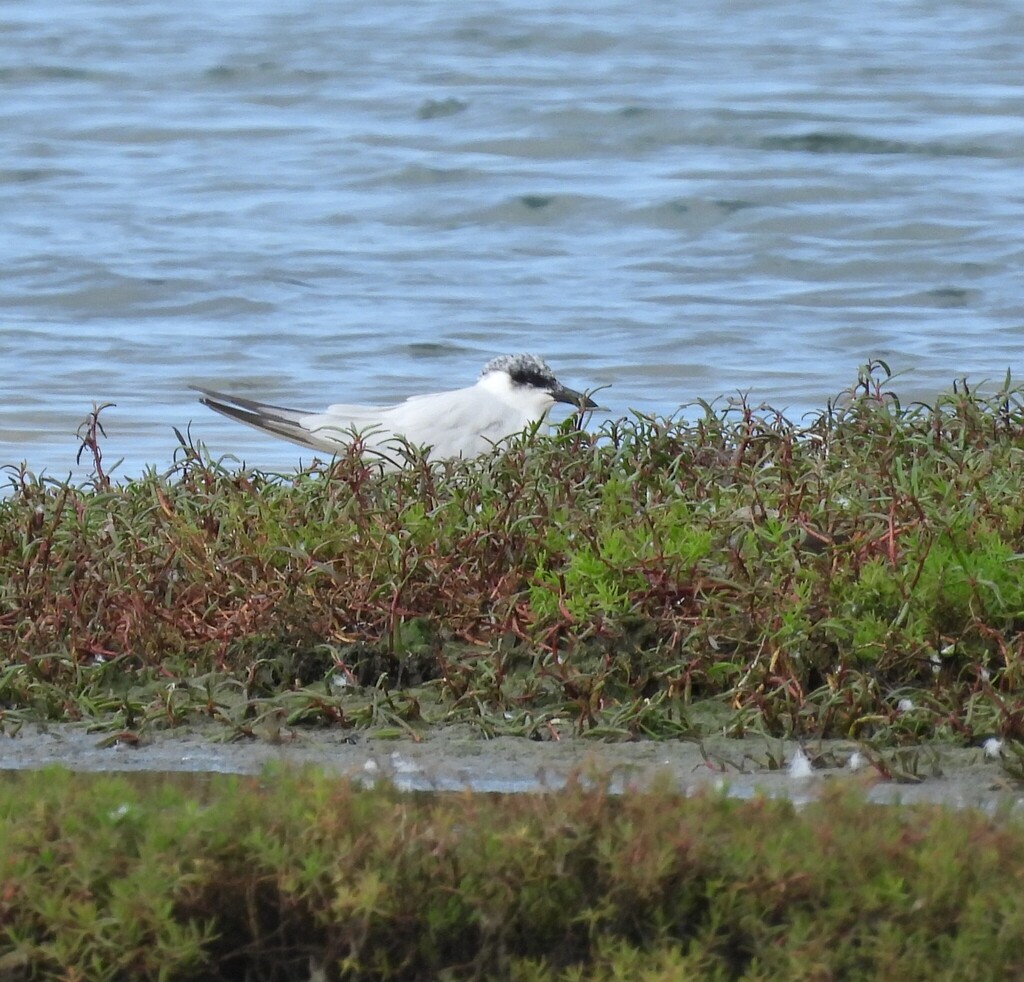
Australian Tern
Photo © Mark Clarke
Photo © Mark Clarke — CC BY 4.0 — Source: iNaturalist #285874944Identification
The Australian tern is a fairly large and powerful tern, similar in size and general appearance to a Sandwich tern. At 33–42 cm in length with a wingspan of 76–91 cm, it is a substantial member of its family. The most distinctive features are its short, thick gull-like bill, broad wings, long legs, and robust body. In summer plumage, adults display pale grey upperparts with white underparts, a striking black cap, strong black bill, and black legs. The characteristic call is a sharp ker-wik. In winter, the bird loses its cap and develops a dark patch through the eye, resembling a Forster's tern or Mediterranean gull. Juveniles show a fainter mask but otherwise resemble winter adults. The Australian tern differs from its closely related cousin, the gull-billed tern, in being slightly larger, paler grey above, and sporting an obviously larger, heavier bill.
Range & Habitat
The Australian tern breeds throughout Australia, with some individuals reaching New Guinea during the non-breeding season. This species breeds in colonies on lakes, marshes, and coastal areas, nesting in simple ground scrapes where females lay two to five eggs.
Behaviour & Diet
The Australian tern is somewhat atypical among terns, appearing similar to Sterna terns but exhibiting feeding habits more reminiscent of marsh terns. Unlike most white terns, it does not normally plunge dive for fish. Instead, it maintains a notably broader diet and employs more varied hunting techniques. The species largely feeds on insects taken in flight and frequently hunts over wet fields and brushy areas in search of amphibians and small mammals. As an opportunistic feeder, the Australian tern has even been observed picking up and consuming dead dragonflies from roads, demonstrating its adaptable foraging strategy.
Best Time & Places to See It
The Australian tern can be found throughout Australian lakes, marshes, and coastal regions where breeding colonies establish themselves. The breeding season represents the best time to observe the species in its most striking plumage, when the black cap and strong bill markings are most prominent. Look for these birds hunting over shallow waters and wet fields, where their characteristic aerial feeding behaviour makes them relatively conspicuous.
Photography Tips
Photographers should focus on capturing the distinctive features that set this species apart: the thick, gull-like bill, the contrast between pale grey upperparts and white underparts, and the striking black cap during breeding season. The bird's aerial hunting behaviour over wetlands and fields provides dynamic photo opportunities. Position yourself near breeding colonies or favoured feeding grounds at lakes and marshes for the best chances. During winter months, include the characteristic dark eye-patch in your composition to document seasonal plumage changes. The robust body shape and broad wings are best appreciated from side angles during flight.
Mount Coolum National Park
Sunshine Coast, Australia
+124 birds+3 mammals
Rising abruptly from the hinterland plateau of Queensland's Sunshine Coast, Mount Coolum commands attention as a distinctive volcanic remnant clothed in open eucalypt woodland and heathland…
VIEW NATIONAL PARKKakadu National Park
Kakadu, Australia
+273 birds+46 mammals
Kakadu National Park is Australia’s largest national park and one of the world’s most remarkable protected areas, covering nearly 20,000 square kilometres in the tropical north…
VIEW NATIONAL PARKDaintree National Park
Dedin, Australia
+362 birds+37 mammals
Daintree National Park is one of the world’s oldest and most biologically diverse tropical rainforests, protecting an extraordinary landscape where ancient forests meet the Great Barrier…
VIEW NATIONAL PARKRoyal National Park
Sydney, Australia
+296 birds+46 mammals
Where sandstone ridges plunge toward the Tasman Sea, Royal National Park unfolds across 343 square kilometres of southeastern Australian coastal wilderness. The park's defining character emerges…
VIEW NATIONAL PARKGheebulum Kunungai National Park
Moreton Island, Australia
+168 birds+7 mammals
Sand dunes rise and fall across Moreton Island's eastern shore, a landscape sculpted by wind and ocean currents into one of Australia's most dynamic coastal ecosystems.…
VIEW NATIONAL PARKAnnan River (Yuku Baja-Muliku) National Park
Australia
+78 birds
Where the Annan River winds through northeastern Queensland's coastal hinterland, a compact national park of roughly 246 square kilometers protects a mosaic of subtropical rainforest, eucalypt…
VIEW NATIONAL PARKEndeavour River National Park
Philadelphia, Australia
+203 birds+1 mammals
Where the Endeavour River winds through northeastern Queensland's tropical lowlands, a compact mosaic of rainforest, open woodland, and riverine corridor creates one of Australia's most ecologically…
VIEW NATIONAL PARKRinyirru National Park
Lakefield, Australia
+258 birds+7 mammals
Where the savanna grasslands of far north Queensland meet seasonal wetlands and eucalypt woodlands, Rinyirru National Park sprawls across more than 12,500 square kilometres of rugged,…
VIEW NATIONAL PARKBribie Island National Park
Brisbane, Australia
+284 birds+20 mammals
Across tidal flats and shallow waterways north of Brisbane, Bribie Island National Park spreads across nearly four hundred square kilometres of subtropical coastal wilderness—a patchwork of…
VIEW NATIONAL PARKWilsons Promontory National Park
Australia
+210 birds+21 mammals
Where granite headlands plunge toward Bass Strait, Wilson's Promontory National Park sprawls across nearly 1,300 square kilometers of southeastern Victoria's most rugged coastal wilderness. The park's…
VIEW NATIONAL PARKFitzgerald River National Park
Fitzgerald River National Park, Australia
+209 birds+11 mammals
Where granite peaks rise above windswept heathlands and pristine river systems carve through untamed wilderness, one of Australia's most biodiverse landscapes unfolds across the southwestern corner…
VIEW NATIONAL PARKWhitsunday Islands National Park
Whitsundays, Australia
+163 birds+9 mammals
Crystalline waters lap against seventy-four islands where rainforest canopies tumble down to pristine beaches and coral gardens flourish in the shallows. This archipelago off Queensland's coast…
VIEW NATIONAL PARKGreat Sandy National Park
Australia
+306 birds+40 mammals
Where coastal dunes rise inland from the Queensland coastline, Great Sandy National Park encompasses a landscape of remarkable ecological diversity shaped by subtropical humid conditions year-round.…
VIEW NATIONAL PARKNoosa National Park
Marcus Beach, Australia
+216 birds+8 mammals
Subtropical eucalypt woodland and open forest meet coastal heathland along the Noosa Peninsula, where the temperate waters of the Tasman current moderate the Queensland climate into…
VIEW NATIONAL PARKBen Boyd National Park
Eden, Australia
+255 birds+47 mammals
Where the temperate forests of the far south coast meet towering sea cliffs, Ben Boyd National Park unveils one of New South Wales' most dramatic coastal…
VIEW NATIONAL PARKGreat Otway National Park
Australia
+255 birds+42 mammals
Temperate rainforest and wet eucalyptus woodland cloak the ridges and gullies of Victoria's Great Otway National Park, where persistent moisture and mild year-round temperatures sustain a…
VIEW NATIONAL PARKMurray-Sunset National Park
Australia
+205 birds+2 mammals
Across the semi-arid borderlands of northwestern Victoria, where the Murray River defines the state's edge, sprawls a landscape of remarkable resilience and subtle beauty. Murray-Sunset National…
VIEW NATIONAL PARKCoorong National Park
Australia
+217 birds+15 mammals
Where the Murray River meets the Southern Ocean, a chain of shallow lagoons stretches across the South Australian coast, separated from the sea by a ribbon…
VIEW NATIONAL PARKCape Range National Park
Australia
+159 birds+15 mammals
Where arid limestone ridges plunge toward turquoise waters, Cape Range National Park frames one of Australia's most dramatic desert-ocean interfaces. The park's spine—a stark, weathered range…
VIEW NATIONAL PARKNo community photos yet. Log in to add the first one.
No community observations of this species yet.