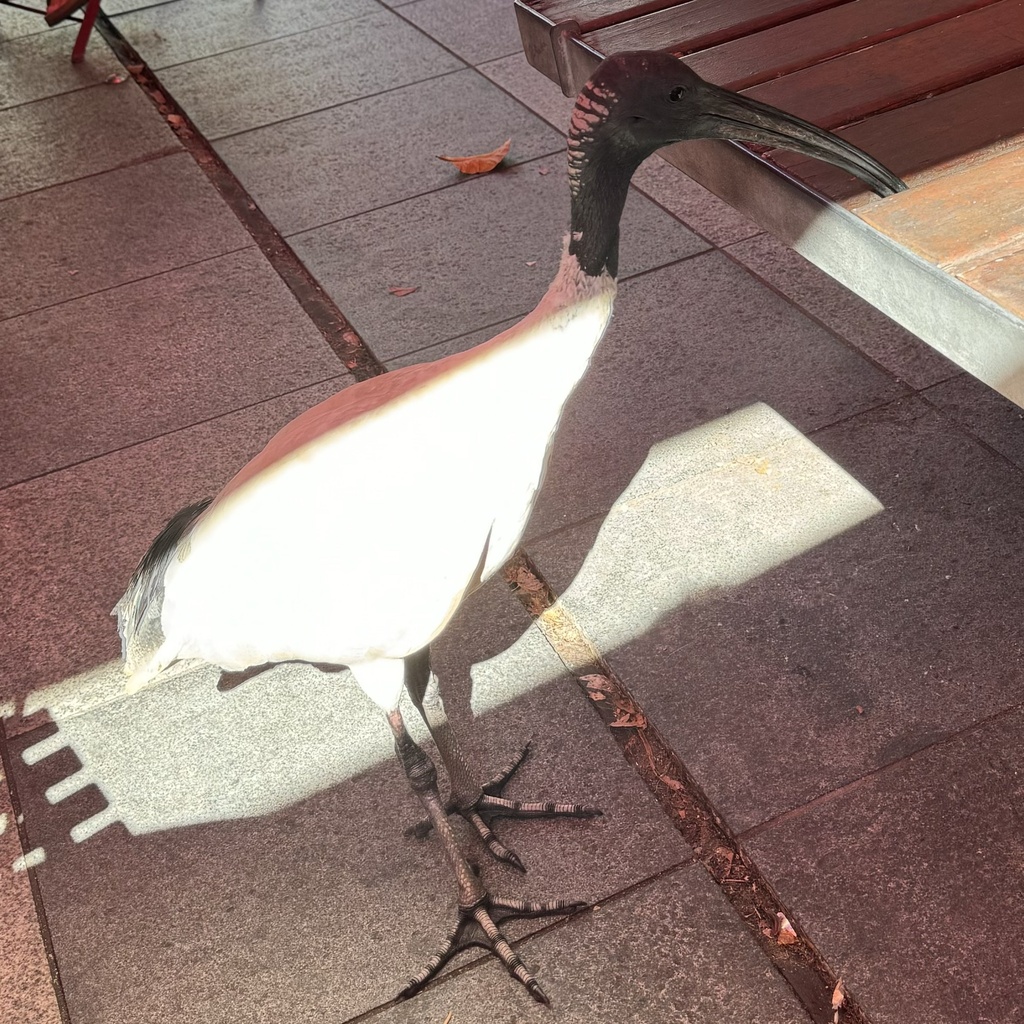
Australian White Ibis
Photo © Sockrosma
Photo © Sockrosma — CC BY 4.0 — Source: iNaturalist #200607379Identification
The Australian white ibis is a large wading bird, 65–75 cm long, unmistakable in its predominantly white plumage. Its most striking features are the bare black head and neck, long downcurved black bill (over 16.7 cm in males), and dark legs. Males are slightly larger and heavier than females, weighing 1.7–2.5 kg compared to females at 1.4–1.9 kg. In breeding season, the upper tail becomes yellow. The inner secondary feathers display as distinctive lacy black markings. Juveniles differ noticeably: they have feathered heads and necks, shorter bills, and show plumage patterns intermediate between adults and other related species. Red skin is visible on the underwing in flight.
Range & Habitat
The Australian white ibis is widespread across eastern, northern, and south-western Australia, absent only from Tasmania. Naturally, it inhabits marshy wetlands often adjacent to open grasslands. Since the late 1970s, it has dramatically increased in urban areas along the east coast and in Perth, becoming common in city parks and rubbish dumps of Sydney, Melbourne, Brisbane, the Gold Coast, Townsville, Adelaide, Darwin, Wollongong, and surrounding towns. Historically rare in cities, the species colonised urban environments after droughts in the late 1970s pushed birds eastward. Ironically, traditional breeding areas such as the Macquarie Marshes in northern New South Wales have seen populations disappear entirely, with no nests recorded there since 2000 despite 11,000 being present in 1998.
Behaviour & Diet
The Australian white ibis reaches sexual maturity at three years and can live to twenty-eight years of age. It produces a distinctive long croak call. The species has successfully adapted to urban life by dramatically reducing its fear response to humans and expanding its diet far beyond natural foods to include human refuse—a flexibility that related species such as straw-necked ibis and spoonbills have not achieved. This dietary plasticity, combined with reduced wariness, has enabled explosive population booms in urban centres, particularly during the 1970s, early 2000s, and around 2010. Urban flocks often approach humans at close quarters, feed from rubbish bins, and scavenge from outdoor dining areas.
Best Time & Places to See It
The Australian white ibis is now reliably seen year-round in major east-coast cities and Perth. Sydney, Melbourne, Brisbane, and the Gold Coast offer the best urban viewing opportunities, where birds are common in parks and around rubbish dumps. The species is present throughout the year, though breeding season (when the upper tail becomes yellow) offers distinctive plumage variations. Outside urban areas, marshy wetlands in eastern, northern, and south-western Australia remain important strongholds, though natural breeding populations have declined significantly.
Photography Tips
The Australian white ibis's stark black-and-white plumage and bold bare head make it visually striking in photographs. Capture the distinctive long downcurved bill in profile to showcase the species's characteristic silhouette. In urban settings, photograph birds interacting with their environment—feeding, wading, or displaying their lacy black secondary feathers in flight. During breeding season, watch for the yellow upper tail. The contrast between white plumage and bare black head is maximized in bright daylight. Juvenile birds offer different photographic interest with their feathered heads and shorter bills; the transitional plumage of young birds can be particularly compelling. Urban flocks often allow close approach, providing excellent opportunities for detailed portraiture.
Annan River (Yuku Baja-Muliku) National Park
Belair National Park
Ben Boyd National Park
Blue Mountains National Park
Bouddi National Park
Bribie Island National Park
Budj Bim National Park
Cania Gorge National Park
Cape Range National Park
Nothing matches these filters.
No community photos yet. Log in to add the first one.
No community observations of this species yet.