Identification
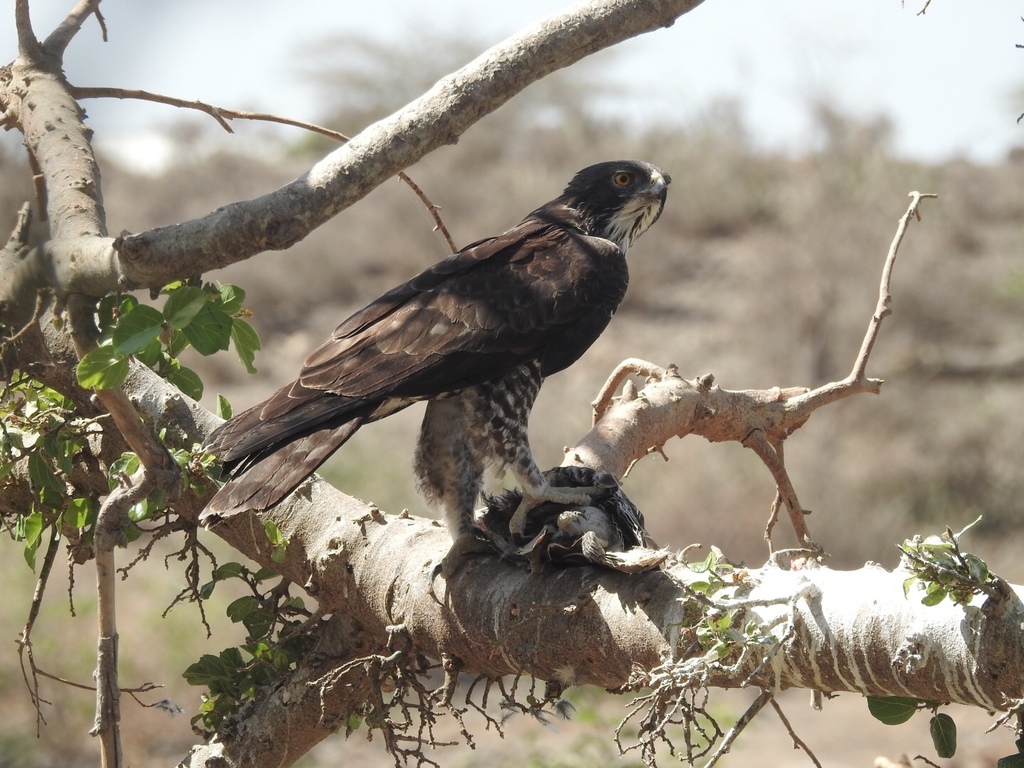
Ayres's hawk-eagle is a compact, medium-sized raptor about the size of a peregrine falcon. Adults display blackish upper parts mottled with white, typically featuring a white forehead and supercilium. The tail is ashy grey with a broad black tip and three to four darker bars. The underparts are white with heavy dark brown spots and blotches concentrated on the breast and belly, with pure white, well-feathered legs. A small but sometimes pronounced crest adorns the crown. Eyes are yellow to orange, with yellow cere and feet; the bill is bluish horn-coloured with a black tip. Females are noticeably larger and heavier than males, with less white on the face and denser spotting below. A melanistic phase exists, appearing mostly black with white markings. Juveniles are dark brown above with largely white underparts and sparse dark markings. The species can be confused with the African hawk-eagle (larger and lankier) and the booted eagle (which shares white wing patches but differs in overall plumage).
Range & Habitat
This eagle has a patchy sub-Saharan distribution extending from Sierra Leone east to Somalia and south to northern Namibia and northeast South Africa. Its core range spans from southern Democratic Republic of the Congo and southern Uganda through most of Kenya, Tanzania, Zambia, Mozambique, Angola, and into northern Botswana and Zimbabwe. Ayres's hawk-eagles favour mature woodlands, particularly Brachystegia and Baikiaea associations, often in irregular, rocky terrain. They show strong seasonal movements, retreating from dense, tall deciduous woodlands during the rainy season to more open savanna habitats further south and into coastal East Africa as woodlands transform into forests. They occasionally visit towns in South Africa and may use riparian zones and Acacia plantations, but avoid forests and treeless, hyper-arid regions.
Behaviour & Diet
Ayres's hawk-eagle is almost exclusively a bird hunter, employing a falcon-like, highly aerial hunting method unique among Aquilinae eagles. It soars high searching for prey, then stoops to intercept birds in mid-air with exceptional agility and speed, capable of overtaking many species in flight. Preferred prey includes laughing doves and red-eyed doves, though it hunts a variety of small birds typically weighing 40 to 200 grams. Occasionally it captures small mammals including bush squirrels and fruit bats, but these remain uncommon in its diet.
Best Time & Places to See It
The species' seasonal movements make timing important for observation. During the rainy season, birds move south from central African woodlands into more open savanna habitats. Southern African locations, particularly in Zambia, Zimbabwe, Mozambique, and northern Botswana, offer good viewing opportunities during these movements. The eagle may also appear in South African towns where it hunts urban pigeon populations. Open woodland habitats with scattered rocky terrain provide the best viewing opportunities, where the bird's high soaring behaviour makes it relatively visible despite its preference for remaining aloft while hunting.
Photography Tips
Photographing Ayres's hawk-eagle requires patience and positioning in open woodland habitat during daylight hours. The species' high-altitude soaring behaviour demands telephoto lenses and fast shutter speeds to capture sharp images against bright skies. Early morning or late afternoon light often provides better contrast for capturing plumage details. Look for the characteristic white underparts and spotted breast pattern as identifying features in flight photos. The eagle's rapid stooping dives when hunting present challenging but rewarding photographic opportunities for those with experience tracking fast-moving raptors. Visiting during seasonal movements into southern savannas increases encounter rates significantly.
Bwindi Impenetrable National Park
Lake Mburo National Park
Mabamba Swamp
Murchison Falls National Park
Queen Elizabeth National Park
Aberdare National Park
Amboseli National Park
Arabuko Sokoke Forest Reserve
Arusha National Park
Nothing matches these filters.
No community photos yet. Log in to add the first one.
No community observations of this species yet.