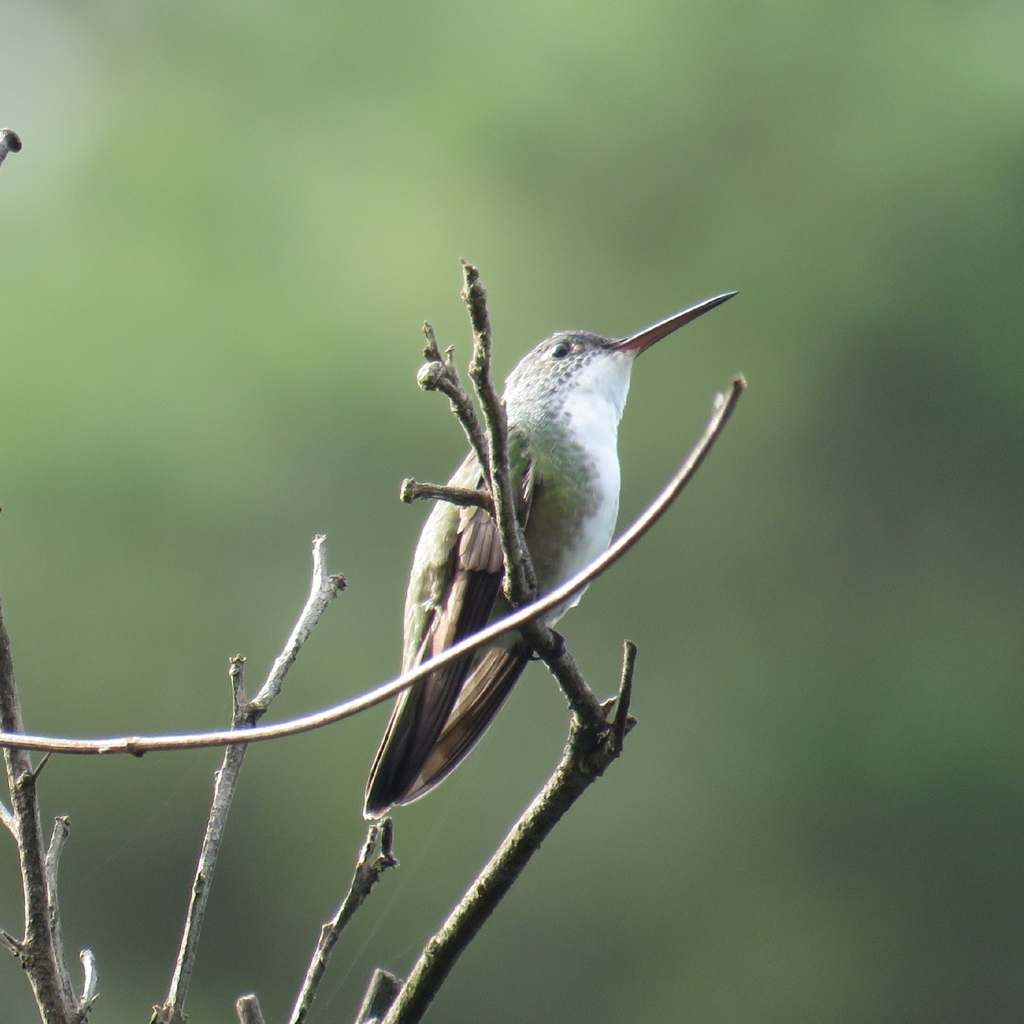
Azure-crowned Hummingbird
Photo © Sobeida Morales
Photo © Sobeida Morales — CC0 1.0 — Source: iNaturalist #108483453Identification
The azure-crowned hummingbird is a small emerald hummingbird, measuring 10 to 11.5 cm long and weighing around 5.6 grams—barely heavier than a penny. Both sexes share a distinctive metallic bronze nape and back, with greenish-bronze to bronze-green rumps and tails. The face is predominantly bluish-green, and the underparts are white with metallic bronze-green sides and flanks. The most striking feature is the crown: males of the nominate subspecies display a bright metallic blue crown, while females show a duller blue to greenish-blue cap. The chlorostephana subspecies replaces this blue crown with a glittering green one. All birds have black upper bills paired with dull pink mandibles that show black outer thirds. Immatures appear duller overall, with grayish-buff tips to the uppertail coverts and a wash of buff across the underparts.
Range & Habitat
The azure-crowned hummingbird is found across Mexico, Central America, and into Nicaragua, with the nominate subspecies ranging from Tamaulipas south through Belize, Guatemala, El Salvador, and into north-central Nicaragua. The disjunct chlorostephana subspecies inhabits the Mosquito Coast of eastern Honduras and northeastern Nicaragua. These birds favor the edges of humid evergreen forests, oak and pine-oak woodlands, scrublands, and secondary growth, typically between 600 and 2,400 meters in elevation. The chlorostephana subspecies shows a preference for pine savanna at lower elevations.
Behaviour & Diet
Azure-crowned hummingbirds are mostly sedentary residents, though they may undertake local seasonal movements. They forage for nectar across multiple forest strata, from the understory to the canopy, employing both trap-lining and territorial feeding strategies. In pine savanna habitats, they have been observed hovering at needle clusters and bark crevices, possibly hunting small arthropods or visiting epiphyte flowers, though dietary details remain incompletely documented.
Breeding seasons vary by location but span at least February through July. Females construct small cup nests from locally available materials, typically placing them in branch forks or saddling them over branches; in urban areas, some nests have been spotted on utility wires. The species produces distinctive vocalizations: a low, buzzy "dzzzrt" sound both in flight and when perched (often repeated steadily), and a fairly mellow, strong chipping that can develop into trills or rattles.
Best Time & Places to See It
For the best chance to encounter azure-crowned hummingbirds, visit humid forest edges, oak-pine woodland, or secondary forest within their range during the breeding season from February to July. The nominate subspecies is more widely distributed and accessible across Mexico and Central America, while the chlorostephana subspecies offers a specialized birding target in the pine savannas of the Mosquito Coast. These mostly sedentary birds can be reliably found in suitable habitat throughout their range.
Photography Tips
Photograph azure-crowned hummingbirds in open understory or forest-edge settings where light penetrates the canopy. The males' brilliant blue crowns photograph best in strong, direct light that reveals their metallic sheen. Patient positioning near flowering plants or known feeding territories will increase opportunities for action shots. Their small size and energetic foraging behavior demand fast shutter speeds and careful focus tracking. Early morning light often produces the most vibrant color rendition of their iridescent plumage.
No community photos yet. Log in to add the first one.
No community observations of this species yet.