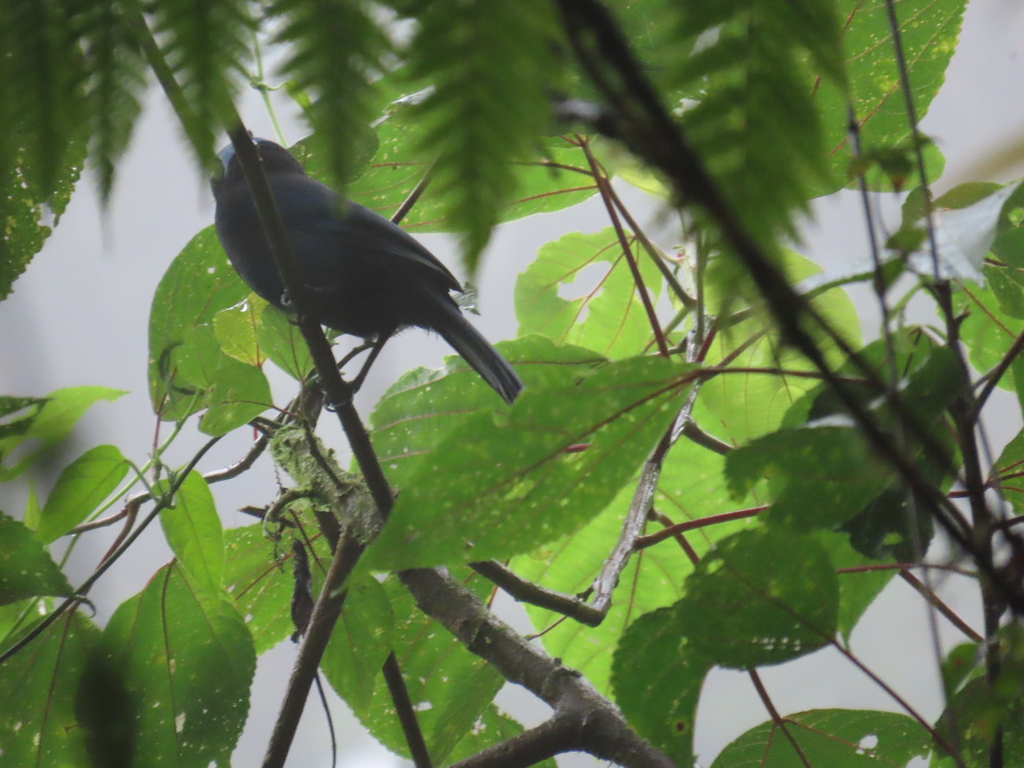
Azure-hooded Jay
Photo © Viktor
Photo © Viktor — CC BY 4.0 — Source: iNaturalist #206833008Identification
The azure-hooded jay is a striking corvid measuring 11 to 12 inches in length. Its most distinctive feature is the striking contrast between its dark blue body and black head and upper chest, set off by a brilliant sky-blue crown and nape bordered in white. The legs and bill are black, and the eyes are a distinctive dark red. Both sexes appear similar, though juveniles are noticeably duller with a sky-blue hood lacking the crisp white border of adults. The bird's large frame supports the considerable flying it undertakes throughout its montane forest habitat.
Range & Habitat
The azure-hooded jay is found across Middle America, with its range spanning from southeastern Mexico through Guatemala, Honduras, Costa Rica, and western Panama. Four subspecies are recognized, each occupying different portions of this range. This species inhabits subtropical and tropical moist montane forests, typically at middle to higher elevations where cloud forest remains uninterrupted. It frequents the edges of humid evergreen forests, sometimes interspersed with pine trees, and is typically found in the canopy rather than at ground level.
Behaviour & Diet
The azure-hooded jay is notably secretive and skulking, which makes it challenging to observe despite its striking appearance. It travels in small groups of two to ten individuals and frequently joins mixed-species flocks with other species such as unicolored jays and emerald toucanets. The bird produces a variety of vocalizations, including a loud, bright "eihnk-eihnk" repeated four to five times, nasal sounds, and a distinctive alarm call described as a nasal, querulous "reek!"
As an omnivore, the azure-hooded jay forages primarily in the forest canopy for berries, seeds, and small dead animals. It has even been documented stealing bait from traps set for small mammals. Like other corvids, it is presumed to be highly intelligent, though its secretive nature has prevented detailed observation of problem-solving behaviors documented in related species.
Best Time & Places to See It
The azure-hooded jay is uncommon in parts of its range, and its secretive behavior makes it a challenging species to locate. Your best opportunities lie in protected cloud forest reserves and montane regions from southern Mexico through Central America. The species is present year-round throughout its range, with young typically fledging between April and June. Patience and careful listening for its distinctive vocalizations are essential, as the bird rarely ventures into open areas where it might be easily spotted.
Photography Tips
Photographing the azure-hooded jay requires patience and persistence given its secretive nature and preference for the forest canopy. Position yourself near known cloud forest habitat and listen carefully for its loud, bright calls, which may lead you to feeding groups. The bird's striking plumage—particularly the contrast between the black head and sky-blue hood with white border—offers excellent photographic potential when you do locate it. Early morning and late afternoon often provide better light in montane forests, and remain alert for mixed-species flocks, which may contain azure-hooded jays.
Arenal Volcano National Park
Peñas Blancas, Costa Rica
+551 birds+21 mammals
Straddling the border between Alajuela and Guanacaste in northwestern Costa Rica, this national park rises dramatically around one of Central America's most active volcanic systems. The…
VIEW NATIONAL PARKBraulio Carrillo National Park
Las Horquetas, Costa Rica
+547 birds+18 mammals
Where the Caribbean slope descends from the central volcanic cordillera toward the humid lowlands of Heredia, Braulio Carrillo National Park preserves one of Costa Rica's most…
VIEW NATIONAL PARKVolcán Poás National Park
Toro Amarillo, Costa Rica
+237 birds+4 mammals
Where volcanic slopes rise sharply from the Central Valley floor, Volcán Poás National Park protects one of Costa Rica's most active and accessible volcanic systems. The…
VIEW NATIONAL PARKLagunas de Montebello National Park
Laguna de Montebello, Mexico
+360 birds+2 mammals
Where turquoise lagoons pierce the limestone plateau of southeastern Chiapas, the Lagunas de Montebello National Park unfolds across roughly 174 square kilometers of spectral water and…
VIEW NATIONAL PARKTapantí Macizo de la Muerte National Park
Orosi, Costa Rica
+503 birds+18 mammals
Where montane cloud forest rises steeply from the Orosi Valley, Tapantí Macizo de la Muerte National Park enfolds a landscape of perpetual moisture and emerald complexity.…
VIEW NATIONAL PARKNo community photos yet. Log in to add the first one.
No community observations of this species yet.