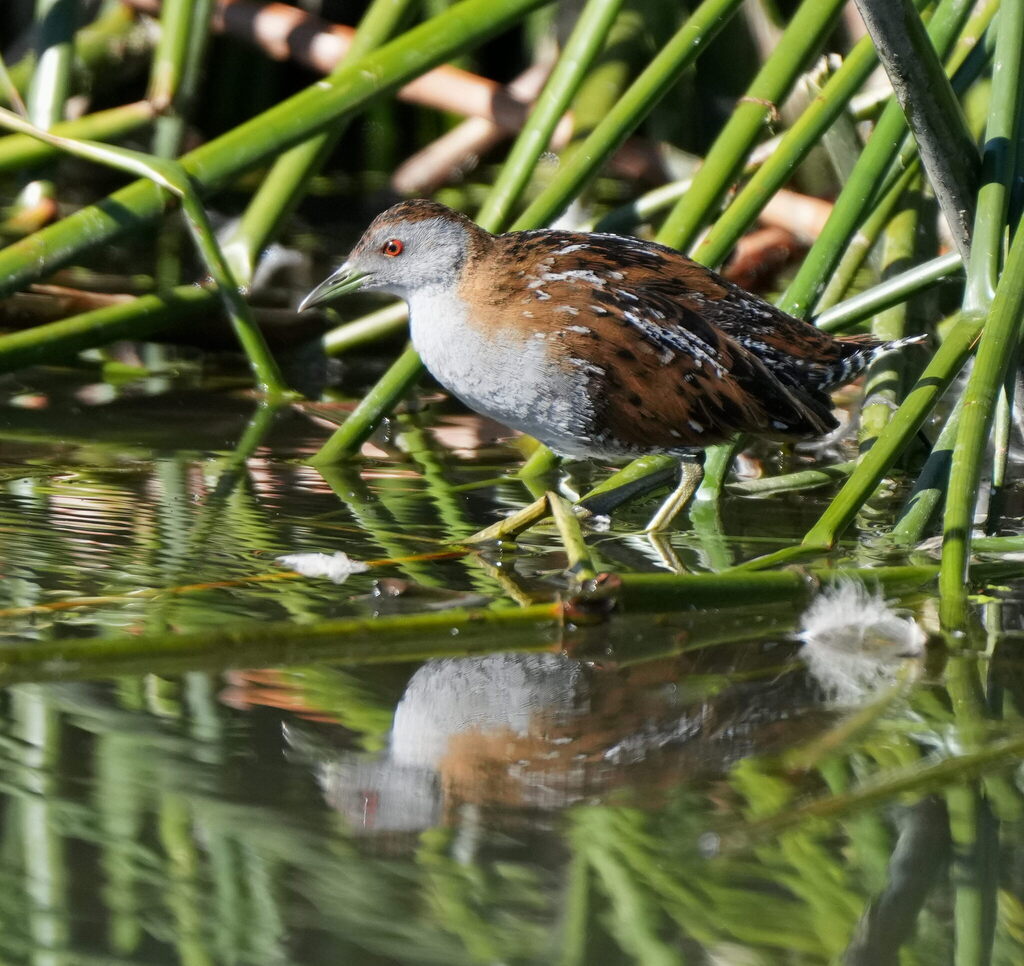
Baillon’s Crake
Photo © William Harland
Photo © William Harland — CC BY 4.0 — Source: iNaturalist #269741316Identification
Baillon's crake is a diminutive waterbird, measuring just 15–18 cm in length, making it one of the smallest members of the rail family. Adults are characterized by ochre-brown upperparts with subtle black and white streaking, contrasting sharply with their distinctive light blue-grey underparts. The throat, breast, and abdomen are paler, while the flanks and under-tail coverts display bold black and white barring. The bird has a short, straight bill that is yellow or green without a red base, and notably olive-green legs with elongated toes. Immature birds are similar to adults but appear duller with more extensive barring on the underparts. Like all rail chicks, juveniles are black.
Range & Habitat
Baillon's crake breeds across a vast range from Eastern Europe to Honshu in Japan, favoring sedge beds and swamps. The European breeding population was estimated at 4,000 to 9,000 individuals as of 2016. Historically present in Great Britain until the mid-19th century, the species has shown remarkable recovery in recent decades, with recolonization documented in Germany and the Netherlands, suspected breeding in Britain, and an Irish record in 2012—the first in over 150 years. The Hungarian population declined during the 20th century due to wetland drainage. This migratory species winters in East Africa and South Asia, while populations also breed year-round in Africa and Australasia. At least five subspecies are recognized across Asia, Africa, Australia, New Guinea, Borneo, and New Zealand. A single North American vagrant was recorded on Attu Island in September 2000.
Behaviour & Diet
Baillon's crakes are exceptionally secretive during the breeding season and are far more often heard than seen. They produce a distinctive, noisy rattling call reminiscent of edible frogs or garganey ducks. These birds forage by probing their bills in mud and shallow water, as well as by picking up food visually. Their diet consists primarily of insects and aquatic animals. They become considerably easier to observe during migration and winter, when they are less tied to breeding territories.
Best Time & Places to See It
While Baillon's crakes are notoriously difficult to observe during breeding season due to their secretive nature, your chances of sighting one improve significantly during migration periods and winter months. The species winters in East Africa and South Asia, offering opportunities for observers in these regions. Recent recolonization efforts in northwestern Europe mean that spring and early summer visits to wetland reserves in Germany and the Netherlands may yield sightings. Listen carefully for their distinctive rattling calls in suitable sedge and swamp habitat, as audio detection often precedes visual confirmation.
Photography Tips
Photographing Baillon's crakes presents considerable challenges owing to their secretive habits and preference for dense vegetation. During breeding season, patience and acoustic monitoring are essential—locate birds by their calls, then position yourself quietly at the habitat edge at dawn or dusk. Wintering birds are generally more approachable; focus on open edges of wetlands and shallow water where they forage. Use a telephoto lens (minimum 400 mm) to maintain distance and avoid disturbance. Fast film or high ISO settings are necessary for the low-light conditions typical of sedge beds. Photographing migrating birds along coastal wetlands may offer better opportunities for closer approaches and clearer images than breeding-season attempts.
Abel Tasman National Park
Amboseli National Park
Bardenas Reales
Bardiya National Park
Biebrza National Park
Bribie Island National Park
Bwabwata National Park
Cabo de Gata-Níjar Natural Park
Camargue Regional Nature Park
Nothing matches these filters.
No community photos yet. Log in to add the first one.
No community observations of this species yet.