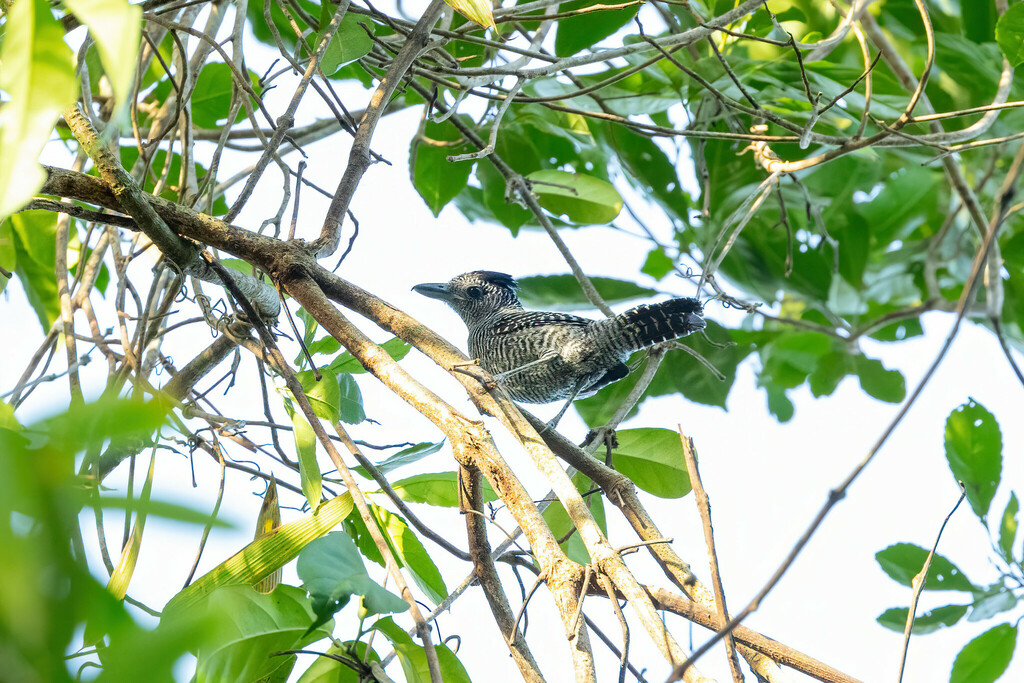
Bamboo Antshrike
Photo © Thibaud Aronson
Photo © Thibaud Aronson — CC BY-SA 4.0 — Source: iNaturalist #196038192The bamboo antshrike (Cymbilaimus sanctaemariae) is a species of bird in subfamily Thamnophilinae of family Thamnophilidae, the "typical antbirds". It is found in Bolivia, Brazil, and Peru. == Taxonomy and systematics == Until the 1980s what is now the bamboo antshrike was treated as a subspecies of the fasciated antshrike (C. lineatus). The two are the only species in genus Cymbilaimus. The bamboo antshrike is monotypic. == Description == The bamboo antshrike is 16 to 17 cm (6.3 to 6.7 in) long and weighs 28 to 33 g (0.99 to 1.2 oz). This species exhibits significant sexual dimorphism. Both sexes have a small crest, a dark brown iris, and a somewhat heavy bill with a hook at the end like true shrikes. Adult males have a black forehead and crown; the rest of their plumage is thin black and white bars. Females have a rufous crown with black tips on the crest feathers. Their upperparts and tail have thin dark brown and pale yellowish brown bars, their throat is plain buffy white, and the rest of their underparts are mostly plain cinnamon-buff with darker barring on the sides and flanks. == Distribution and habitat == The bamboo antshrike is found…
Pacaás Novos National Park
Brazil
+279 birds+1 mammals
Across the border between Rondônia and Amazonas, vast tracts of humid tropical forest rise and fall in gentle undulations, carved by clear-flowing rivers that feed into…
VIEW NATIONAL PARKManu National Park
Manu, Peru
+892 birds+26 mammals
Across the eastern slopes of the Peruvian Andes, tropical rainforest descends into the Amazon basin with a complexity that few terrestrial ecosystems match. Manu National Park…
VIEW NATIONAL PARKBahuaja Sonene National Park
San Pedro de Putina Punco, Peru
+602 birds+8 mammals
Where the Madre de Dios and Heath rivers converge in southeastern Peru rises one of South America's most biodiverse wilderness regions: a vast protected realm of…
VIEW NATIONAL PARKNo community photos yet. Log in to add the first one.
No community observations of this species yet.