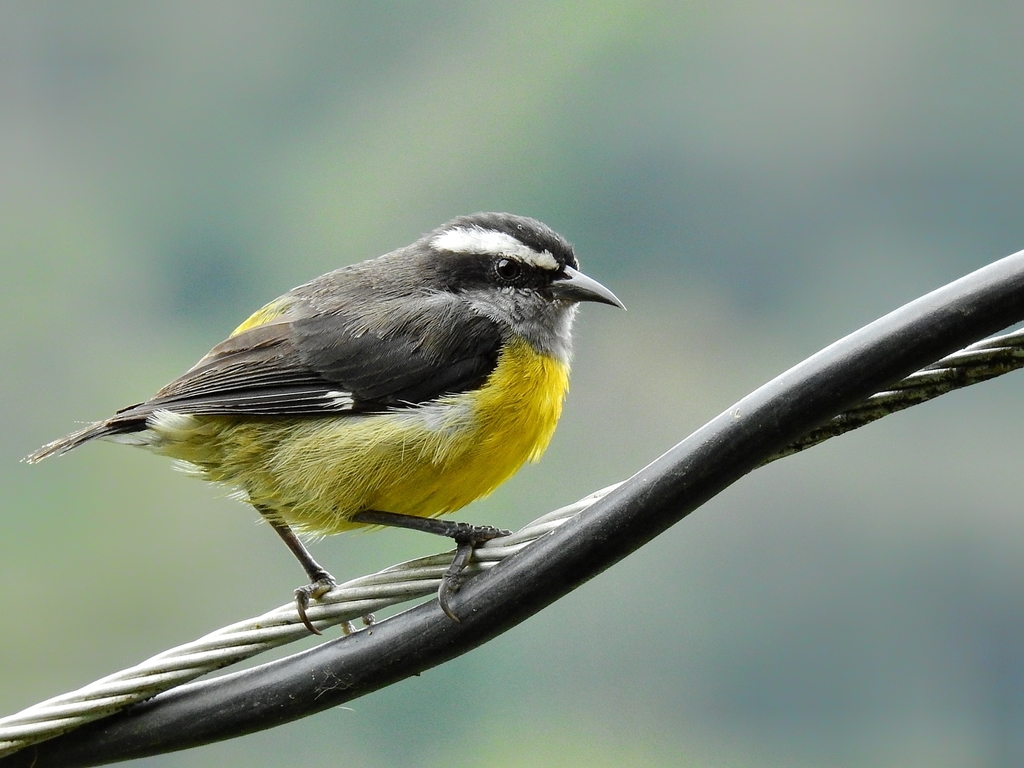
Bananaquit
Photo © Esteban Poveda
Photo © Esteban Poveda — CC BY 4.0 — Source: iNaturalist photo #163872869Identification
The bananaquit is a small passerine, measuring 10 to 13 cm in length and weighing between 5.5 and 19 grams depending on subspecies. Most bananaquits display striking plumage: dark grey (almost black) upperparts, black crowns and facial sides contrasted by a prominent white eyestripe, grey throat, and distinctive yellow chest, belly, and rump. The white vent provides another useful field mark. Males and females are alike in appearance, while juveniles are noticeably duller with partially yellow eyebrows and throat. The bird's most distinctive feature is its slender, curved bill—perfectly adapted for its nectarivorous lifestyle. Island subspecies show considerable variation: some Caribbean populations have white or pale grey throats and upper chests, while others are overall blackish. A paddled tongue, adapted for feeding, is unusually long and specialized.
Range & Habitat
The bananaquit is a resident species found throughout the warmer parts of the Americas, ranging from tropical South America north to southern Mexico and across the Caribbean. It occurs throughout the West Indies with the notable exception of Cuba. Occasionally, birds from the Bahamas wander as rare visitors to Florida. The species is remarkably adaptable, occurring in a wide range of open to semi-open habitats including gardens and parks where it readily habituates to human presence. However, it is rare or absent in dense forests such as large tracts of the Amazon rainforest, deserts, and at altitudes exceeding 2,000 meters.
Behaviour & Diet
The bananaquit is an active, primarily nectarivorous bird that feeds by perching on flowers rather than hovering like hummingbirds. It uses its specialized curved bill to extract nectar from flowers, including mistletoes, though it sometimes engages in nectar robbing by piercing flowers from the side without pollinating them. Beyond nectar, it readily consumes mistletoe fruits, berries, and ripe bananas—the latter inspiring its common name. The bird supplements this diet with small insects, larvae, and arthropods such as ants, flies, and spiders.
The bananaquit is notably gregarious and highly adaptable to human environments, frequently visiting gardens and becoming remarkably tame. Its affection for sugar-filled bird feeders has earned it the nickname "sugar bird." The species breeds year-round, building distinctive spherical nests with side entrance holes in natural locations and human-made objects such as lampshades and garden trellises. Females incubate clutches of up to three eggs without male assistance, and pairs construct new nests continuously throughout the year.
Best Time & Places to See It
The bananaquit's year-round presence and year-round breeding make it visible at any season throughout its range. The species is generally common and readily found in gardens, parks, and open woodland habitats across tropical South America, Mexico, and the Caribbean islands. Urban and suburban gardens with flowering plants or sugar feeders offer excellent viewing opportunities, and the bird's tameness makes approach relatively easy. Look for it in lowland areas below 2,000 meters elevation; the absence of this species actually helps identify dense rainforest or high-altitude zones.
Photography Tips
The bananaquit's small size, bold plumage pattern, and willingness to visit gardens and feeders make it an excellent photography subject. Frame shots to highlight the striking white eyestripe and contrasting yellow and black markings—these provide strong compositional elements. The bird's curved bill is a distinctive feature worth capturing in profile. Since it visits feeders regularly, photographers can anticipate behavior and pre-position themselves at sugar feeders or flowering plants. The bird's tameness allows relatively close approach, but avoid sudden movements. Backlighting can beautifully illuminate the yellow underparts, while side lighting emphasizes the textured plumage. Photograph throughout the day, as the bird forages actively in good light across gardens and open habitats.
Amacayacu National Park
Amazônia National Park
Anavilhanas National Park
Antisana National Park
Arenal Volcano National Park
Arrecifes de Cozumel National Park
Bahuaja Sonene National Park
Barbilla National Park
Barra del Colorado National Wildlife Refuge
Nothing matches these filters.
No community photos yet. Log in to add the first one.
No community observations of this species yet.