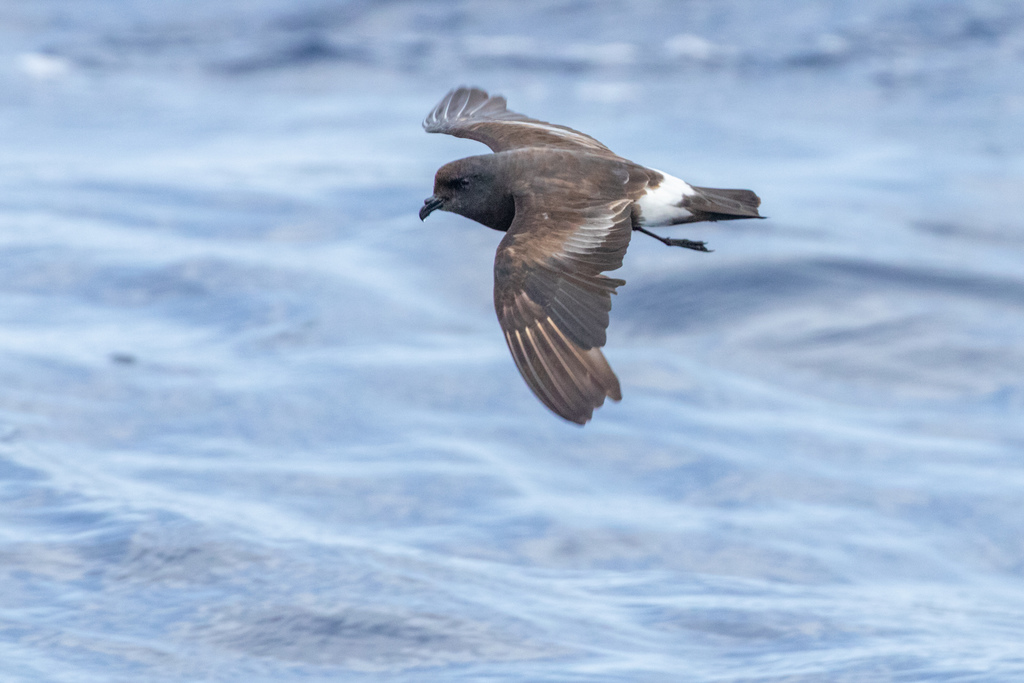
Band-rumped Storm Petrel
Photo © Thibaud Aronson
Photo © Thibaud Aronson — CC BY-SA 4.0 — Source: iNaturalist photo #160719011Identification
The band-rumped storm petrel is a small seabird measuring 19–21 cm in length with a wingspan of 43–46 cm and weighing 44–49 g. It is mainly brownish black in plumage and distinguished by an extensive white rump patch. At sea, it can be confused with Leach's storm petrel, but several field marks separate them: the band-rumped has a less deeply forked tail, a more linear or 'band-like' white rump (rather than the V-shaped or triangular pattern of Leach's), and exhibits a characteristic 'shearwater-like' flight style, whereas Leach's employs a more erratic, 'tern-like' action with longer, more angular wings.
Range & Habitat
This species breeds on islands across the warmer parts of the Atlantic and Pacific Oceans. Atlantic breeding colonies are found on the Berlengas (off mainland Portugal), the Azores, Madeira, the Canary Islands, and Saint Helena. Pacific populations nest off eastern Japan, on Kauai and Hawaii, and throughout the Galápagos Islands. Recent reports suggest breeding has also begun on Mauna Loa volcano on the island of Hawaii. During the non-breeding season, the band-rumped storm petrel is strictly pelagic, spending its time at sea away from land.
Behaviour & Diet
Band-rumped storm petrels are highly specialised nocturnal visitors to their breeding colonies, coming ashore only under cover of darkness to avoid predation by gulls and diurnal raptors such as peregrines. They are so strictly nocturnal that they will avoid landing on clear, moonlit nights when visibility is high. The species nests in colonies in rock crevices close to the sea, with females laying a single white egg per breeding attempt. Their walking ability is limited to a short shuffle between burrow and sea, typical of petrels.
At sea, birds feed by surface-picking, carefully selecting invertebrates, small vertebrates, and occasionally carrion from the water. Recent taxonomic work has revealed the existence of cryptic populations that differ in breeding seasonality, vocalisation patterns, and moulting periods, suggesting potential hidden diversity within the species.
Best Time & Places to See It
To observe band-rumped storm petrels, visit their breeding islands during the breeding season, though sightings ashore are challenging owing to their strict nocturnal habits. The best opportunities for observation are from boats at sea near breeding colonies, particularly around the Azores, Madeira, the Canary Islands, and the Galápagos Islands. Those visiting Hawaiian islands such as Kauai may also encounter this species, particularly near coastal breeding sites.
Photography Tips
Photographing band-rumped storm petrels is difficult due to their small size, nocturnal behaviour at breeding sites, and ocean habitat. The most practical approach is pelagic seabird photography from boats operating near breeding colonies, where birds are more likely to be encountered at sea during daylight hours. The extensive white rump is a key field mark to capture, as it distinguishes the species from similar petrels. Fast film speeds and image stabilisation are essential for capturing these fast-moving, small seabirds on open water.
Timanfaya National Park
Tinajo, Spain
+37 birds
Across Lanzarote's northwestern plains, where the Atlantic wind sculpts black lava fields into a landscape of geological drama, lies one of Europe's most visually arresting volcanic…
VIEW NATIONAL PARKHawaiʻi Volcanoes National Park
Hawaiʻi County, United States
+84 birds+2 mammals
Where volcanic slopes descend toward the Pacific across more than five thousand square kilometers, Hawaiʻi Volcanoes National Park presents one of Earth's most dynamic laboratories of…
VIEW NATIONAL PARKParque Nacional de Galápagos
Santo Tomás, Ecuador
+139 birds+23 mammals
Volcanic peaks and weathered lava fields dominate this remote archipelago in the Pacific, where the interplay of cold ocean currents and tropical latitude creates an ecological…
VIEW ISLAND & ARCHIPELAGOCoiba National Park
Montijo, Panama
+260 birds+10 mammals
An archipelago of volcanic and sedimentary islands rises from the Pacific waters off Panama's southwestern coast, its densest rainforest canopy unbroken for millennia. Coiba National Park…
VIEW NATIONAL PARKBiscayne National Park
Miami-Dade County, United States
+263 birds+7 mammals
Coral reefs and mangrove shallows dominate this marine sanctuary where the Florida Keys meet the Atlantic, creating a mosaic of shallow seagrass meadows, patch reefs, and…
VIEW NATIONAL PARKDry Tortugas National Park
Monroe County, United States
+211 birds+1 mammals
Seventy miles west of Key West, where the Gulf of Mexico surrenders to the Atlantic, lies a constellation of low coral keys that rise barely above…
VIEW NATIONAL PARKMerritt Island National Wildlife Refuge
Brevard County, United States
+341 birds+19 mammals
Brackish marshes and palmetto scrub define this wildlife sanctuary spanning the coastal lowlands of central Florida, where the Atlantic tide meets freshwater systems in a dynamic…
VIEW WILDLIFE SANCTUARYFarallon National Wildlife Refuge
San Francisco, United States
+384 birds+16 mammals
Windswept granite peaks rising abruptly from the Pacific, the Farallon Islands form a wildlife sanctuary of extraordinary seabird abundance and ecological significance just twenty-seven miles west…
VIEW WILDLIFE SANCTUARYPea Island National Wildlife Refuge
Dare County, United States
+356 birds+15 mammals
Where the Outer Banks taper toward the Atlantic, a sliver of barrier island creates a microcosm of coastal ecology. Pea Island National Wildlife Sanctuary spans over…
VIEW WILDLIFE SANCTUARYKīlauea Point National Wildlife Refuge
Kilauea, United States
+79 birds+1 mammals
At the northernmost tip of Kauai, where the Pacific trades collide with volcanic rock, Kīlauea Point National Wildlife Sanctuary crowns a dramatic headland overlooking one of…
VIEW WILDLIFE SANCTUARYNo community photos yet. Log in to add the first one.
No community observations of this species yet.