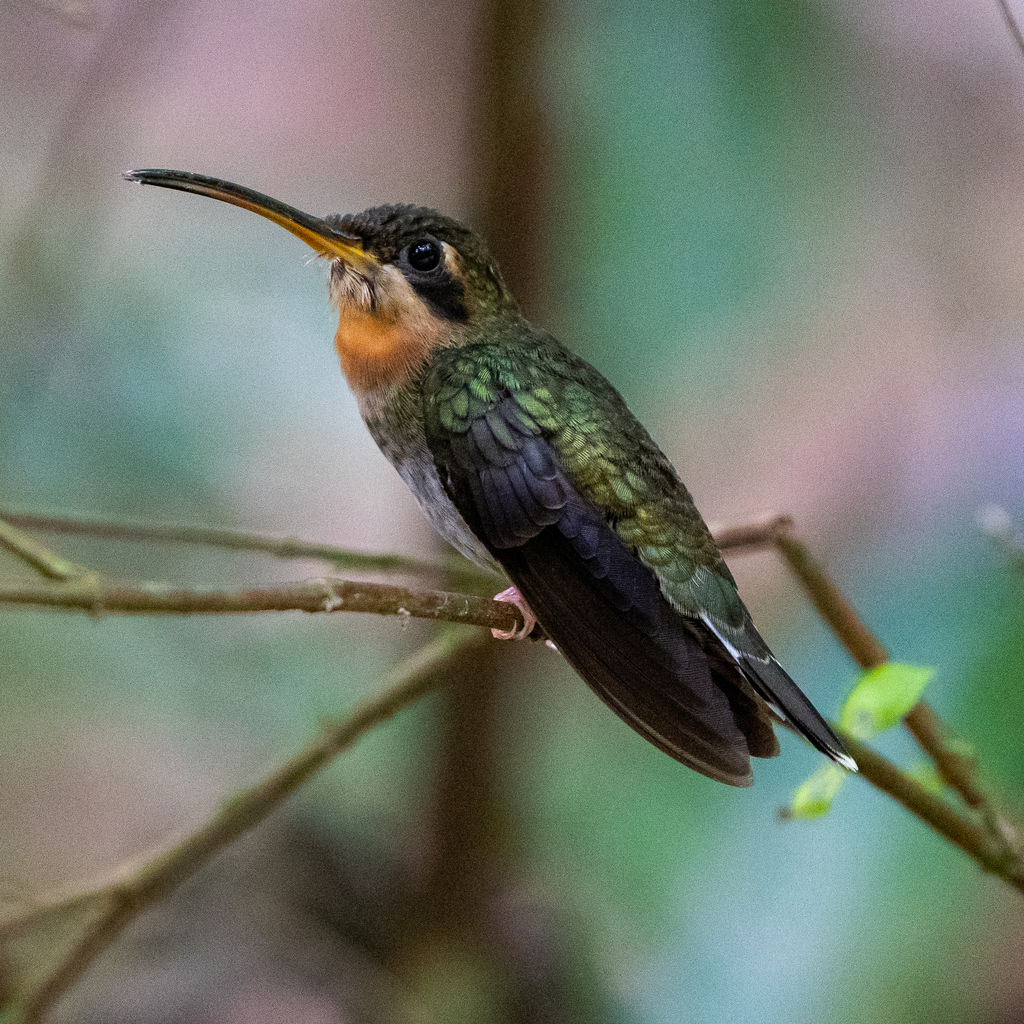
Band-tailed Barbthroat
Photo © Anthony Batista
Photo © Anthony Batista — CC BY 4.0 — Source: iNaturalist #197171103Identification
The band-tailed barbthroat is a medium-sized hummingbird measuring 10 to 11 cm in length, with males weighing 5.5 to 7 g and females slightly less at 5 to 7 g. The adult male of the nominate subspecies displays bronze-green upperparts with a distinctive dark ear patch and chin, complemented by a dusky malar stripe. The most striking feature is the tail: dark feathers with white bases and tips that create a bold black band near the end. The throat is ochraceous, while the underparts are predominantly gray with scattered green feathers. As with other hermit hummingbirds, the sexes are remarkably similar, though females have a slightly more decurved bill and less contrasting plumage between throat, breast, and belly. Subspecific variations occur: T. r. venezuelensis displays a somewhat larger ochraceous throat patch, while T. r. ventosus has a much larger and brighter orange throat patch with an ochraceous tinge to the belly.
Range & Habitat
The band-tailed barbthroat is found across a broad range from southeastern Guatemala and Belize south through Central America and into South America, extending to western Ecuador and northwestern Venezuela. Three recognized subspecies partition this range: T. r. ventosus occupies the northernmost distribution from eastern Guatemala through Belize, Honduras, Nicaragua, Costa Rica, and into Panama; the nominate T. r. ruckeri ranges from northern and western Colombia south to western Ecuador; and T. r. venezuelensis is restricted to northwestern Venezuela.
This species inhabits the understory and edges of primary forest and old second growth, showing flexibility by also using semi-open shrublands, thickets, and plantations. It occurs from sea level up to 1,200 m in elevation, making it accessible across diverse terrain throughout its range.
Behaviour & Diet
The band-tailed barbthroat is presumed to be sedentary, though post-breeding season movements have been documented, particularly among young birds. Like other hermit hummingbirds, it employs a "trap-line" feeding strategy, visiting a regular circuit of flowering plants. Its diet consists primarily of nectar from Heliconia and other tubular flowers, supplemented with small arthropods, especially spiders. In addition to legitimate flower probing, the species exhibits nectar-robbing behavior, piercing the base of flower tubes to access nectar without pollinating.
The nesting season varies across the species' range. Females construct delicate cup nests from plant fibers and cobweb, attaching them to the underside of long drooping leaves. Clutches consist of two white eggs, incubated by females alone, though males have been observed remaining near the nest. The species produces a distinctive fast, high-pitched song comprising 5–10 notes repeated at several-second intervals, with Pacific slope populations in Costa Rica singing more complex songs including trills compared to their Caribbean slope counterparts.
Best Time & Places to See It
The band-tailed barbthroat appears to be generally common throughout its range and occurs in several protected areas, making it a reliable sighting for dedicated hummingbird watchers. Since nesting season varies widely across its distribution, timing visits to specific regions requires local research. The species' preference for understory and forest edges means that searching flowering plants and shrubby areas at lower elevations will yield better results than canopy-level observation.
Photography Tips
Photographing the band-tailed barbthroat requires patience and attention to its feeding behavior. Position yourself near flowering Heliconia or other tubular flowers where the species visits on its trap-line route. The bird's relatively small size and preference for understory habitat demand a telephoto lens and fast shutter speeds to capture sharp images in often dappled light. Watch for the distinctive tail pattern and the ochraceous throat patch, which provide excellent identification markers and photographic subjects. Early morning light, when hummingbirds are most active, offers the best opportunities for compelling images.
Corcovado National Park
Puerto Jiménez, Costa Rica
+444 birds+48 mammals
Where the Osa Peninsula juts into the Pacific, rainforest descends almost to the tide line, and Corcovado National Park protects one of Central America's most intact…
VIEW NATIONAL PARKManuel Antonio National Park
Quepos, Costa Rica
+426 birds+22 mammals
Where tropical rainforest descends steeply to a rocky Pacific coastline, Manuel Antonio National Park distills Central American biodiversity into one of Costa Rica's most compressed and…
VIEW NATIONAL PARKArenal Volcano National Park
Peñas Blancas, Costa Rica
+551 birds+21 mammals
Straddling the border between Alajuela and Guanacaste in northwestern Costa Rica, this national park rises dramatically around one of Central America's most active volcanic systems. The…
VIEW NATIONAL PARKTortuguero National Park
Roxana, Costa Rica
+420 birds+23 mammals
Canals and lagoons thread through a labyrinth of lowland rainforest where the Caribbean coast of Costa Rica meets the wetland frontier. This is terrain shaped by…
VIEW NATIONAL PARKBraulio Carrillo National Park
Las Horquetas, Costa Rica
+547 birds+18 mammals
Where the Caribbean slope descends from the central volcanic cordillera toward the humid lowlands of Heredia, Braulio Carrillo National Park preserves one of Costa Rica's most…
VIEW NATIONAL PARKPiedras Blancas National Park
Golfito, Costa Rica
+386 birds+24 mammals
Where the Golfo Dulce meets the southwestern Pacific coast of Costa Rica, Piedras Blancas National Park protects a dramatic transition zone where lowland rainforest descends toward…
VIEW NATIONAL PARKGeneral de División Omar Torrijos Herrera National Park
La Pintada, Panama
+401 birds+2 mammals
Across the highlands of central Panama, where the continental divide funnels moisture-laden trade winds into steep river valleys, the terrain rises and falls in a landscape…
VIEW NATIONAL PARKSoberanía National Park
Cristóbal, Panama
+495 birds+34 mammals
Rainforest and riverine woodland blanket the rolling terrain of this 714-square-kilometre national park in Colón Province, where the Caribbean watershed feeds a maze of streams and…
VIEW NATIONAL PARKChagres National Park
Caimitillo, Panama
+486 birds+19 mammals
Where the Chagres River carves through the humid tropics of central Panama, a vast montane and lowland forest sprawls across more than 2,300 square kilometers, anchoring…
VIEW NATIONAL PARKDarién National Park
Tucutí, Panama
+534 birds+13 mammals
Where the spine of Central America crumbles into wetland and rainforest, Darién National Park sprawls across more than 20,000 square kilometres of some of the tropics'…
VIEW NATIONAL PARKPortobelo National Park
Portobelo, Panama
+366 birds+9 mammals
Where the Caribbean's turquoise waters meet the Darién's verdant shore, Portobelo National Park sprawls across 570 square kilometers of coastal forest, mangrove wetland, and coral-fringed islands…
VIEW NATIONAL PARKCarara National Park
Tárcoles, Costa Rica
+397 birds+19 mammals
Where the Pacific coastal plain meets transitional forest, Carara National Park straddles one of Central America's most dynamic ecological boundaries. The park's landscape encompasses lowland deciduous…
VIEW NATIONAL PARKCahuita National Park
Talamanca, Costa Rica
+359 birds+15 mammals
Where the Caribbean shoreline dissolves into mangrove creeks and coral gardens, Cahuita's mosaic of habitats unfolds across the Limón coast. The park's signature feature—a living coral…
VIEW NATIONAL PARKRincón de la Vieja National Park
Liberia, Costa Rica
+451 birds+30 mammals
Where volcanic slopes rise abruptly from the Guanacaste lowlands, Rincón de la Vieja National Park sprawls across a landscape shaped by geothermal drama and seasonal extremes.…
VIEW NATIONAL PARKTapantí Macizo de la Muerte National Park
Orosi, Costa Rica
+503 birds+18 mammals
Where montane cloud forest rises steeply from the Orosi Valley, Tapantí Macizo de la Muerte National Park enfolds a landscape of perpetual moisture and emerald complexity.…
VIEW NATIONAL PARKLa Amistad International Park
Crorina, Costa Rica
+532 birds+20 mammals
Where the Caribbean slopes of Costa Rica's Talamanca Mountains rise steeply inland from Limón, the boundary between two nations dissolves into an unbroken expanse of rainforest.…
VIEW NATIONAL PARKBarbilla National Park
Chirripó, Costa Rica
+226 birds
Where the Caribbean slope of Costa Rica's eastern cordillera plunges into perpetual moisture, Barbilla National Park rises as one of Central America's most water-rich ecosystems. Fed…
VIEW NATIONAL PARKVolcán Tenorio National Park
Guatuso, Costa Rica
+480 birds+12 mammals
Where volcanic slopes rise through Costa Rica's northwestern borderlands, Volcán Tenorio National Park sprawls across terrain shaped by ancient lava flows and mineral-rich springs. The park's…
VIEW NATIONAL PARKMarino Ballena National Park
Bahía Ballena, Costa Rica
+336 birds+8 mammals
Where mangrove forests meet coral-fringed shorelines along Costa Rica's southern Pacific coast, Marino Ballena National Park encompasses a marine and terrestrial mosaic that ranks among Central…
VIEW NATIONAL PARKCaño Negro National Wildlife Refuge
Caño Negro District, Costa Rica
+486 birds+16 mammals
Where the San Juan River's seasonal floodplain opens into expansive wetlands, Caño Negro Wildlife Sanctuary sprawls across one of Central America's most productive freshwater ecosystems. This…
VIEW WILDLIFE SANCTUARYGandoca-Manzanillo National Wildlife Refuge
Manzanillo, Costa Rica
+394 birds+18 mammals
Where the Caribbean coastal plain surrenders to water-logged forest and mangrove tangles, Gandoca-Manzanillo Wildlife Sanctuary shelters one of Costa Rica's most biodiverse lowland wetland ecosystems. The…
VIEW WILDLIFE SANCTUARYBarra del Colorado National Wildlife Refuge
Tortuguero, Costa Rica
+462 birds+36 mammals
Where the Caribbean's restless waters meet the Limón Province coastline, Barra del Colorado National Wildlife Sanctuary unfolds across a landscape of extraordinary ecological complexity. This equatorial…
VIEW WILDLIFE SANCTUARYNo community photos yet. Log in to add the first one.
No community observations of this species yet.