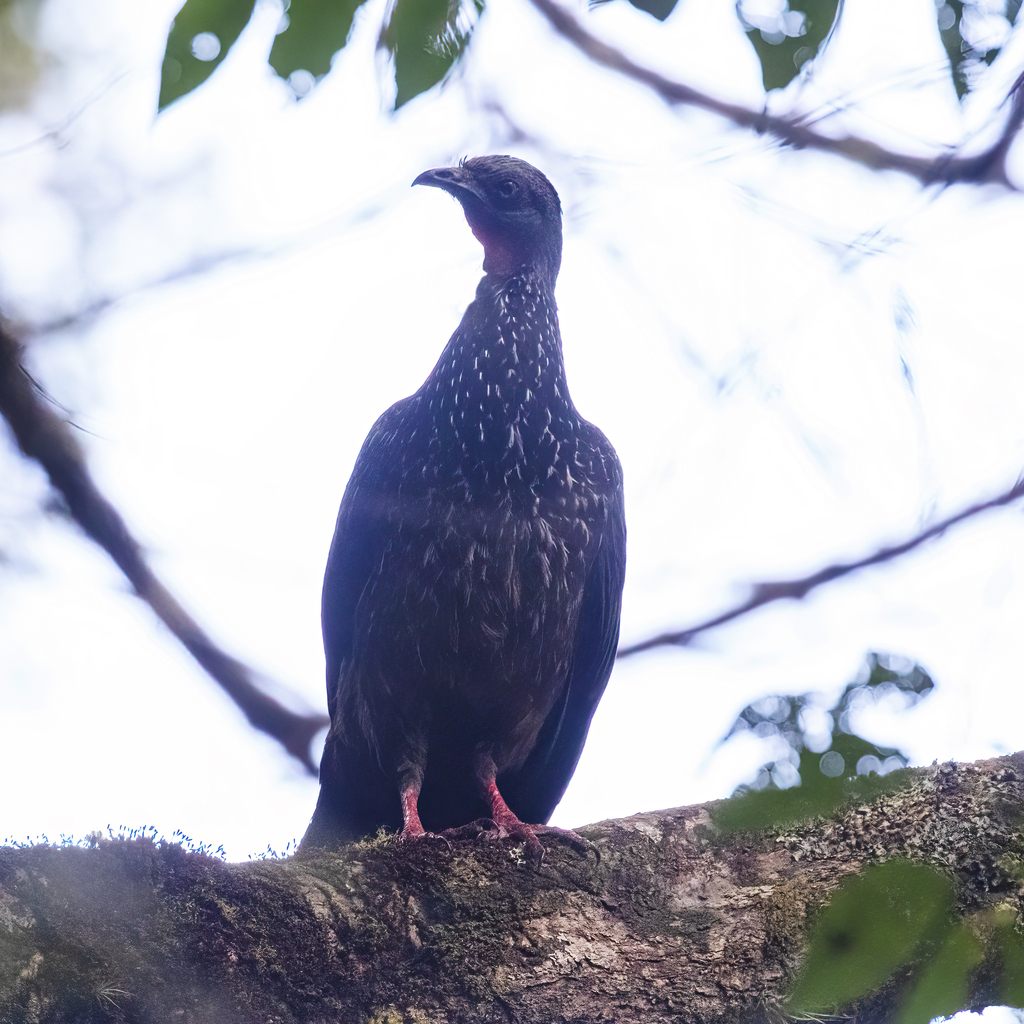
Band-tailed Guan
Photo © Dan Vickers
Photo © Dan Vickers — CC BY 4.0 — Source: iNaturalist #258794480Identification
The band-tailed guan is a medium-sized member of the Cracidae family, measuring 50 to 61 cm in length. Males typically weigh 686 to 981 grams, while females are slightly lighter at 625 to 900 grams. The bird's most distinctive feature is the wide chestnut band that crosses the end of its tail, which gives the species its common name. The nominate subspecies displays blackish-brown to dark rufous upperparts heavily streaked with white, an olive-brown breast, and a pale to medium brown belly. Its face is notably pale grey to white, and it sports a prominent red dewlap that is particularly conspicuous in the field. Regional subspecies show subtle variations: P. a. albicauda features buffy tips on the tail feathers, while P. a. colombiana has more white on the crown and less white on the face.
Range & Habitat
The band-tailed guan is restricted to northwestern South America, found exclusively in Colombia and Venezuela. The nominate subspecies inhabits the eastern Andes of Colombia and western Venezuela, including the Venezuelan Coastal Range, while other subspecies occupy the Serranía del Perijá and the Sierra Nevada de Santa Marta. These birds prefer dense wet virgin forest but will adapt to secondary forest, shade coffee plantations, and the upper reaches of drier forest. Elevation varies by region: in the Sierra Nevada de Santa Marta they range from 550 to 2,000 meters, while in Venezuela they typically occur from 800 to 2,400 meters, though local populations may be found at considerably higher or lower altitudes.
Behaviour & Diet
Band-tailed guans are social foragers, typically gathering in groups of up to six individuals, though larger congregations form in fruit-laden trees. They are primarily frugivorous, feeding in the mid-story canopy but also descending to the ground to consume fallen fruit. Territorially inclined during the breeding season—which runs from January to May—these birds produce distinctive sounds to maintain their territories, including a striking wing-rattling display that resembles canvas ripping forward and in reverse. When alarmed, they produce soft, piping whistles, escalating to repeated shrieking calls interspersed with gruff notes in extreme danger. They nest in loose structures of plant matter positioned up to 8 meters high in trees.
Best Time & Places to See It
The breeding season from January to May is an excellent time to locate band-tailed guans, as territorial males are more vocal and active. The species is uncommon to fairly common throughout most of its range and occurs in several protected areas in Venezuela, making these reserves reliable viewing locations. Their preference for mid-story fruit sources in wet forests means observers should scan fruiting trees carefully during dawn and mid-morning hours when feeding activity is highest.
Photography Tips
Patience and early morning visits to productive fruit trees offer the best opportunities for photography. The bird's striking facial markings, red dewlap, and distinctive tail band photograph well in natural light. The white streaking on the upperparts provides good contrast for detail shots. Listen for the characteristic wing-rattle and vocal displays to locate birds, then position yourself to capture the mid-story foraging behavior that is typical of this species.
Natural el Cocuy National Park
Güicán, Colombia
+313 birds+3 mammals
Where the Andes rise to their highest peaks in Colombia's eastern cordillera, El Cocuy National Park sprawls across more than 6,600 square kilometers of some of…
VIEW NATIONAL PARKMorrocoy National Park
Municipio Silva
+290 birds
Where the Caribbean coast of northwestern Venezuela meets protected coastal waters, a mosaic of mangrove forests, sandy beaches, and coral reef systems defines Morrocoy National Park.…
VIEW NATIONAL PARKNatural Sumapaz National Park
Cubarral, Colombia
+368 birds+1 mammals
Where the Andes descend toward the Amazon basin, the high páramo grasslands of Sumapaz National Park sprawl across more than five thousand square kilometers of Meta…
VIEW NATIONAL PARKEl Tamá National Park
Toledo, Colombia
+435 birds
Where the Andes descend toward the Caribbean coastal lowlands of northern Colombia, El Tamá National Park sprawls across nearly 3,800 square kilometres of montane forest, cloud…
VIEW NATIONAL PARKNo community photos yet. Log in to add the first one.
No community observations of this species yet.