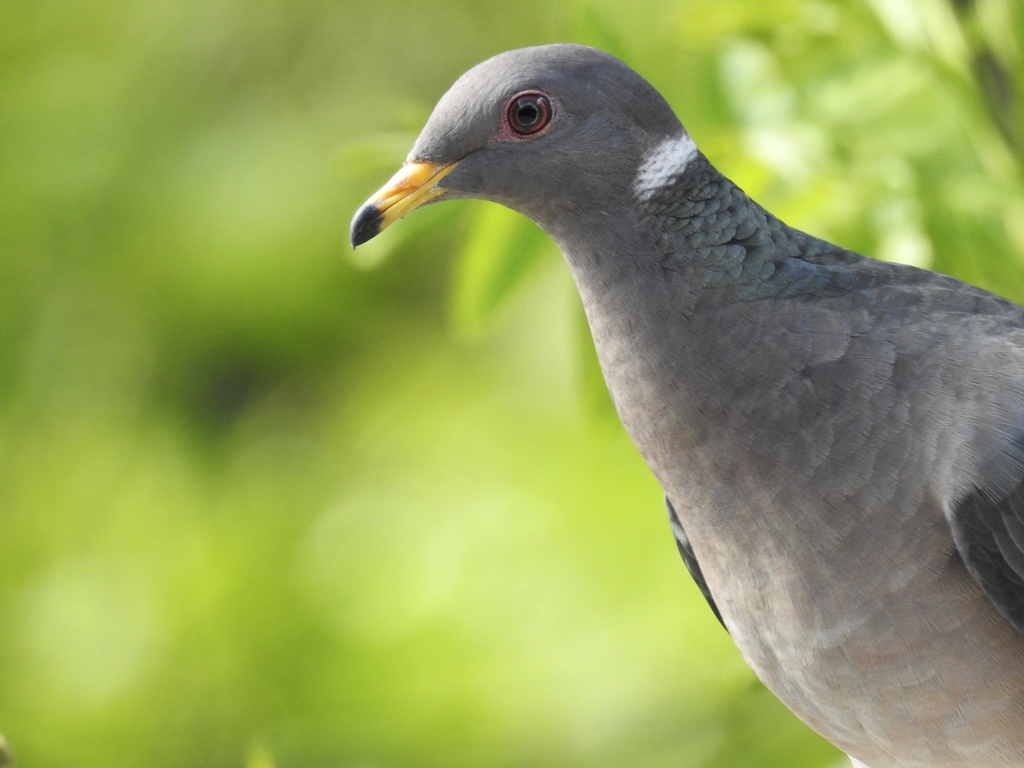
Band-tailed Pigeon
Photo © Kristiina Hurme
Photo © Kristiina Hurme — CC BY 4.0 — Source: iNaturalist photo #7029758Identification
The band-tailed pigeon is one of the largest pigeons in the Americas, measuring 33 to 40 cm long with a wingspan of 66 cm. Its plumage is predominantly gray, somewhat darker above, with a distinctive thin white collar on the nape and a purple-gray breast tinged with pink, especially in males. The distal half of the tail is pale with a darker gray band at the base—the feature that gives this species its English name. The yellow bill and feet are excellent identifying marks at close range, though note that northern subspecies have a black tip to the bill while southern subspecies are all-yellow. Adults display striking green iridescence on the back of the neck, while juveniles lack the white collar and neck iridescence and show pale feather edges giving a scaly appearance.
Range & Habitat
Band-tailed pigeons range from British Columbia and the Pacific Coast south through the western mountains and coasts to northern Argentina, occurring in higher elevations throughout Mexico, Central America, and the Andes. Unlike most birds, they are nomadic year-round rather than maintaining a single home range. They favor damp coniferous forests, oak woodlands, and scrublands, typically at higher elevations. In times of food scarcity, they venture into suburban areas, forested parks, orchards, and backyards.
Behaviour & Diet
Band-tailed pigeons are nomadic feeders that change their diet seasonally and will travel up to 5 km from their nests to find food. They feed both from the ground and in trees, with acorns forming the cornerstone of their diet, supplemented by berries, seeds, flowers, leaves, and insects. The species is relatively quiet for a pigeon, with a distinctive low-pitched, owl-like voice often delivered in two-syllable calls.
Best Time & Places to See It
Look for band-tailed pigeons in coniferous forests, oak woodlands, and mountain scrublands throughout the western mountains from British Columbia to Argentina. In winter, they congregate in oak woodlands and suburban areas where acorn mast is available. Higher elevations and areas with healthy oak and conifer forests offer the best opportunities for observation.
Photography Tips
The band-tailed pigeon's subtle plumage—gray with pink and purple tones—demands careful attention to lighting to capture the delicate coloration, especially the iridescent green on the nape. Focus on the distinctive thin white collar, pale tail band, and yellow feet as key identifying features. The bird's nomadic habits mean patience is essential; positioning yourself near productive feeding areas such as oak trees or berry-bearing shrubs during dawn or late afternoon will increase your chances of productive encounters.
Alaska Maritime National Wildlife Refuge
Amacayacu National Park
Antisana National Park
Arches National Park
Arenal Volcano National Park
Bahuaja Sonene National Park
Baru Volcano National Park
Big Bend National Park
Bitter Lake National Wildlife Refuge
Nothing matches these filters.
No community photos yet. Log in to add the first one.
No community observations of this species yet.