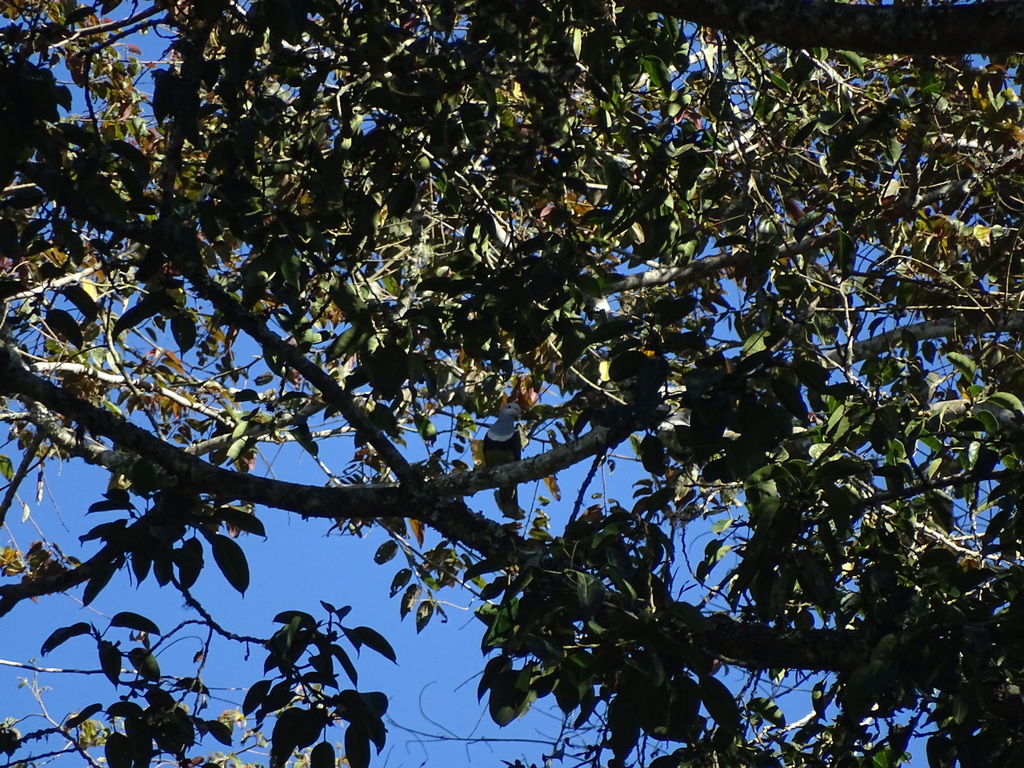
Banded Fruit Dove
Photo © Julia Moning
Photo © Julia Moning — CC BY 4.0 — Source: iNaturalist #38022670Identification
The Banded Fruit Dove is a large pigeon, measuring 38–44 cm in length and weighing 450–570 g. It is instantly recognizable by its striking white head, neck, and upper breast that contrasts sharply with its dark gray back and upperwings, which grade to grey on the rump. A distinctive black breast-band separates the white upper breast from the yellow underbelly, while the black tail features a broad grey terminal band. The underparts are grey, clearly demarcated from the pure white of the head and neck.
Range & Habitat
Native to the Lesser Sunda Islands, the Banded Fruit Dove ranges from Bali eastward to Timor-Leste. The species inhabits monsoonal rainforests, subtropical and tropical forests, and wooded hillsides throughout this region. It shows a strong preference for the upper canopy of fig trees and other fruit-bearing rainforest species, where it spends much of the day feeding quietly or resting. Rocky terrain that provides protection for rainforest vegetation is also favored, though the birds may be less abundant in areas with dense understory weeds.
Behaviour & Diet
Banded Fruit Doves are quiet, unobtrusive birds that feed primarily on figs and other rainforest fruits. They spend considerable time resting in the canopy, making them challenging to observe, though they become more active during early morning and late afternoon hours when they may be seen flying near escarpments to and from feeding trees. Their vocalization is a distinctive short, deep "woo-oo," with the sound rising at the beginning and falling at the end.
The species breeds by mating and building a fragile nest in rainforest trees, typically laying two eggs. While the global population has not been formally quantified, estimates suggest more than 10,000 adult individuals remain, though the population trend appears to be decreasing. The species is classified as Least Concern by the IUCN Red List, though it has been identified as one of Australia's top 100 most climate-sensitive terrestrial birds.
Best Time & Places to See It
For the best chance of observing Banded Fruit Doves, visit during early morning or late afternoon when the birds are most active. In Australia, the species is most frequently reported around Nourlangie Rock in Kakadu National Park. The Nawurlandja Lookout within the park provides an excellent vantage point from which to search for the species; banded fruit doves can sometimes be seen on the rocky ridges to the left of the lookout.
Photography Tips
Photographing this species requires patience and timing. Focus your efforts during early morning and late afternoon when birds are actively flying to and from feeding trees. Position yourself at elevated vantage points such as lookouts overlooking escarpments and rocky ridges where birds are known to travel. Look for them in the upper canopy of fig trees and other fruiting rainforest species. The birds' preference for the canopy means telephoto lenses will be essential. Overcast conditions are often preferable for capturing the subtle grey tones and high contrast between the white head and dark back.
West Bali National Park
Gerokgak, Indonesia
+240 birds+8 mammals
Across West Bali's northwestern reaches, where the Indian Ocean meets volcanic slopes and limestone cliffs plunge toward turquoise shallows, sprawls a protected realm of roughly 325…
VIEW NATIONAL PARKMutis Timau National Park
Timor Tengah Selatan, Indonesia
+77 birds
Where the volcanic highlands of Timor Tengah Selatan rise above the surrounding lowlands, Mutis Timau National Park unfolds across approximately 224 square kilometres of mountain forest…
VIEW NATIONAL PARKKomodo National Park
Komodo, Indonesia
+155 birds+14 mammals
Where volcanic peaks rise dramatically from turquoise waters, a primordial landscape unfolds across three main islands and countless smaller ones scattered throughout the Lesser Sunda archipelago.…
VIEW NATIONAL PARKNo community photos yet. Log in to add the first one.
No community observations of this species yet.